Global Uprising
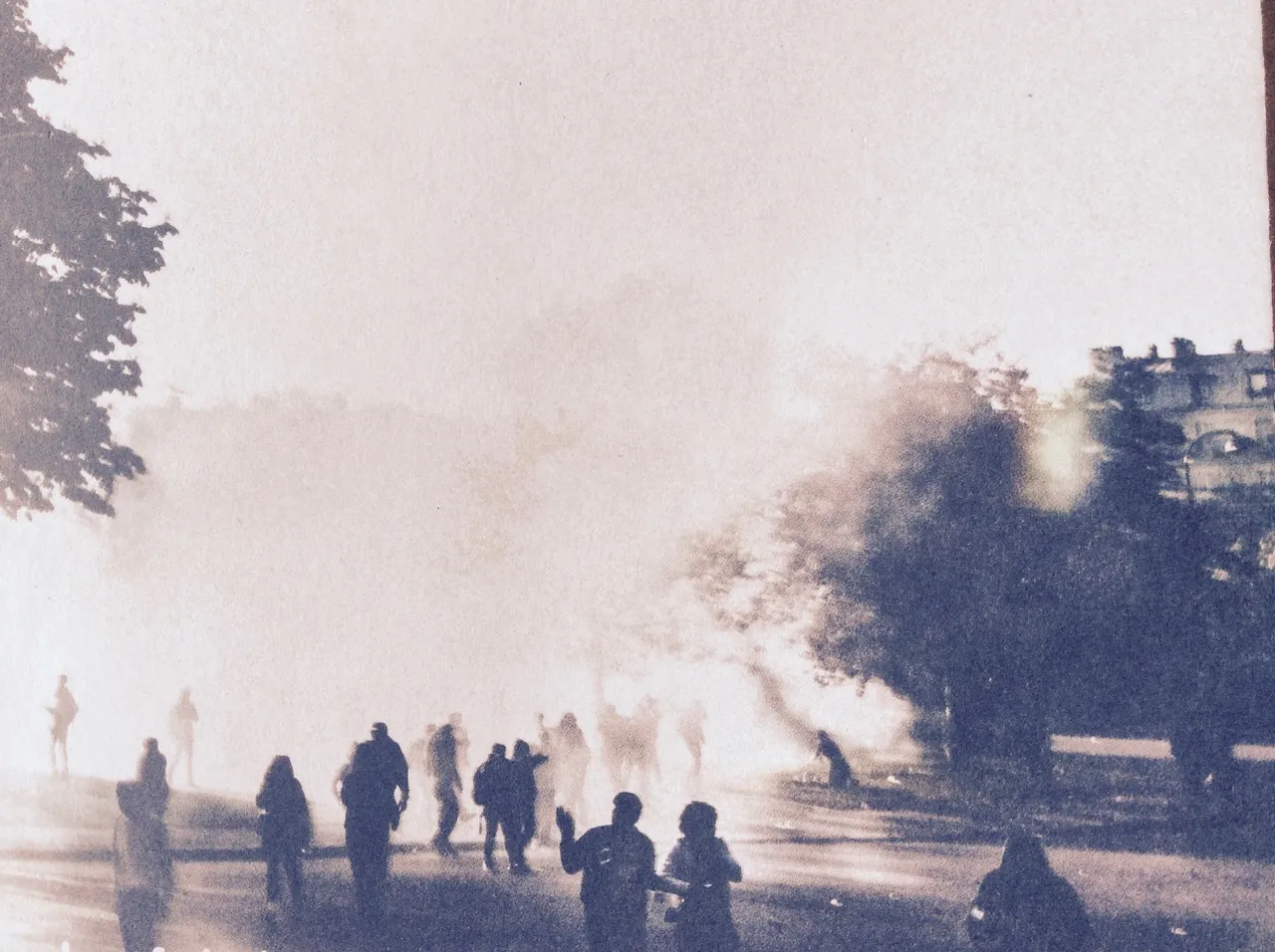
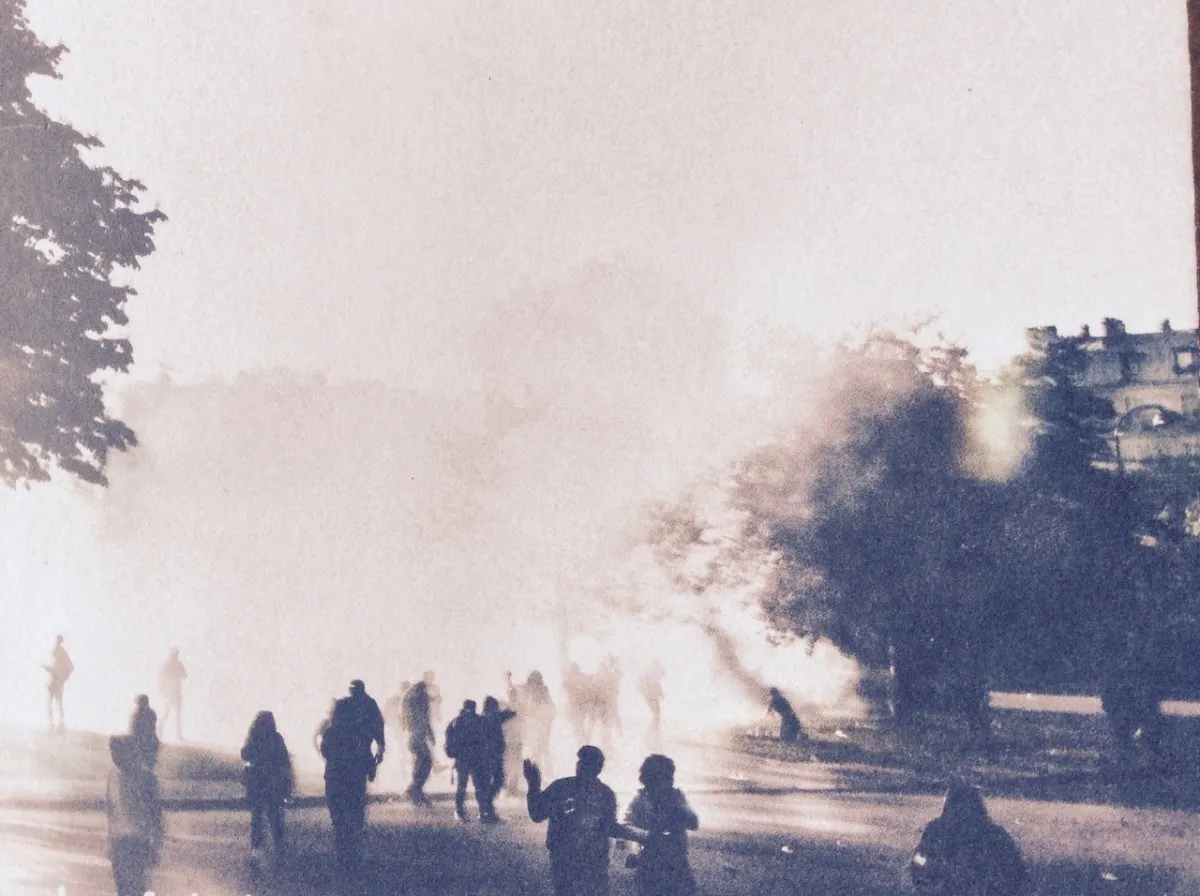
cover to Maintenant. Photo: Jean-Pierre Sageot
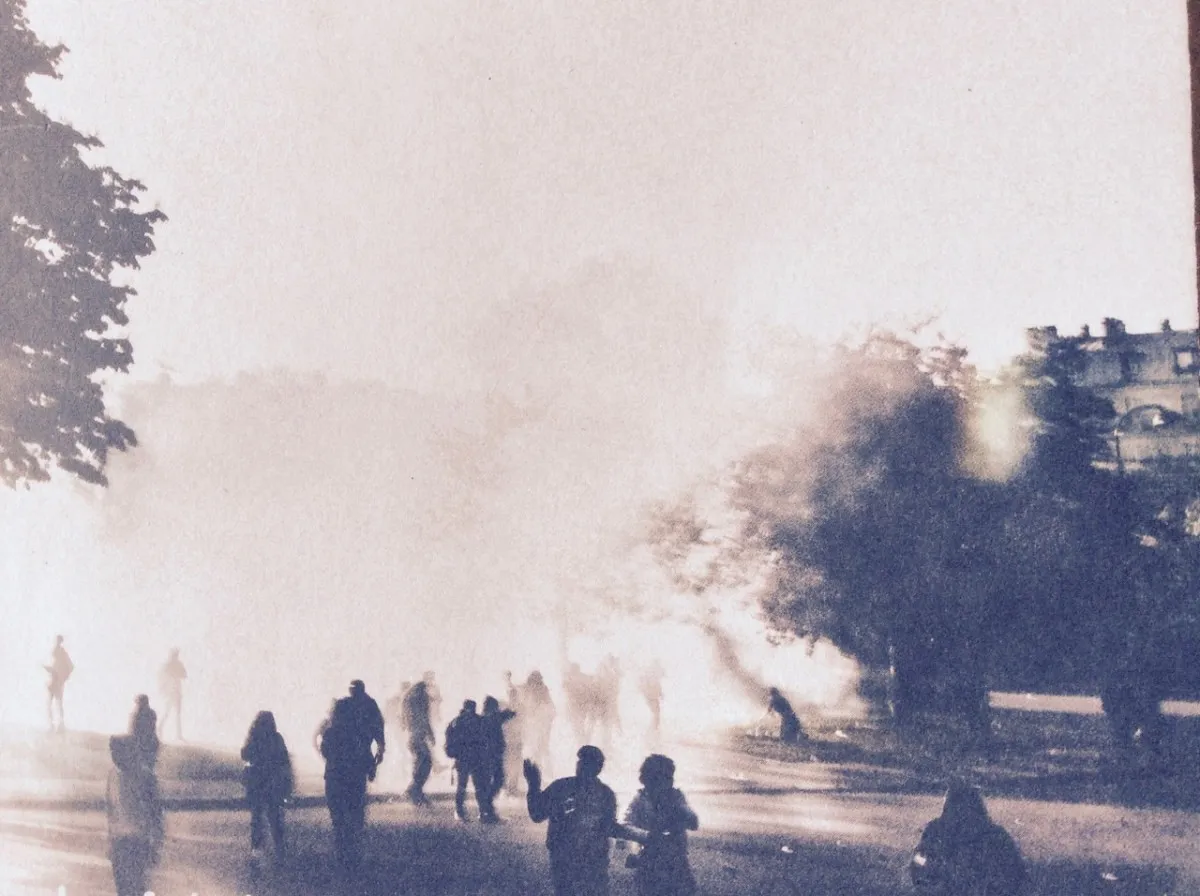
cover to Maintenant. Photo: Jean-Pierre Sageot
GLOBAL UPRISING
cover to Maintenant. Photo: Jean-Pierre Sageot
Our present is defined not only by global uprising, but, even more decisively, by the open-endedness of global uprising. To speak of uprising today is no longer to speak of an event or moment in time, but of a protracted, discontinuous temporality. Uprising in many senses is our present: part of the way things just are. If 2020 has so far felt at once strange and eerily familiar, it is in part because it bookends a full decade of open global revolt. Here we are, yet again. That year of “living dangerously” in 2010/2011, so associated with the “Arab revolts” and the “Occupy movement,” has turned out not to be a ruptural exception, but the start of a new norm; the opening of a long duration of uprising that has exposed and hastened the unravelling of the post-war global liberal order but in which no new decisive stabilization has emerged. A decade later, America’s cities, caught in the entangled knot of mass unemployment, a mismanaged pandemic, deepening dispossession, and relentless anti-Black violence, are engulfed by an anti-racist uprising so widespread and intense as to probably have no local historical precedent. And this time the stakes are that much starker, the forces of reaction that much stronger.
This is a decade that demands we rethink what constitutes uprising. What do we call this discontinuous chain of forms of refusal, protest, disobedience, and flight? How do we historicize it? What kind of concepts might capture and make sense of the ubiquity of shared feelings of having had enough, of being unable to tolerate things as they are, of the willingness to put bodies and life on the line? How have modes of action and mediation changed across this decade? It is too easy and, surely, too facile to say we live in a post-revolutionary time in which large-scale transition is no longer possible—this itself might still be contested—and that the cycle of uprising is just that, a circular repetition in which little actually changes. The onus instead is to rethink how we understand collective action and its effects today.
The uprisings are undoubtedly diverse and locally contingent: they can take sharply different ideological bents across right and left divides, or at times seem to have an indeterminate or not yet settled relation to ideological currents; they occupy different points along geopolitical faultlines and are exposed to different orders of state and imperial violence. At the same time, there is no doubt that the uprisings are connected in ways that exceed the politics of solidarity. They are connected in material historical terms across structures and circuits that shrink the space between the purported “liberal-democratic” world and its various others: police violence, its connections to militarism, and the almost complete indistinction between policing and war; rampant inequality, crises of accumulation, and deepening dispossession and extraction; global regimes of racialization and anti-Blackness; the weakness of political parties and the strength of crowds and abiding tensions between mass politics and communal exit; and the ambiguous centrality of digital mediation and visuality. These are the recombinant but global coordinates of uprising. The present of uprising is also in many senses the present of convergence.
This series takes the Middle East—a region arguably at the heart of the entanglement of policing and war—and the tenth anniversary of the Arab revolts as a springboard for a set of workshops around global uprising. We envisage these workshops as a series of open and incomplete conversations; not the presentation of finished ideas or work, but the thinking through together of a host of questions and ideas emerging from and responding to our present. To that end, each workshop will revolve around three speakers and a discussant.Instead of a traditional paper panel we invite speakers to each give ten-minute interventions that respond, from their own current work, to a set of questions and prompts. A discussant will respond in a way so as to mediate a wider conversation first between the participants and then with the larger audience
Global Uprising was developed by Jared McCormick and Nasser Abourahme.
This website is built off of the 2020–2021 series at NYU’s Hagop Kevorkian Center for Near Eastern Studies:
Digital Forays in Middle Eastern Studies & Global Uprising.
All of the events in these series are our attempt to address public programing in this moment of remote instruction and distance - but they were also built directly into the classroom.
This platform is the result of student group work through our required core course for incoming graduate students: Problems and Methods in Middle Eastern Studies.
The 22 students faced a difficult task: to enter the program & begin their degrees studying remotely. To meet this challenge, we designed the course so that students could work in smaller groups to think through the events in each series. We view this as a novel way for cohort building, a way to integrate asynchronous material into the classroom, and a unique opportunity to model public scholarship!
The 4 groups (Apple, PAH, Saffron Vesper, Octopus) were charged to work together to EXTEND the events to which they were assigned. This was realized through:
This was their prompt for the extension:
This “extension” might take many forms: a deeper dive into one of the presenters’ work, a lesson plan for a high school classroom around the event, developing a concept from the event and extending it into a new application where your group applies it differently? This is NOT a synopsis of the event, it is meant to E_X_T_E_N_D the event into new directions based on your groups’ thinking and conversations.
We asked the students to map out what the event aimed to achieve, what transpired in the conversation, and then develop a meaningful extension that synthesizes new directions! We know that working in groups is difficult - but it’s the real world. These assignment are in the spirit of thinking & working collectively.
FALLSchedule2020
SpringSchedule2021
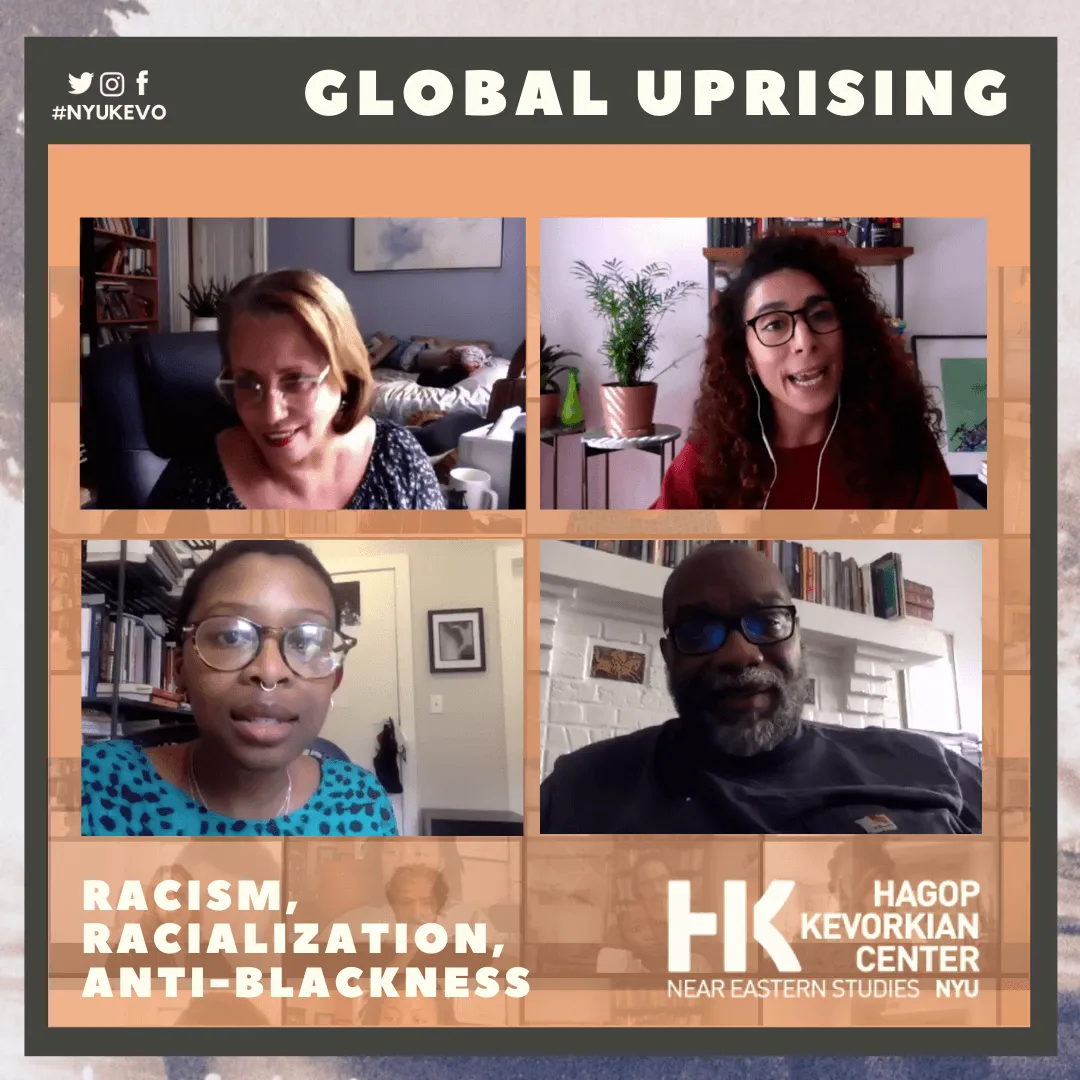
Sept 15, 2020Sophia Azeb // Eve TrouTt PowellZoé Samudzi // Fred Moten
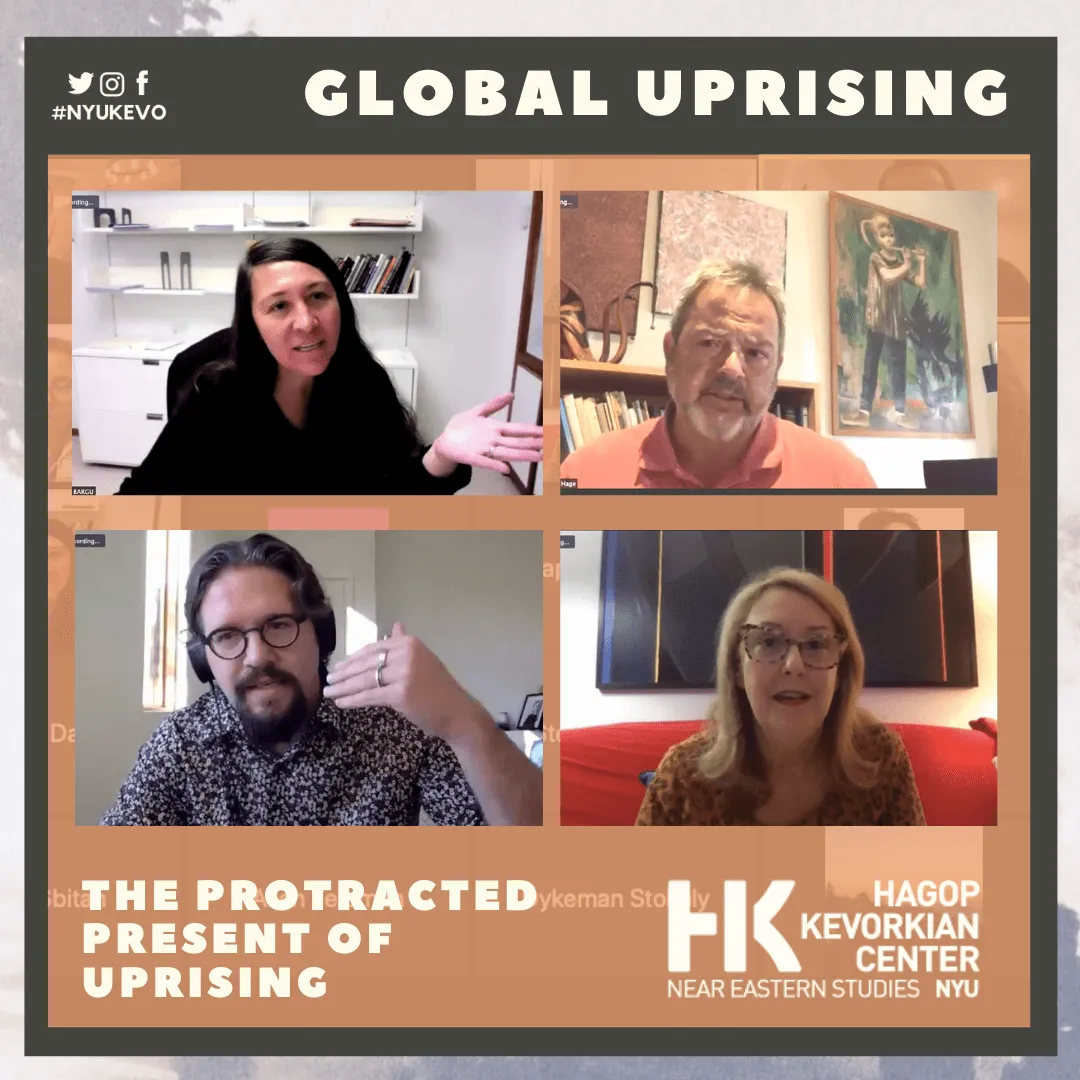
Oct 20, 2020Banu Bargu // Ghassan HageAlberto Toscano // Lisa Duggan
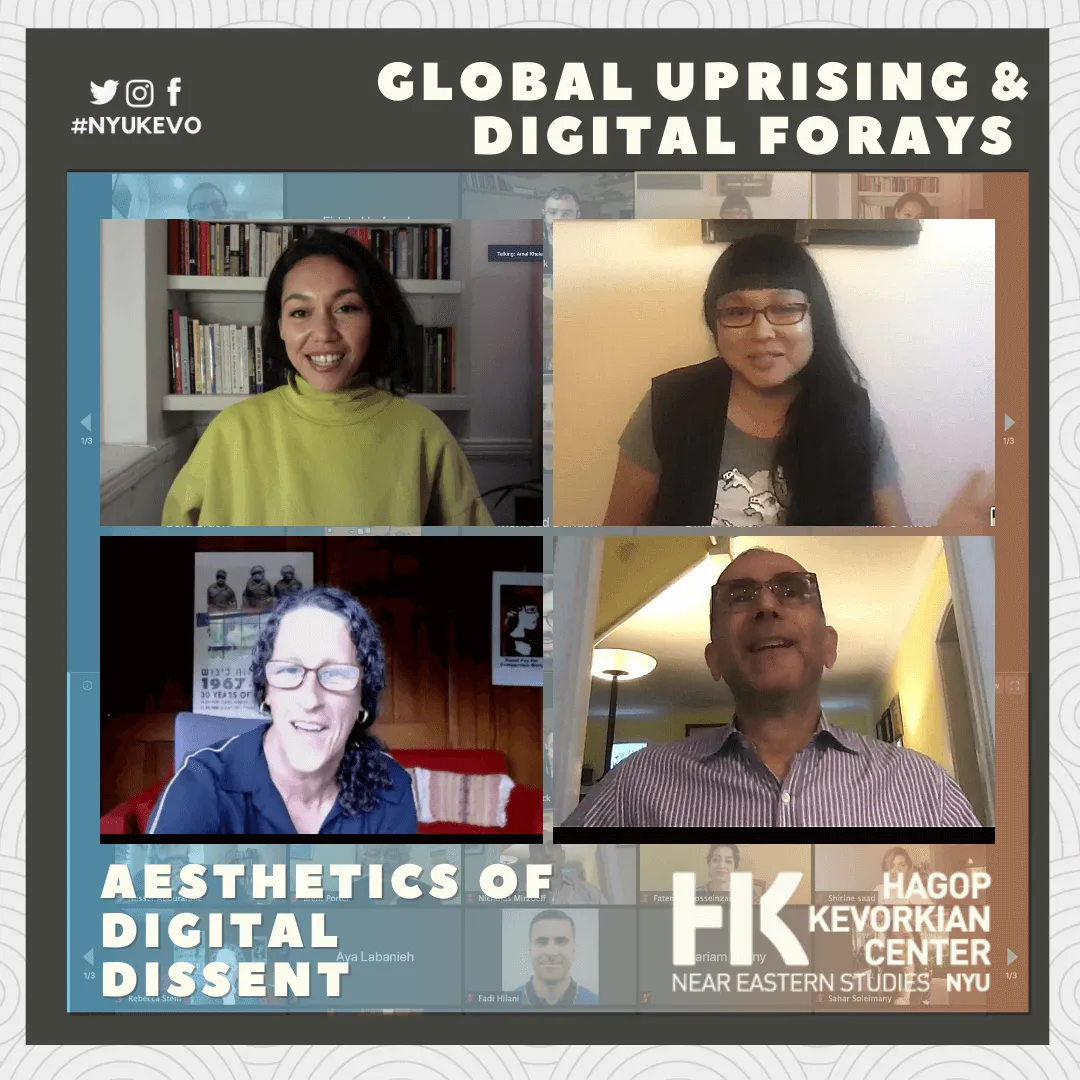
Oct 29, 2020Amal KhalaF // An Xiao MinaRebecca Stein // Nicholas Mirzoeff
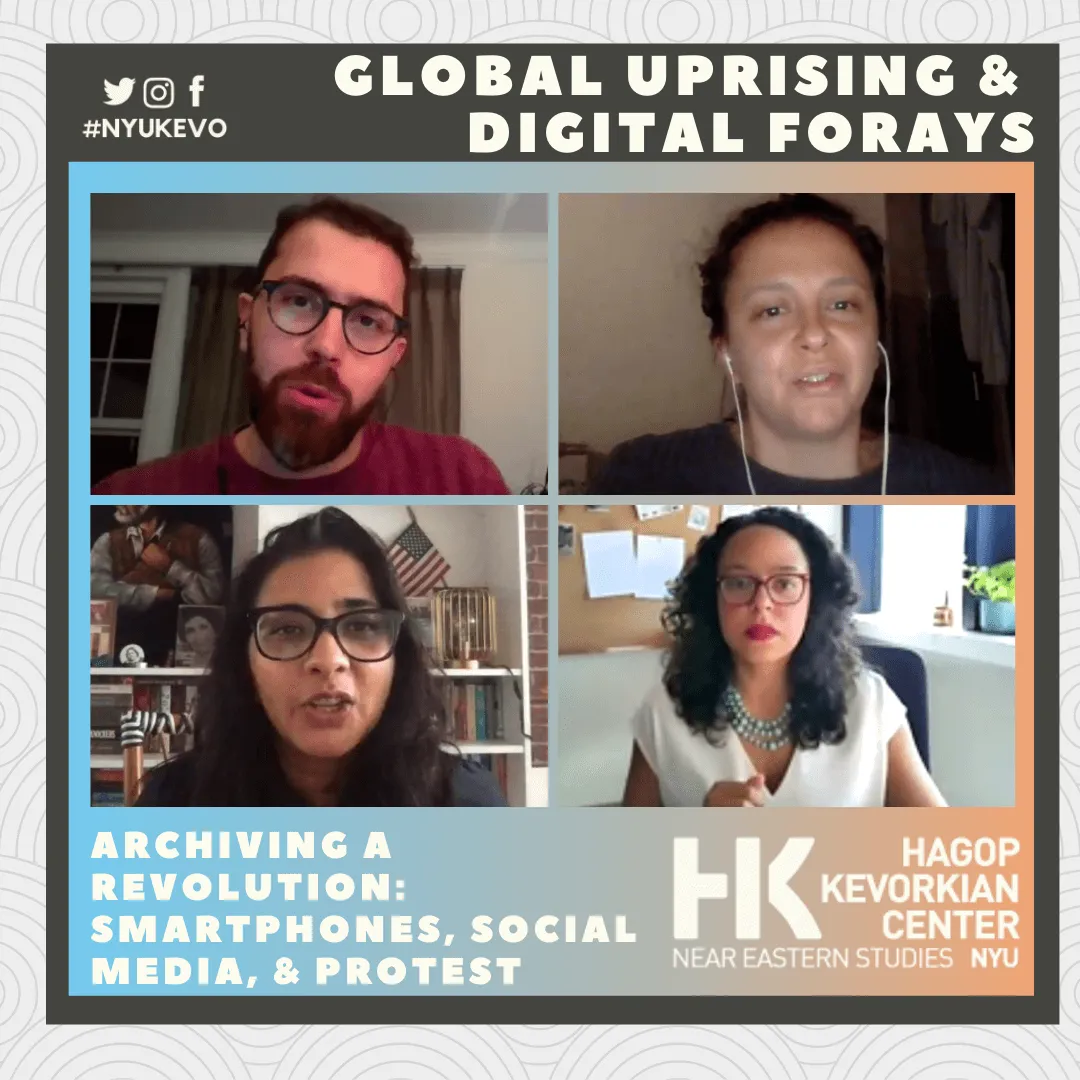
Nov 5, 2020Omar Al-Ghazzi // Jasmina MetwalyIsra Ali // Marie Grace Brown
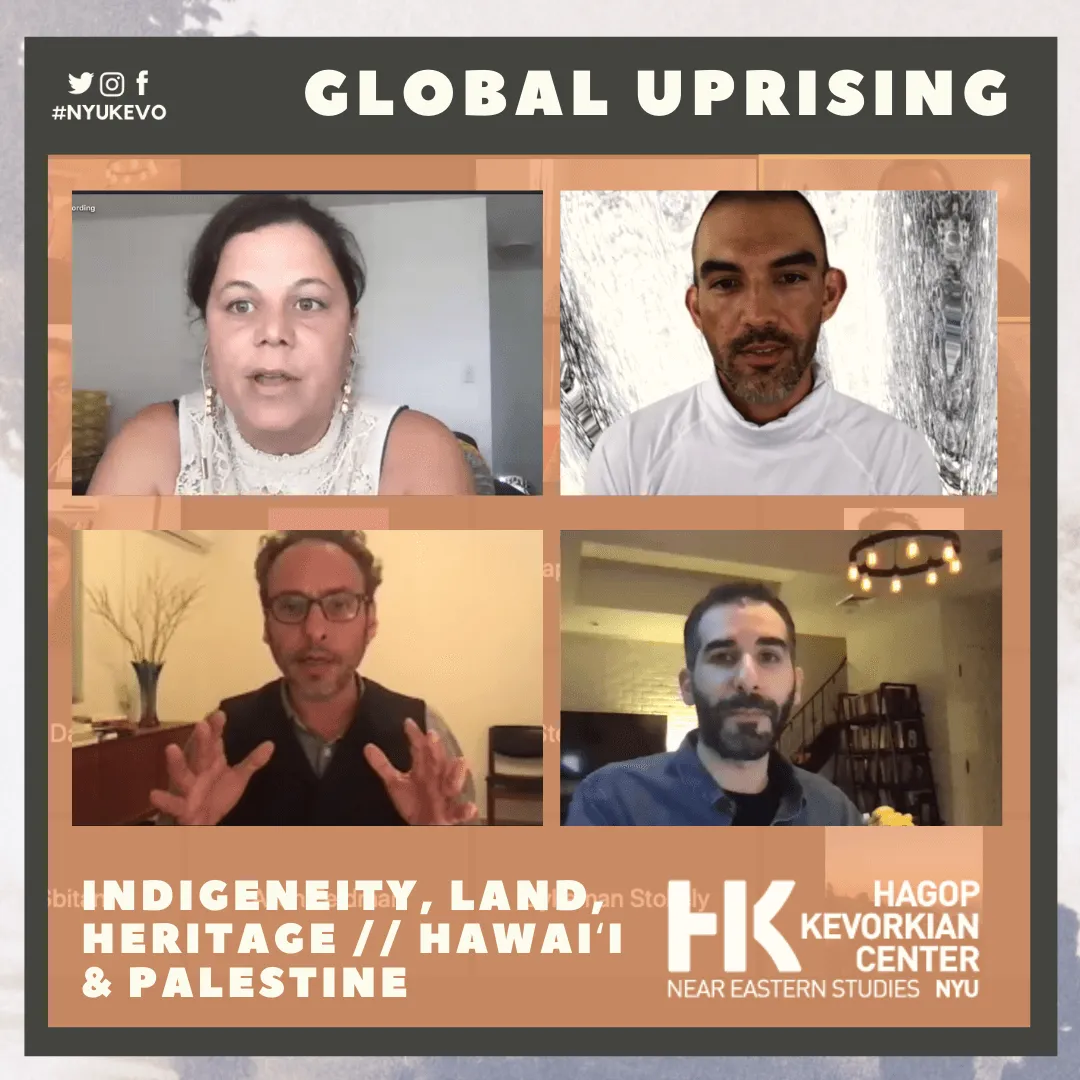
Nov 15, 2020'llima Long // Sean ConnellyNida Sinnokrot // Nasser Abourahme
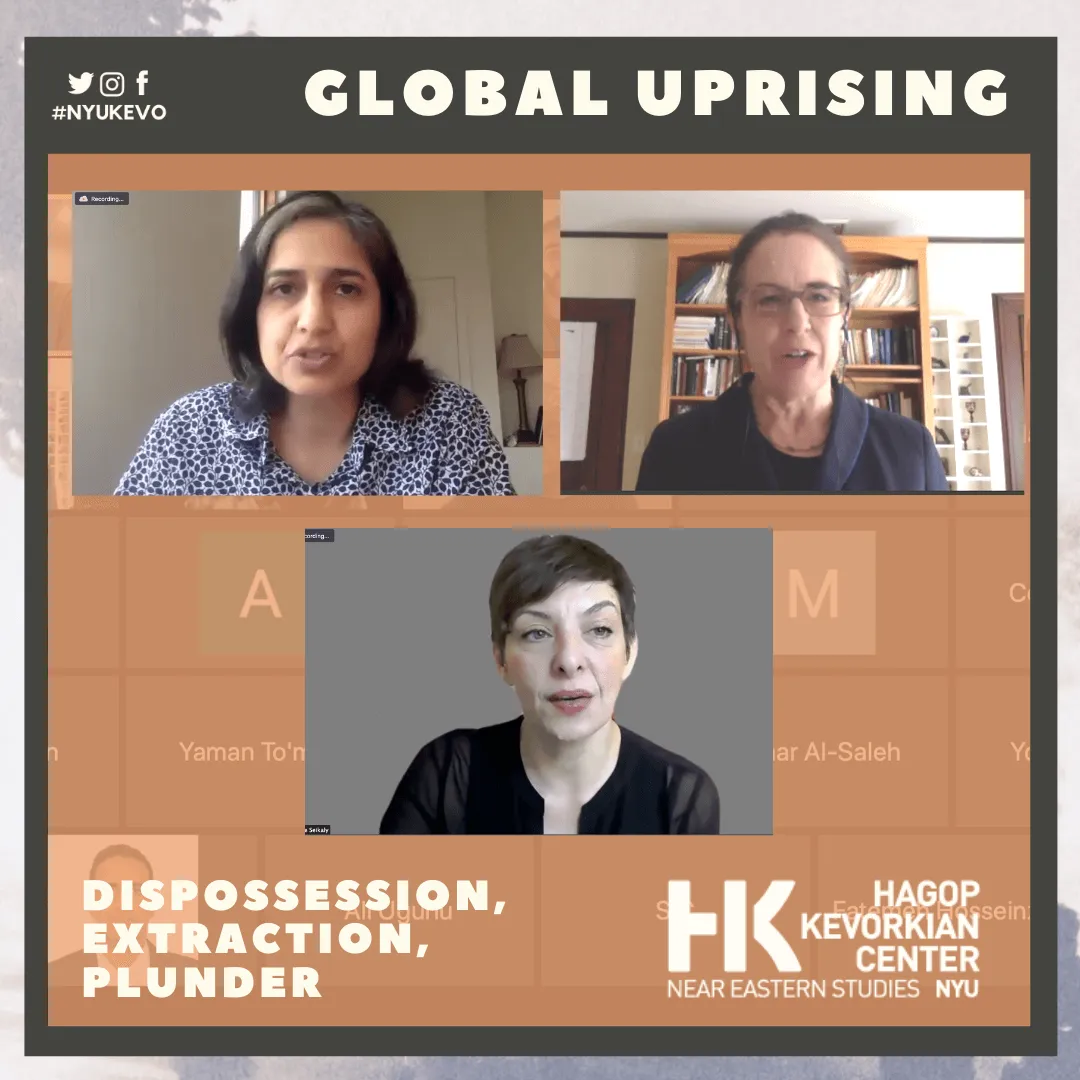
Nov 17, 2020Brenna Bhandar // Julia Elyachar Sherene Seikaly
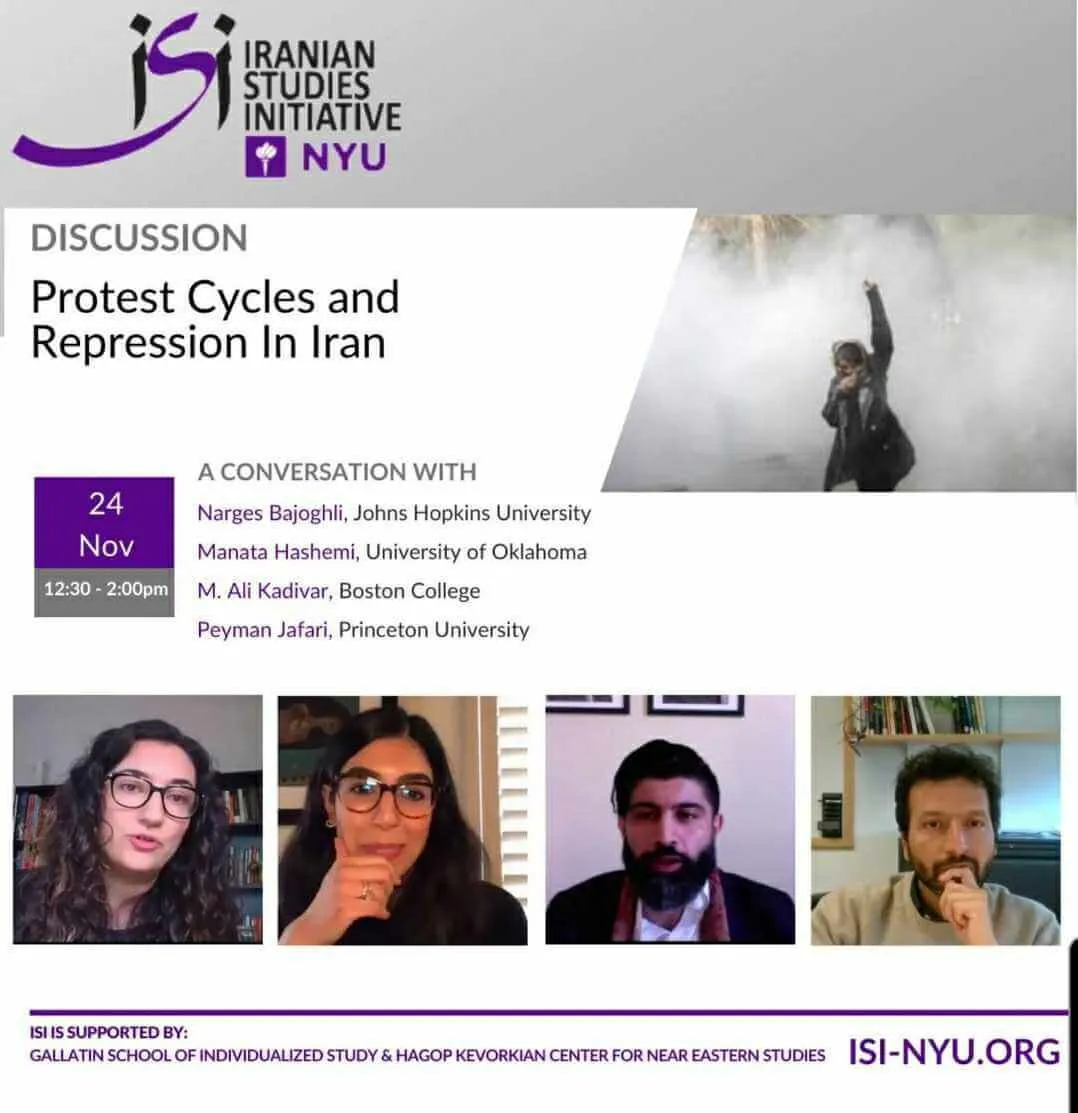
Nov 24, 2020Narges Bajoghli // Manata HashemiM. Ali Kadivar // Peyman Jafari
Dec 8, 2020Pinar Bedirhanoğlu // Nils GilmanAdam Hanieh // Aaron Jakes
SpringSchedule2021
Jan 26, 2021Nadia Abu El-Haj // Paul AmarStuart Schrader // Nikhil Pal Singh
Feb 9, 2021Anthony Alessandrini // Ayça Çubukçu Bargu // Alejandro Velasco // Vijay Prashad
Feb 24, 2021Nadje Al-Ali // Frances Hasso // Jasbir Puar // Gayatri Gopinath
March 9, 2021Joshua Clover // Dean Saranillio // Nazan Üstündağ // Lenora Hanson
March 23, 2021Madiha Tahir // Randa Wehbe //Amina Zarrugh // Sinan Antoon
April 6, 2021AslI Iğsiz // Leopold Lambert //A. Naomi Paik // Paula Chakravartty
How might we think uprising in light of the resurgence and relegitimization of racial/racist thought? How do we think historically about the return of certain colonial grammar and rhetoric in right-wing reactionary thought—"reverse colonization,” “white genocide,” “replacement theory”? In the now total collapse of the multicultural normative consensus and imagery of the global village, how does this period recall but also implore us to reimagine Afro-Arab, Afro-Palestinian, or ‘third worldist’ assemblages and solidarities? What is or might be the place of Blackness and Black liberation in wider constellations of anti-racist and anti-colonial politics? Or, in solidarities against resurgent transphobic and homophobic politics? If the brief foray into a social-democratic revival has collapsed under the twin weight of racist nativism on the one hand and its own national limitations on the other, then how might we reimagine what’s left of internationalism?
Sophia Azeb is an Assistant Professor of Black Studies in the Department of English Language and Literature at the University of Chicago. Her current book project, Another Country: Constellations of Blackness in Afro-Arab Cultural Expression, examines how Blackness and Black identity is variously translated, mobilized, circulated, and contested by African American, African, and Afro-Arab cultural figures in North Africa and Europe in the twentieth century.
Eve M. Troutt Powell is a Professor in the Department of History at the University of Pennsylvania. She teaches the history of the modern Middle East and the history of slavery in the Nile Valley and the Ottoman Empire. As a cultural historian, she emphasizes the exploration of literature and film in her courses. Her most recent book is Tell This in My Memory: Stories of Enslavement in Egypt, Sudan and the Late Ottoman Empire (Stanford University Press, 2012).
Zoé Samudzi is a writer and Ph.D. candidate in Medical Sociology at the University of California, San Francisco where she is working on a dissertation about German colonial biomedicine and the Herero and Nama genocide (1904-1908). She is co-author of As Black as Resistance (AK Press 2018) and a research fellow with Political Research Associates where she is writing a report about contemporary white nationalism and white supremacy in the United States.
Fred Moten is a professor in the Department of Performance Studies, Tisch School of the Arts. He holds an A.B. from Harvard and a Ph.D. from the University of California, Berkeley.
Part of the Fall 2020 course Problems and Methods in Middle Eastern Studies


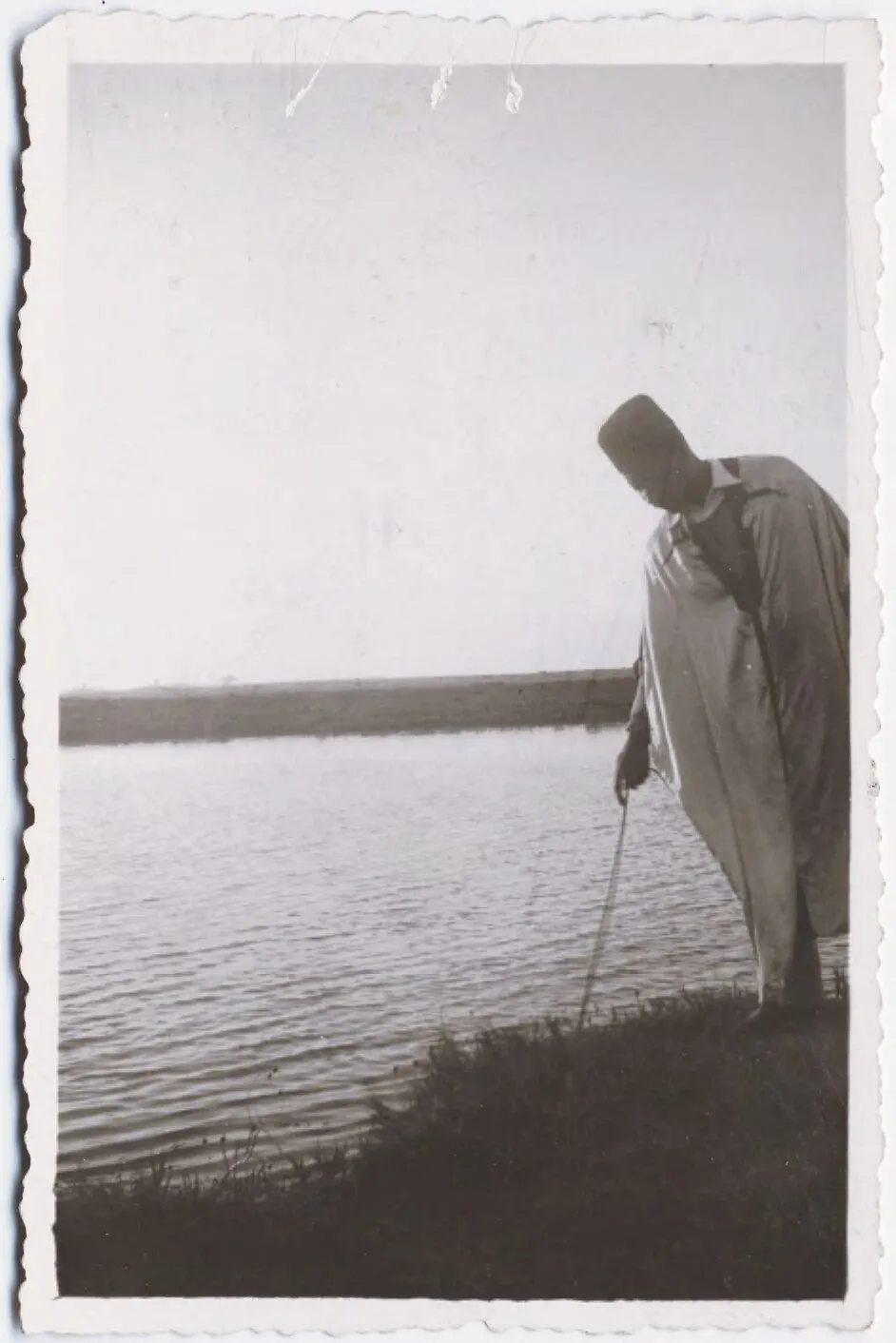
McKay in Morocco , c. early 1930s, Claude McKay Collection,
Yale Collection of American Literature, Beinecke Rare Book and Manuscript Library
Following this year’s uprisings against police terror, white supremacy, and anti-Blackness, the Middle East Studies Association of North America released a solidarity statement . The statement was a point of critique and discussion during the first event in the Kevorkian Center’s Global Uprising series, “Racism, Racialization, Anti-Blackness.” We have used MESA’s text to structure our inquiry and extend upon the questions and ideas initiated in the event, namely: the question of solidarity, the limits of analogy, Black struggle and internationalism, and the disciplinary segregation between Black Studies and Middle East Studies. We employ the statement as a medium through which we may critique the vacuous expression of solidarity present, not only in MESA’s text, but in the discipline of Middle East Studies, and the academy at large. While our observations are deeply indebted to the panelists and discussant—Sophia Azeb, Eve Trout Powell, Zoé Samudzi, and Fred Moten—we also learned a great deal from Taylor Moore and Wendell Marsh, whose insights during the question and answer section inform the questions we ask.
We recognize that we too are reacting: responding to mobilization locally and globally, and that our participation in such conversations cannot be removed from this context. As Zavier Wingham mentioned in the opening of “ Notes from the Field ,” if it were not for crisis and death we would not be centering such conversations on the study of race/Blackness to the extent that we currently are. This raises the question, how do we navigate beyond the limits of crisis when institutions push us to bureaucratize and filter voice, affect, and action? This urges us to point to Middle Eastern Studies’ active part in the marginalization of scholars within the discipline who have been concerned with questions of Blackness in the region and in the field. Scholars of the ‘Near East’ are obligated to ask how the discipline, established on the construction of fetishized Others, has been complicit in the practice it attempts to move away from by marginalizing Blackness.
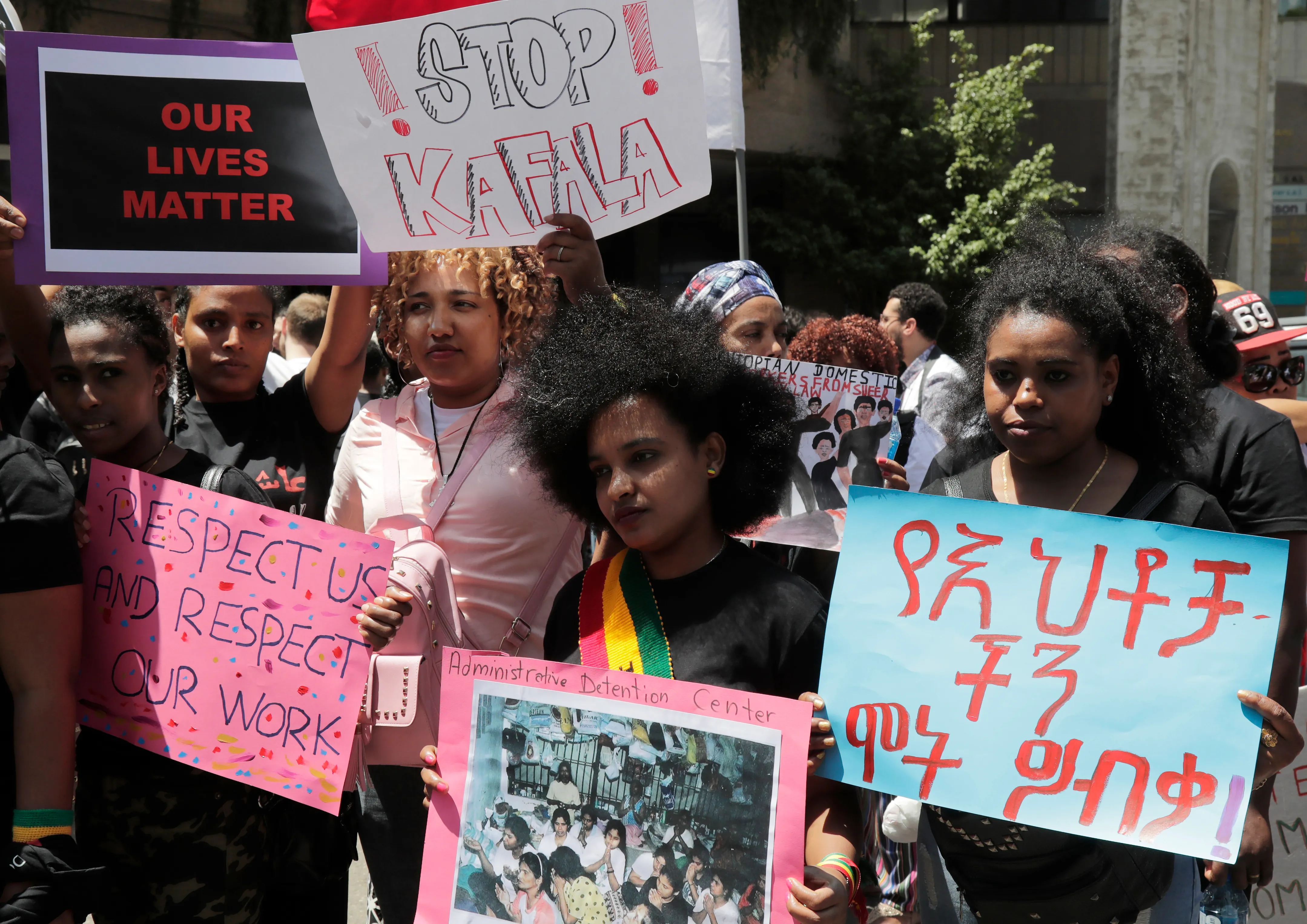
A demonstration against Lebanon’s Kafala system on May 5, 2019. (AFP)
Given this, we want to examine how the meaning of solidarity has been appropriated and dispatched in the context of the statement; is it a verb or a synonym for empathy? The latter flattens Black liberation movements to which this solidarity ostensibly refers. When institutions distort the radical potential of solidarity as a mutual togetherness in shared struggle, social movements appear as external, static objects. “We stand in solidarity” can be alternatively read as: “There’s the movement ‘out there’ and the empathy ‘in here.’” This solidarity distances itself from the potential of solidarity as a relation, thus creating an abstract and a hypothetical rather than an immediate material. Through this abstraction, the institution preemptively memorializes and reifies struggles and peoples. The consequence is pernicious: the stifling and dilution of revolutionary practices and movements. Further, it is disingenuous for institutions to feign innocence in that doing so obfuscates the institution’s reproduction of violence and embeddedness in racial capitalism and colonialism.
When solidarity is conceptually confined to analogy, and temporally confined to an event/moment, it leaves no room for complexity, for dynamic life, for movement outside of the allocated, or for the insurgency Moten spoke of as constitutive of the study of Blackness. We begin to see what spaces are given and what spaces are omitted; more importantly, we see what spaces are already filled.
Zoé Samudzi offered an analysis of analogy as a method of detaining events: limiting the dimension, depth, and condition in which solidarity can exist. Temporally transplanting “events,” as demarcated and bounded spaces inhibits the particularity of the contemporary. Analogies based on sensationalized moments dissociate and disorient movements and peoples. The onus is placed on individuals to exhibit suffering, and this spectacle is taken up as a moment disarticulated from structural violence. Movements and struggles are repackaged as bite-sized sympathies, thereby taming insurgent movements as evanescent impulsive reactions. Through this process solidarity becomes a way to cut corners and take shortcuts, rendering it a route of comfort. By relying on moments of activation and analogy as an organizing tactic, the stage becomes depopulated of any particularities or nuance. Then, we must ask, who is creating the circumstances for the suffering institutions claim to address? By connecting the two related threads of how this limited solidarity is activated (as analogy) and what activates this solidarity (a decontextualized moment), we begin a discussion of how this solidarity ultimately reproduces the very social compression it disavows.
Our intention is not to discount solidarity, rather, drawing on Sophia Azeb, we want to think of solidarity as a shared struggle against structures of violence, such as colonialism and capitalism, that allows the particulars to coexist while informing our notion of the collective. If resonance between particular moments of injustice is the basis for solidarity, then, as Azeb asks, what happens when these moments end?
MESA parallels the “militarization of the U.S. streets, the state sponsored attacks on journalists and the free press, and the destruction of Black lives” to “the experiences of people living under authoritarian regimes and U.S. imperialism in the Middle East.” Placing U.S. imperialism and authoritarian regimes on the same plane is dangerous;‘authoritarianism’ is imbued with a racial and imperial logic which is often cast onto Third World states that do not bow to the heel of U.S. domination. Will popular academic discourse ever signal America as authoritarian? What do we call a white supremacist settler-colony with 20 per cent of the world’s prisoners? Perhaps we should refract the language of authoritarianism back onto America, who, in the relentless terror it inflicts on Black and Indigenous people, is an “authoritarian regime” par excellence. Secondly, it is not simply that the lives of those under imperialism ‘resonate’ with those subject to carceral violence in the U.S. Rather, there is a material relationship between the militarization of U.S. streets that MESA signals, and U.S. imperialism globally. The Black Alliance for Peace centers this material relationship in their organizing by opposing both the U.S. global war agenda and domestic state repression against racialized communities. An organization like BAP should indeed be supported by academics who understand Black liberation as an international project.
Returning to analogy: Although it may be tempting to compare authoritarianism and U.S. intervention in the Middle East to the racism and police terror against Black Americans, MESA’s framing does a disservice to the very issues its attempts to garner support for. On one hand, the comparison may aid those who are not familiar with the context of the uprisings in the United States, with references they can understand through their lived experiences. On the other hand, analogy grossly limits the readers ability to fully comprehend the conditions that sparked the uprisings, leading to misconceptions of Black struggle in the U.S. Thus, the analogy only evokes empathy at a personal level, while solidarity with Black liberation remains superficial and contemporary anti-black sentiment in the Middle East goes unchallenged. In his essay, “Against Analogy,” Ben Ratskoff argues against the temptation for white Jews to understand anti-Blackness through antisemitism. Referencing bell hooks’ concept of “victim-bonding,” which argues that by bonding as “victims,” white feminists prevent themselves from acknowledging complicity in white supremacy. Ratskoff argues that, “activating our white Jewish family members’ and peers’ identification as victims—even if only in historical terms—can, counterintuitively, make it more difficult for them to confront their role in the maintenance and perpetuation of white supremacy.” Similarly, by “activating” Arab identification as victims of “the experiences of people living under authoritarian regimes and U.S. imperialism in the Middle East,” the statement excuses non-Black Arab Americans and non-Black Arabs in the Middle East from addressing their complicity in racism, racialization, and anti-blackness.
Drawing such a parallel as a basis for solidarity not only distorts the focus of Black liberation, but also obfuscates the rampant anti-Blackness in the Middle East and the systems that keep it in place. One example is the kafala system, alluded to through mention of Faustina Tay. In Lebanon, the kafala system (which exists in many Gulf states as well) excludes migrant domestic workers from protections offered by Lebanese labor laws, instead tying the worker’s migration status to their employer. This means that a worker can only end their contract with their employer if the employer agrees to it, resulting in a coercive system that allows for labor abuses, including wage-theft, debt bondage, withholding of passports, physical and sexual abuse, long work hours, and many other restrictions. A worker who must terminate employment for any reason but does not gain consent from the employer is considered an illegal migrant in Lebanon, and is usually detained and deported. While we wish to emphasize that this form of labor is highly racialized and gendered, we also want to connect it to a specific system of racial capitalism that employs anti-Blackness as one of its modes of operation. Rather than understand the kafala system as “modern slavery,” an analysis that tends to be enmeshed only in human rights discourses, we propose an analysis of the kafala system as a product of capitalism and the continuation of colonial modes of labor management.
As Faisal Hamadah argues in his article, “COVID and Kafala,” the kafala system “works by outsourcing management of migrant labor from the state to the citizen…in order to limit governmental oversight regarding exploitation of labor.” This also limits the means available in the fight for labor reform by workers. Last month, caretaker Minister of Labor Lamia Yammine issued a standard unified contract that “enshrines the rights” of migrant domestic workers, whose plight during the COVID-19 lockdown and Lebanon’s economic crisis sparked a global outcry. However, since this notoriously abusive system has been the staple for worker-employee legal affairs, ensuring compliance with the new contract could prove to be a bigger challenge. As Aya Majzoub, the Lebanon researcher of Human Rights Watch, argues “A revised contract that recognizes and protects workers’ internationally guaranteed rights would be a positive first step to ending the kafala system and protecting migrant domestic workers.” In finally abolishing the kafala system, migrant workers would be extended the same protections offered to Lebanese workers, linking the struggle against the kafala system to that against racial capitalism.
The MESA statement’s mention of U.S. imperialism also misses an opportunity to draw from a rich anti-colonial, anti-imperialist ethos that might inform the interconnections between the struggle against U.S. imperialism and the colonial logic of Arab nationalism as well as acknowledging the uncomfortable reality of both these projects existing simultaneously. Nasser’s construction of the Aswan High Dam, which was part of an attempt at constructing a postcolonial nation, exemplifies this tension. As Timothy Mitchell argues, “Dams…offered more than just a promise of agricultural development or technical progress. For many post-colonial governments, this ability to rearrange the natural and social environments became a means to demonstrate the strength of the modern state as a techno-economic power.” Thus, “the Aswan High Dam became the centerpiece of postwar nation making in Egypt.”
While declaring Egyptian nationhood and economic independence from colonial powers, in the same breath, Nasser’s dam displaced the people of Nubia, thus becoming a project informed by the logic of the colonizer. Nasser’s dam can be seen as a continuation of the British colonial project which initially displaced the Nubian people in 1902 with the construction of the Aswan low dam, and again each time the dam was raised. The displacement and dispossession of the Nubian people can also be seen as an assimilationist project; schools in areas where Nubians were resettled teach only in Arabic and offer no opportunities to study Nubian languages. Under Sisi’s regime, more Nubian land has been accumulated by the state, barring Nubians from the right of return to their ancestral lands, and Nubian activists have been detained for protesting the state’s decrees. Failing to mention the colonial logic underlying projects of Arab nationalism, such as the violent and contradictory history of the Aswan High Dam, the MESA statement’s declaration of solidarity with Black people in the U.S. and the Middle East makes the emptiness of such declarative statements and unsuitable analogies conspicuous.
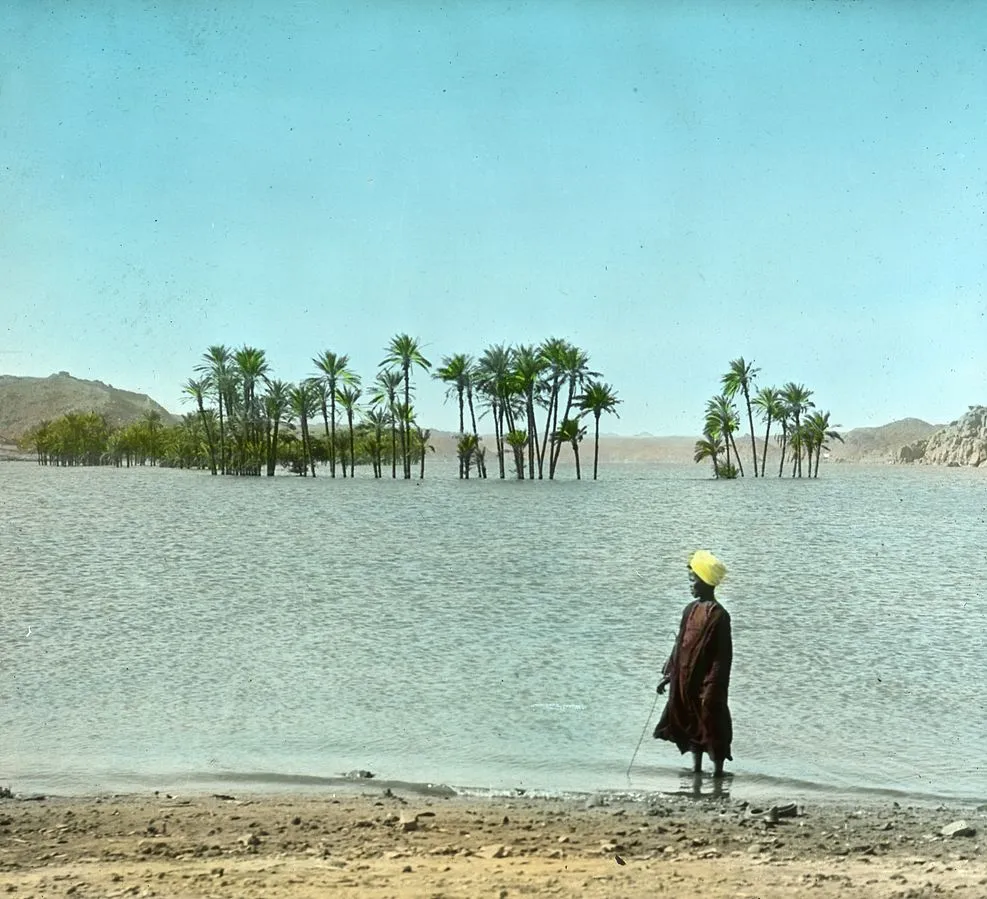
Partly submerged palms above the Aswan High Dam , 1908. (Brooklyn Museum)
The disciplinary insulation of Middle East Studies makes it appear as though Black and Indigenous thought exist distinctly outside of scholarship about and within the Arab world. MESA situates Black and Indigenous Studies beyond its margins and asserts a relation of extraction: Black and Indigenous thought are stripped of their rich intellectual and political histories and are half-heartedly esteemed for their potential to provide pedagogical guidance.
In her introductory note, Sophia Azeb argued that this language not only “obfuscates Black and Indigenous scholars already working within Middle East Studies, but also those who work on the periphery of Middle East studies but not in Middle East Studies out of necessity.” The effects of such language, as Azeb shows us, is harmful not only in its positioning of scholars who work within and across the field, as Eve Trout Powell discussed, but in its crude reduction of the fields it deems subsidiary. What does it mean for a field to commit to dismantling white supremacy when its epistemological assumptions are based in the sealing off of Black & Indigenous thought while the latter is preordained to a particular function? Our question does not intend to insist upon inclusion, incorporation, or a more rigorous interdisciplinary approach. Rather, we are interested in thinking about why such assumptions are prevalent and in exploring their implications within and beyond the academy.
Azeb was correct to point out —in response to a participant who asked why it has taken so long for the field to consider race—the “incredible amount of racism and white supremacy built into the field of Middle East Studies.” We can further address this question by pointing to a pervasive liberalism in academia that trades in international solidarity for injury politics; the erasure of the relationship between Blackness and insurgency; petit-bourgeois academic white guilt and chauvinism (a companion to and iteration of white supremacy); area studies’ embeddedness in U.S. empire; and, its failure to contend with “the very idea of civilization.”
MESA’s positioning of Black people within a framework of victimhood reveals who is and is not considered central to the trajectories of revolution and change in the region and thus, who is and is not considered a normative subject. This historical revisionism renders Black and Indigenous people passive non-agents whose leadership and participation in liberation struggles all over the world are ignored. In the process, Afro-Arabs and Black Americans who have invariably shaped transnational revolutionary politics, are erased. Edan Mehretu Tessema’s unpublished thesis, “A Historiography on Fatima Bernawi and the African Palestinians of the Old City,” brilliantly challenges such revisionism through situating the political life of Afro-Palestinian Fatima Bernawi within a genealogy of Black Palestinian resistance to settler-zionist colonization. Such work urges us to address the multilevel erasures of Afro-Arab and Afro-Palestinian communities within historigraphies of the Middle East while asking how the field of Middle East Studies has played a role in foreclosing scholarship it deems peripheral.
Additionally, MESA’s concern for Black people as citizens— Black citizens of Middle East and North African states face legal, social, economic exclusion and discrimination on a daily basis —invokes a legal classification that further sidelines these communities. This framework excludes Black people in the region who are not citizens—for example, the large refugee populations in Jordan, migrant worker populations in Qatar and Kuwait, and non-Jewish African refugees in Israel—and who face even more “legal, social, and economic” exclusion than their counterparts. A primary site for Black struggle in the Middle East is the one created by the kafala system, and well-intentioned academics should perhaps focus on that issue: not only rhetorically but materially.
In Imagined Communities , Benedict Anderson identifies a key paradox involved with operating from a nationalistic framework; he problematizes “the formal universality of nationality as a socio-cultural concept” and identifies the dangerous gap between the “‘political’ power of such nationalisms” and “their philosophical poverty and even incoherence” (Anderson, 5). In a part of the world where a significant portion of its Black inhabitants do not even enjoy the rights of citizenship, and sometimes hail from an assortment of countries with citizenship regulations in place, it is especially important to criticize the nation-state structure which demarcates individuals within a state and provides them with an allotted value. The power dynamics between citizens and non-citizens is one that cannot be separated from the power dynamics of racialization, and at times the citizenship designation may perhaps be a more helpful lens through which to tackle inequalities in the region. Faustina Tay, the sole Black person named in the MESA statement, was not a citizen. Her case opens up the questions of how, and why, citizens of Lebanon (and other countries) regularly get away with the violence and abuse of non-citizens.
Eradicating anti-Blackness requires upending the epistemological assumptions within MESA’s statement that treats Blackness as “Other”—an interruption or exception to regional identities and scholarship that is concerned with them. It also means upending the way that Blackness is analyzed as a national, bordered thing ; a phenomenon that inevitably marginalizes non-citizens and impedes imaginations of global solidarity, imaginations that can perhaps be grounded in issues of class or post-coloniality instead. (Although those groundings are, admittedly, not as trendy in the current moment.) The words of W.E.B. Du Bois, a Black American scholar, whose work’s global application has been underrated, come to mind: “The emancipation of man is the emancipation of labor and the emancipation of labor is the freeing of that basic majority of workers who are yellow, brown and black.”What do we lose when we decontextualize moments of race-reckoning from historical class analyses?
Last but certainly not least, eradicating anti-Blackness means questioning not only the way area studies tends to “create” an area by describing it, as well as the problematics that come with Middle Eastern area studies specifically, but also the way that academia at large works to replicate the power dynamics it seeks to understand. Academic liberalism often prioritizes empty recompense, victimization, and passive knowledge production at the expense of a radical project embraced by the intellectual and political work of whom Walter Rodney names “the guerilla intellectual.” It is in this context that Fred Moten’s assertion resonates: “what we are interested in, at the end of the day, is a radical disruption of the boundaries and the protocols of academic study in the first place.”
The MESA statement is one of many released in reaction to the uprisings against white supremacy, anti-Black racism, and police violence. While we appreciate the effort required to generate a mass-outpouring of condemnation, such statements, as we have argued throughout this extension, dilute the revolutionary potential of the uprisings by confining solidarity to the sphere of reform. Indeed, a perfectly representative site of such phenomena is the neoliberal university: as university administrators release statements expressing their lukewarm commitment to fighting anti-Blackness, they reject demands to kick cops off campus and further entrench austerity measures against their workers. Perhaps the BLM Instagram graphics that have been posted by various corporations are not so different from the obligatory statements churned out by academic institutions.
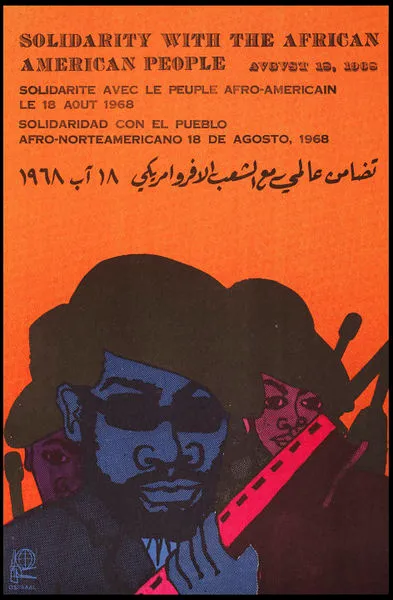
“ Solidarity with the African American People ,” 1968, OSPAAAL. (V&A)
Sophia Azeb, Fred Moten, and Wendell Marsh discussed to varying degrees how institutional roots and respective histories form the direction and lens of Black and Middle Eastern Studies. Given Middle Eastern Studies’ inception as a colonial project, which constructed a region and identities, it stands in stark juxtaposition to Black Studies, which came to be through an external insurgency, antagonistic to the academy. Before engaging in a deeper comparison between the two, we must step outside of the assumed and critically ask what the Academy is worth. How far can a discipline stray from its roots, and how much can an institution concede to life outside of itself? Although we would do well to draw from Black and Black-American scholars (Fanon, Dubois, Wynter, Moten, Hall, Horne etc) when considering race as a point of departure into revolution, transformation, and global solidarity, there are many non-academics to look to as well. A litany of Black writers, artists, and athletes have provided us with valuable work that allows us to better understand the bridges between various national struggles: novelists James Baldwin and William Gardner Smith on Algeria, singer Eartha Kitt and the boxer Mohammed Ali on Vietnam, poet June Jordan on Palestine, artist and athlete Paul Robeson on the Soviet Union. And of course, Black activists who managed to link all of the above in their pursuit of global liberation: Assata Shakur, Elaine Brown, Claudia Jones, and Angela Davis.
We have to embrace the discomfort of change and critically question the conditions in which things exist. These conversations call into consideration how an institution can exist in its current scope in a way that is also satisfactorily in service to a struggle that exists outside of its appointed “moment.” It is critical to remember that meaningful shifts require unbounded imagination; the eventualities we entertain are only as sustainable as they are flexible and generous to those they are meant to serve and support. The institution is rigid by definition: how far can its malleability go before it collapses onto itself? The institution—like the brand of solidarity it brandishes—has become an end in and of itself. How much can a system of fumes and fantasies offer to those it must suppress to sustain itself, the living and breathing muses by which it claims any and all legitimacy? This piece is meant to promote a dialogue of what it means to move past the institution as well as what is gained. While we do not have answers to all the questions posed, we believe they must be addressed in a material way if genuine solidarities are to be sustained.
Abolitionist University Studies: An Invitation
The Imperial University: Academic Repression & Scholarly Dissent
Recording the Complexity of Struggle: An Interview with the COLA Agitation Committee
The Fantasy and Fate of Ethnic Studies in an Age of Uprisings: An Interview with Nick Mitchell
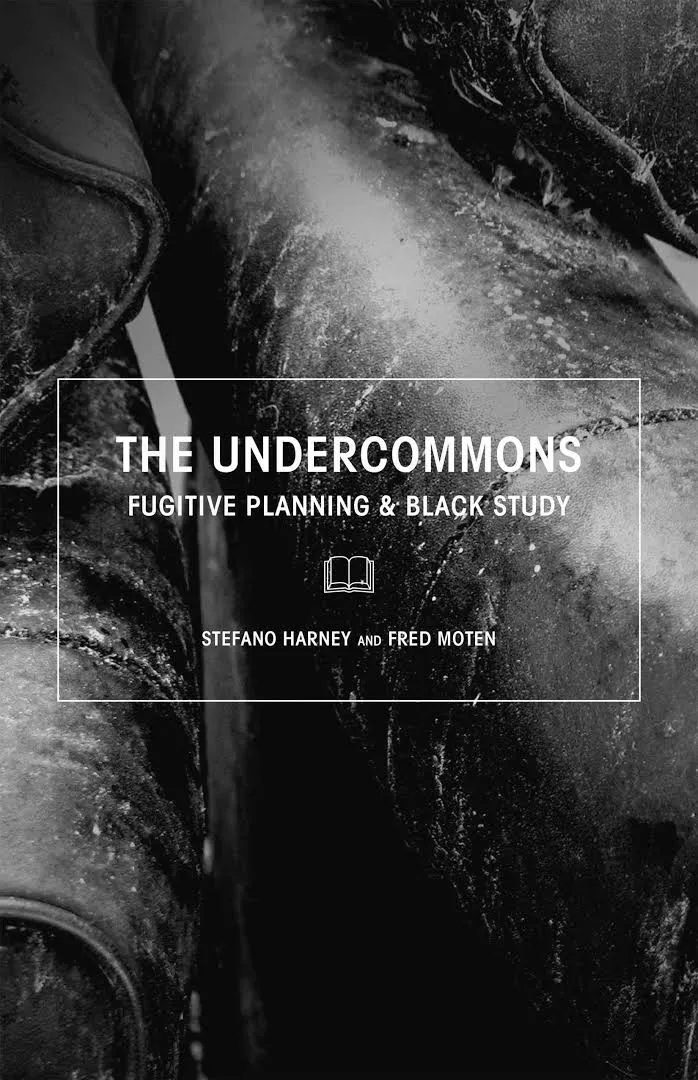
The Undercommons: Fugitive Planning & Black Study, Moten & Harney
PROUD FLESH Inter/Views: Sylvia Wynter
Against Middle East studies pane l at MESA 2020, Huma Gupta, Hana Sleiman, Nader Atassi, Esmat Elhalaby
Watusa - Sun Ra Arkestra with Salah Ragab in Cairo (1/13/1984)
Black Radical Tradition and Palestine, Gerald Horne
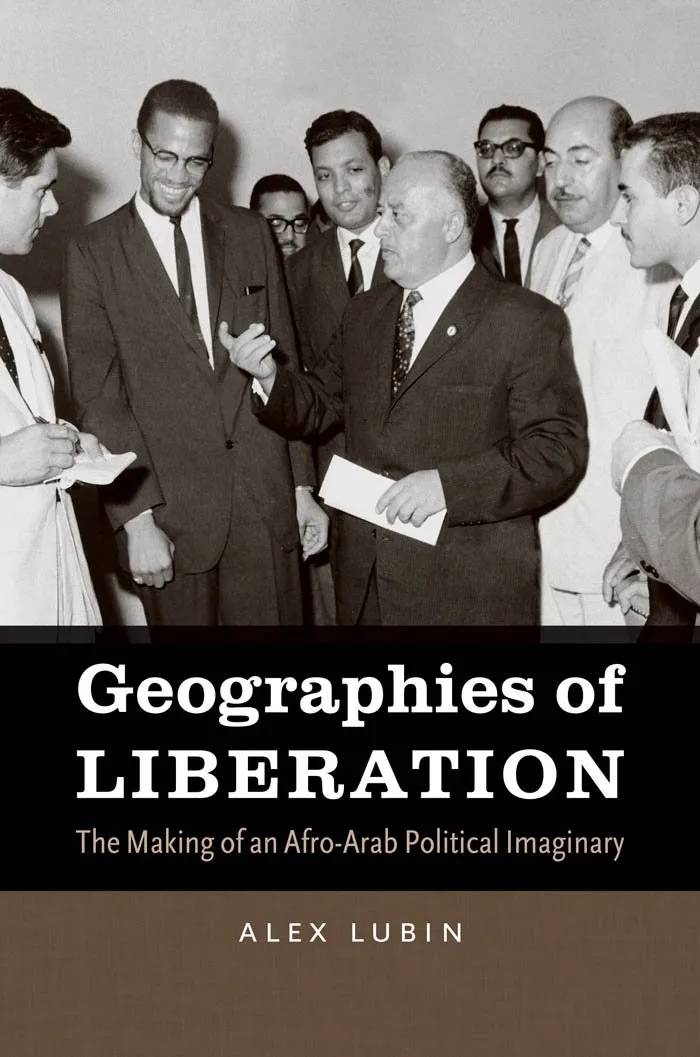
Geographies of Liberation: The Making of an Afro-Arab Political Imaginary, Alex Lubin
Another Country: Black Americans , Arab worlds , 1952-1979 by Sophia Azeb
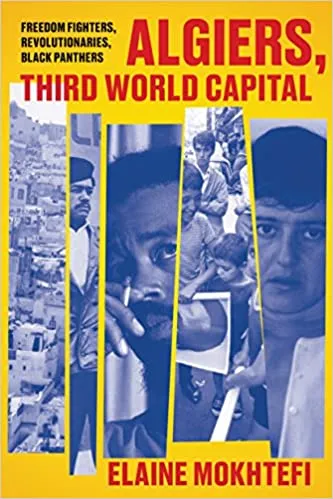
Algiers, Third World Capital: Freedom Fighters, Revolutionaries, Black Panthers, Elaine Mokhtefi
The Black Arts Movement in the United States and Algeria
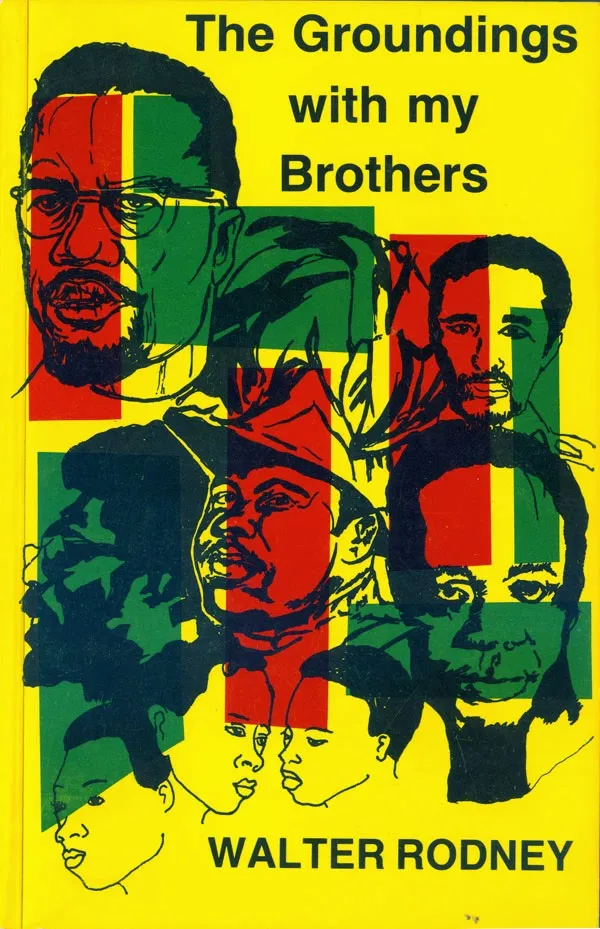
The Groundings with my Brothers, Walter Rodney
Extraordinary Renditions cluster on 9/11; “ Epilogue: From Antigua to Algérie: The Particularity and Promise of the Afro-Arab ”
“ Anti-Blackness in the Arab World ” Compiled by Aida Bardissi and Asma Elgama
Maryam Abu Khaled on anti-Blackness in the Arab World (Palestine specific; video linked in article )
Claudia Jones School for Political Education panel: “ Against White Supremacist Capitalist Imperialism: We Charge Genocide and Lessons for the Present ”
Laleh Khalili, Time in the Shadows: Confinement in Counterinsurgencies, “Introduction” discussing racialization in war, liberal and asymmetric warfare
Audra Simpson, Mohawk Interruptus, theorizing sovereignty/belonging/refusal, p. 8-18
Blackness on the Iranian Periphery
Excerpts from: A Historiography on Fatima Bernawi and the African Palestanians of the Old City , Edan Mehretu Tessema
The Black Indian Ocean Reading List
Aime Cesaire’s resignation letter
Jasbir Puar, The Right to Maim
Sylvia Wynter: Black Metamorphosis
Patrick Chamoiseau, Texaco
Wingham also noted how the study of race, even if unacknowledged, is actually the study of Blackness. See here for more.
Wingham also noted how the study of race, even if unacknowledged, is actually the study of Blackness. See here for more.
While we are using the MESA statement, we are interested in the function of solidarity statements made by academic institutions more generally.
Sophia Azeb, " Epilogue: From Antigua to Algérie: The Particularity and Promise of the Afro-Arab ," Post45 , September 11, 2020.
Take, for example, Angela Davis’ insight about the symbiotic relationship between America’s military detention facilities and domestic prisons in Abolition Democracy: Beyond Empire, Prisons, and Torture.
Ben Ratskoff, " Against Analogy ," Jewish Currents , June 09, 2020.
Ibid.
Ibid.
Faisal Hamadah, " COVID and Kafala ," MR Online , August 17, 2020.
Timothy Mitchell, Rule of Experts: Egypt, Techno-politics, Modernity (Berkeley, CA: University of California Press, 2012), 21.
Ibid, 45.
Janmyr, Maja. 2017. “ Human Rights and Nubian Mobilisation in Egypt: Towards Recognition of Indigeneity .” Third World Quarterly 38 (3): 717–33.
" Minority Profile: Egypt's Nubians ," Eshhad , February 06, 2018.
See the YouTube video of this event at the top of this page. (12:20)
Ibid (1:12).
Ibid (Moten).
Ibid.
Du Bois, W. E. B., Black Reconstruction in America: Toward a History of the Part Which Black Folk Played in the Attempt to Reconstruct Democracy in America , 1860-1880 (New York, NY: Routledge, 2017), 16.
Edward Said, Orientalism (London: Penguin Modern Classics, 2003).
Walter Rodney, Walter Rodney Speaks: The Making of an African Intellectual (Trenton: Africa World Press, 2014).
See the YouTube video of this event at the top of this page. (51:20)
Wingham also noted how the study of race, even if unacknowledged, is actually the study of Blackness. See here for more.
Wingham also noted how the study of race, even if unacknowledged, is actually the study of Blackness. See here for more.
While we are using the MESA statement, we are interested in the function of solidarity statements made by academic institutions more generally.
Sophia Azeb, " Epilogue: From Antigua to Algérie: The Particularity and Promise of the Afro-Arab ," Post45 , September 11, 2020.
Take, for example, Angela Davis’ insight about the symbiotic relationship between America’s military detention facilities and domestic prisons in Abolition Democracy: Beyond Empire, Prisons, and Torture.
Ben Ratskoff, " Against Analogy ," Jewish Currents , June 09, 2020.
Ibid.
Ibid.
Faisal Hamadah, " COVID and Kafala ," MR Online , August 17, 2020.
Timothy Mitchell, Rule of Experts: Egypt, Techno-politics, Modernity (Berkeley, CA: University of California Press, 2012), 21.
Ibid, 45.
Janmyr, Maja. 2017. “ Human Rights and Nubian Mobilisation in Egypt: Towards Recognition of Indigeneity .” Third World Quarterly 38 (3): 717–33.
" Minority Profile: Egypt's Nubians ," Eshhad , February 06, 2018.
See the YouTube video of this event at the top of this page. (12:20)
Ibid (1:12).
Ibid (Moten).
Ibid.
Du Bois, W. E. B., Black Reconstruction in America: Toward a History of the Part Which Black Folk Played in the Attempt to Reconstruct Democracy in America , 1860-1880 (New York, NY: Routledge, 2017), 16.
Edward Said, Orientalism (London: Penguin Modern Classics, 2003).
Walter Rodney, Walter Rodney Speaks: The Making of an African Intellectual (Trenton: Africa World Press, 2014).
See the YouTube video of this event at the top of this page. (51:20)
What are the political concepts we need to make sense of the last ten years of uprising? Can or should we think of these uprisings in temporal terms? Can we go further and historicize them—what would this be the age of exactly? And how has uprising, understood as a kind of praxis, changed over the decade? In turn, how might we think through what is left of the concept of revolution, and its various dilemmas (vs revolt, vs reform etc.)? Are other adjacent concepts—insurrection, riot, rebellion etc.—now more useful? And finally, what does parsing the temporality of the uprisings across a “global” scale do to still standing political distinctions between the “liberal-democratic” and “post-colonial” worlds?
Banu Bargu is associate professor of History of Consciousness at the University of California, Santa Cruz and currently a member at the Institute for Advanced Study. She is a political theorist, with a focus on modern and contemporary political thought and critical theory. Her first book, Starve and Immolate: The Politics of Human Weapons (Columbia UP, 2014), explored self-destructive protests in the context of Turkish prisons through the ethnography of a radical movement. This book received the First Book Prize given by the Foundations of Political Theory section of the American Political Science Association and was named an Outstanding Academic Title by Choice. Bargu is also the editor of Turkey's Necropolitical Laboratory: Democracy, Violence, and Resistance (Edinburgh UP, 2019), co-editor of a special issue of the journal Rethinking Marxism on Louis Althusser (2019), and co-editor of Feminism, Capitalism, and Critique (Palgrave, 2017).
Ghassan Hage is a Professor of Anthropology at the University of Melbourne. He has worked for many years on racism and white nationalism from a comparative perspective. His recent work Is Racism an Environmental Threat? (2017) deals with the common basis for the colonial practices of racialization and exploitation of people and the speciesist practices of exploitation of nature. His main ethnographic work has been on Lebanese diasporic culture. A monograph on the topic will be published by the University of Chicago Press in 2021. He has a long interest in critical anthropological theory and has written Alter-Politics: Critical Anthropological Thought and the Radical Imaginary (2015). He is currently writing a book on Pierre Bourdieu also for Duke University.
Alberto Toscano is Reader in Critical Theory and Co-Director of the Centre for Philosophy and Critical Thought at Goldsmiths, University of London. He is the author of Fanaticism: On the Uses of an Idea and Cartographies of the Absolute (with Jeff Kinkle). He edits The Italian List for Seagull Books and sits on the editorial board of the journal Historical Materialism.
Lisa Duggan is a journalist, activist, and Professor of Social & Cultural Analysis at New York University. She is author of Sapphic Slashers: Sex, Sensationalism and American Modernity and Twilight of Equality? Neoliberalism, Cultural Politics and the Attack on Democracy, co-author with Nan Hunter of Sex Wars: Sexual Dissent and Political Culture, and co-editor with Lauren Berlant of Our Monica, Ourselves: The Clinton Affair and National Interest. Mean Girl: Ayn Rand and Neoliberal Greed is in the new e-book series she is co-editing with University of California Press, American Studies Now. She was president of the American Studies Association during 2014-2015.
Part of the Fall 2020 course Problems and Methods in Middle Eastern Studies
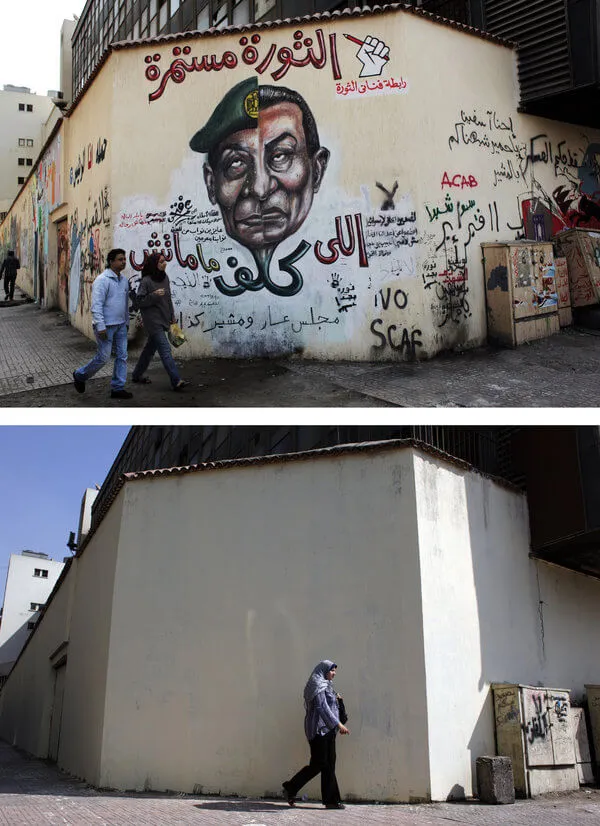
A mural in Tahrir Square, Cairo, was whitewashed in October 2012 and later repainted by graffiti artists. (Reuters)
When synthesizing the event, we found ourselves grappling with new terminology. Many of the terms embraced by academics to talk about revolution appear distant from the phenomena they seek to describe. This is inevitably because they are enmeshed in decades of debates and different schools of thought. Still, the concepts which become part and parcel of intellectual discourse are in many ways rooted in social movements, so the question becomes: why do these concepts often look so different when they travel from the square to the ivory tower?
We struggled with the conceptualization of the body and the social. What follows is an attempt to grapple with the concepts which the speakers have provided to help us think through the past decade of uprising and revolutions. This exercise was fruitful for us in understanding the event itself, but it also left us wondering, can the gap between academic discussions about uprising and the uprisings themselves be breached? What is at stake when we conceptualize uprisings and revolutions?
In what follows, we too engage in academic writing style that might be inaccessible to many. We realize that there is a tension here that is a common problem in the role of the intellectuals and their areas of interest. In this event, we were challenged as a group to engage with the terminology that was presented by the speakers, and on a personal level we were challenged to respond to these big questions in simpler accessible language when talking to our family members and friends.
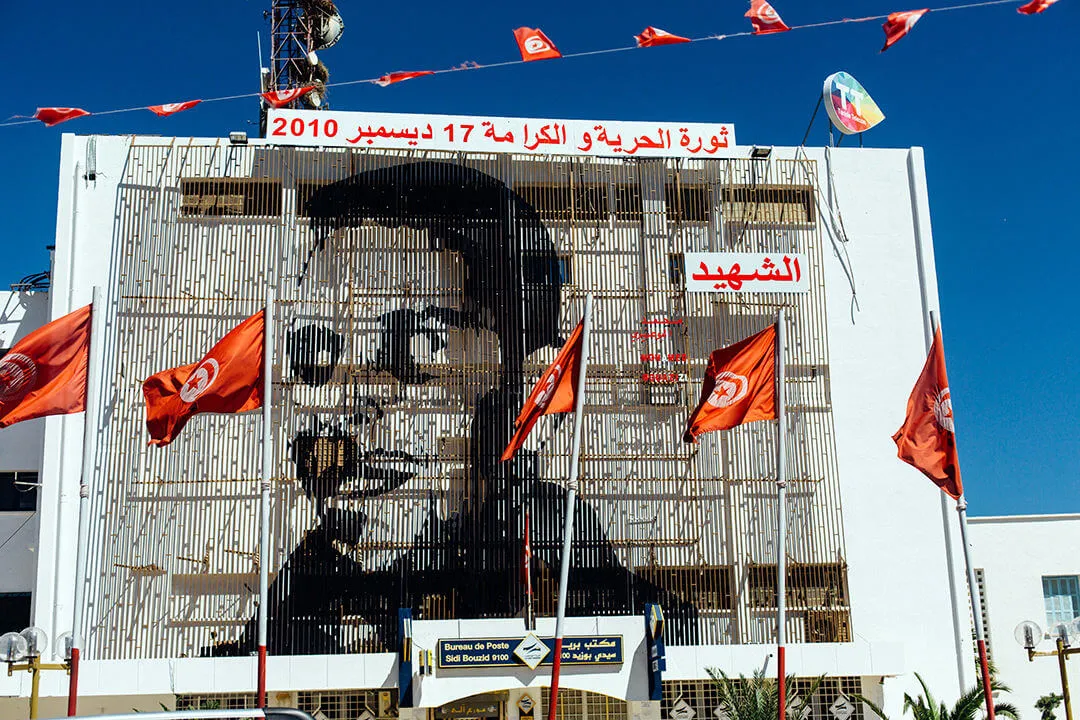
A monument to Mohamed Bouazizi in Sidi Bouzid, Tunisia (ECCEB/Atlas Obscura)
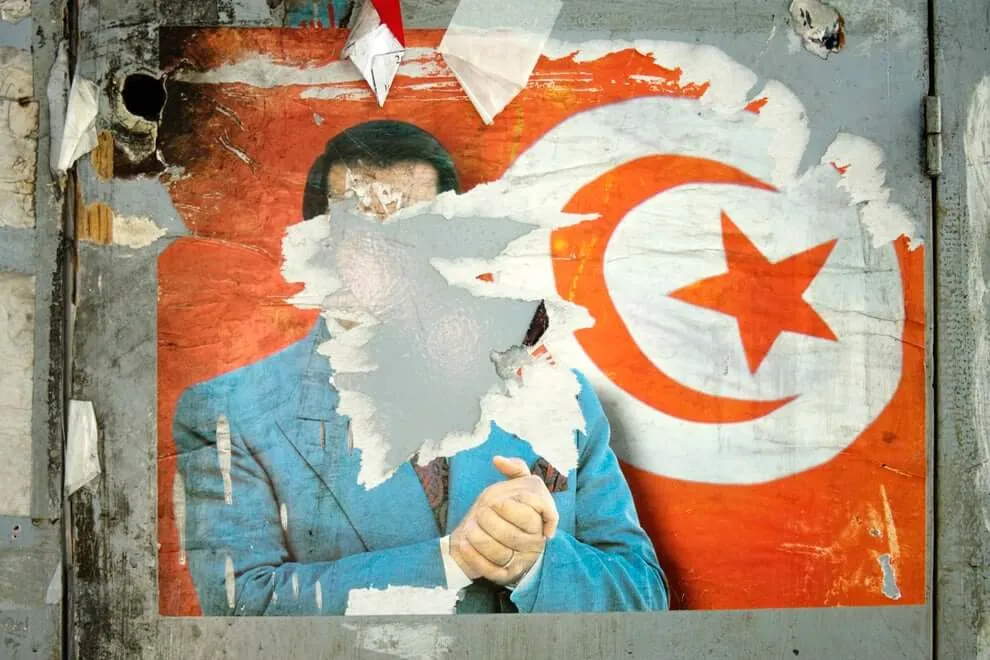
A torn poster of overthrown Tunisian President Zine El Abidine Ben Ali. (Getty)
In response to Nasser Abourahme’s question about necessary concepts, Banu Bargu gave us the concept of ‘the body’ to help us make sense of the last decade of uprising. She is thinking with examples of bodily harm as resistance to oppression. We provide here three examples of protesters who use their bodies as a means of insurrection: Mohamed Bouazizi, Maher al-Akhras, and Loujain al-Hathloul.
On December 17, 2010, Mohamed Bouazizi set himself on fire in front of the provincial government building in the town of Sidi Bouzid, Tunisia in an act of self-immolation and political protest. As a street vendor, Bouazizi had been targeted by the local police repeatedly for several years. Bouazizi was once again harassed by the police on the morning of December 17 for lacking a vendor’s permit and refusing to pay a bribe. A municipal official followed up by confiscating Bouazizi’s electronic scale and knocking over his cart. Bouazizi went to the government building to make a complaint, but was denied entrance. Two and a half weeks after his self-immolation, Bouazizi succumbed to his injuries and passed away on January 4, 2011. Bouazizi’s political protest, against both the economic inequalities in Tunisia and the repressive security apparatus that enforced these conditions, led to an uprising across Tunisia and others in the rest of North Africa and the Middle East that resulted in political change in Tunisia, Egypt, and Yemen, the last of which has resulted in a protracted civil conflict as with Libya and Syria.
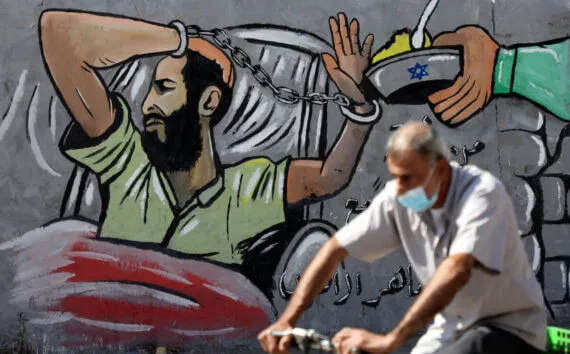
A man bicycles past a mural of Maher al-Akhras in Gaza City in October 2020 (Getty)
On July 27, 2020, Maher al-Akhras was arrested by the Israeli Shin Bet forces and was put in administrative detention. ‘Administrative detention’ is the Israeli method for incarcerating Palestinians without pressing charges or holding trial, which makes it impossible for detainees to defend themselves against administrative detention order. In protest, on the day of his arrest al-Akhras began a hunger strike. After more than a hundred days, during which al-Akhras was in critical condition, the Israeli authorities had agreed to not extend his administrative detention beyond November 26 (the original date for the expiration of the detention order), if al-Akhras ended his hunger strike. Al-Akhras agreed to the condition and is expected to be released on November 26.
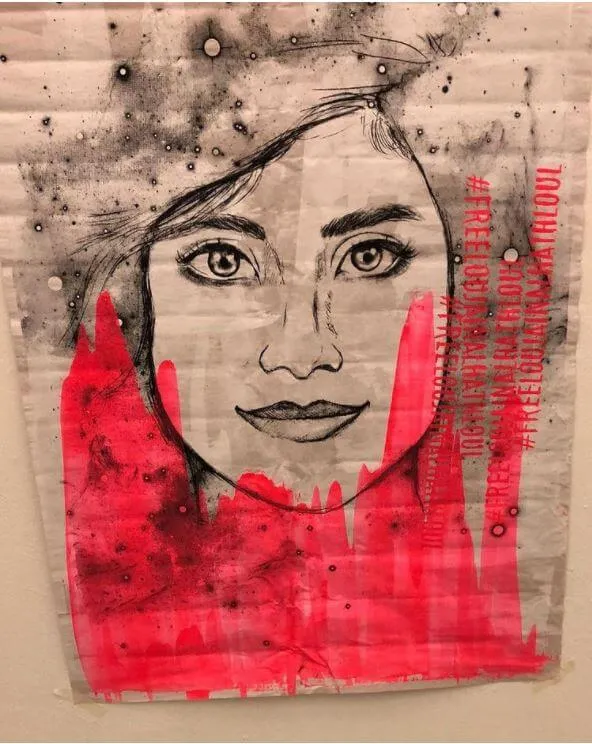
A paste up of a collaboraton between Melbourne-based Saudi artist Ms, Saffa and American artist Allie Ballesteros calls for Loujain Hathloul’s release. (Ms. Saffa/Instagram)
Loujain al-Hathloul is a women’s rights activist in Saudi Arabia. Al-Hathloul has been in and out of jail on several occasions due to her active political expression and calls for structural change by defying many of the oppressive patriarchal laws, such as the right to drive and the male guardianship system. Al-Hathloul has now been detained by Saudi Arabia since May 2018. Several human rights organizations have reported that al-Hathloul has been tortured extensively throughout her imprisonment, and her trial has been indefinitely postponed. In August 2020, al-Hathloul successfully went on a six day hunger strike in order to get permission to speak to her family, an opportunity previously denied to her but permitted to others. On October 26, 2020 al-Hathloul began a new hunger strike to demand regular phone calls with her family. Under international pressure stemming from this most recent hunger strike, the Saudi authorities at the time of this lecture were reportedly considering al-Hathloul’s release ahead of the upcoming November 2020 G20 summit.
Returning to Bargu’s intervention, we asked ourselves, what does ‘the body’ mean? What can a focus on ‘the body’ do? What does a focus on ‘the body’ render visible? Poignantly, Bargu argues that acts of self-harm as resistance, such as Bouazizi’s self immolation, and al-Akhras’ and al-Hathloul’s hunger strikes, turn the body into both an object and subject of violence. An object, because structural violence operates on the body. A subject, because a political act of self-harm reflects the violence of the regime back at it. It is a “somatization of structural violence,” Bargu further argues, which presents a critique of a disembodied conception of politics. Indeed, a focus on ‘the body’ renders visible the corporeal dimension of resistance. As Bargu notes, these acts are “writing the body back into the social.” In paying close attention to the weaponization of the body as a form of protest, we are able to notice the nuances of this form of resistance. With that in mind, we turn to ask: what does a focus on ‘the body’ as a concept render invisible?
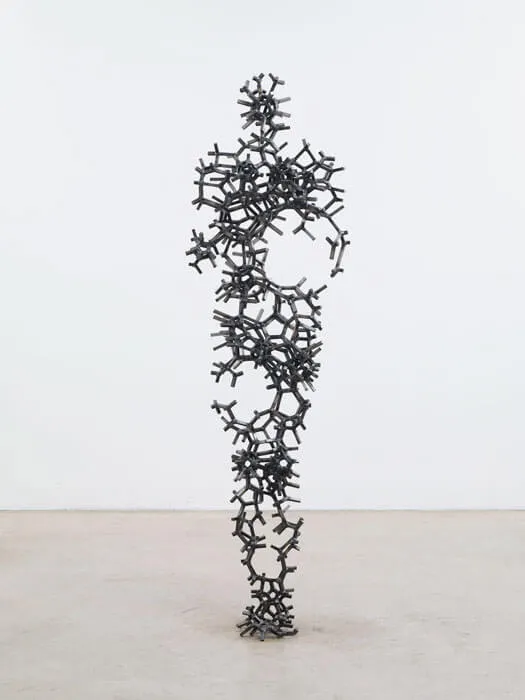
APERTURE XVII (2011) by artist Antony Gormley .
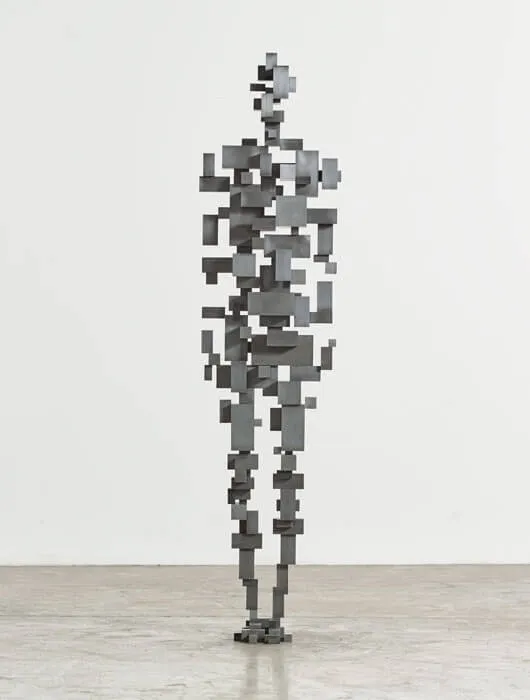
SUBLIMATE XIII (2007) by artist Antony Gormley .
‘The body’ as a concept could help us understand the uprising and provide a technical tool to explore the ‘how’, but the ‘why’ could slip away when X will use their body in a relation to the political and socio-economic rationale behind the act. The death of Alan al-Kurdi, for example, sparked heartwarming acts throughout Europe to welcome refugees in the short term, but in the long term it failed; individualizing al-Kurdi’s body failed to address the reasoning of why the family was forced to seek refuge in the first place. The problem of this approach deals with consequences rather than the causes. As these acts happen on the margins, they do not reach the surface unless they end with death. We fear the focus on the body as a weapon against the state, as much as it is important to understand, may shift the focus away from the circumstances that create a deprived situation that leads X to harm themselves. The poetics and romanticized ideas, probably, are the last thoughts behind X intention. Indeed, while the hunger strike is the weapon, the act’s context should remain in our focus when attempting to understand the greater reason behind it.
Can ‘the social’ as a concept help us better understand uprisings and revolutions in the 21st century?
In his talk, Hage described the L-shaped spatial distribution of the uprising in Beirut. “In the top of the L, were people who were facing the parliament and were looking for confrontation and wanted to engage the police… A bit further down the L, there were people who were engaging in creative sloganeering and graffiti… On the corner of the L you had academics doing sit-ins and engaging in teach-ins. And on the bottom of the L, facing the mosque, there was a huge section of the population, which was political because it came down [to the protest], but there was more carnival feeling with families with kids, ice-cream, popcorn and what have you” (24:00). Hage describes the L shaped clusters of protesters in order to ask, what do these protesters have in common, besides a general dissatisfaction with the political situation in Lebanon? For Hage, it is a “desire for the social” that brought the protesters down to the streets. When we were thinking about how to synthesize this event, we were wondering what does ‘the social’ even mean? What is its antithesis? Why is there a ‘desire’ for ‘the social’? And, can ‘the social’ as a concept help us better understand uprisings and revolutions in the 21st century?
This past decade of uprising, the protracted present, is defined by the neoliberal era which began its ascendancy in the 1970s and fully asserted dominance in the early 1980s. The neoliberal era of global capitalism, which continues through the present, was a direct response to the democratizing trends of the 1960s and has dramatically escalated economic inequality and placed political power solidly back in the hands of the global elite. Neoliberalism, or neoliberal capitalism, considered narrowly characterizes economic policy centered around the primacy of the free market such as the dismantling and privatization of state-functions or the welfare state, and the deregulation of markets. More broadly, neoliberalism can also be considered as a cultural, sociopolitical ideology that emphasizes individuality, diminishing the power of labor unions and collective action.
Largely influenced by the withdrawal of the state from social institutions and burgeoning rates of both deindustrialization and financialization, we have seen traditional modes of struggle change. In Joshua Clover’s Riot. Strike. Riot: The New Era of Uprisings , he asks provocatively: In the absence of robust organized labor in much of the world and the inability to directly affect global market-based prices with local looting and riots, what type of revolt is possible? Or, put by Toscano, how does one “extract, develop, reinvent a theory of revolution in the absence of its traditional Marxist referents?” Neoliberalism has had a marked effect on the acceptable boundaries of political economic thought. The dominance of the market has a tendency to act as an ideological prison, preventing most professional or public intellectuals from venturing outside what is considered normal and natural. Neoliberalism’s market fundamentalism actively cultivates compliance and manufactures consent.
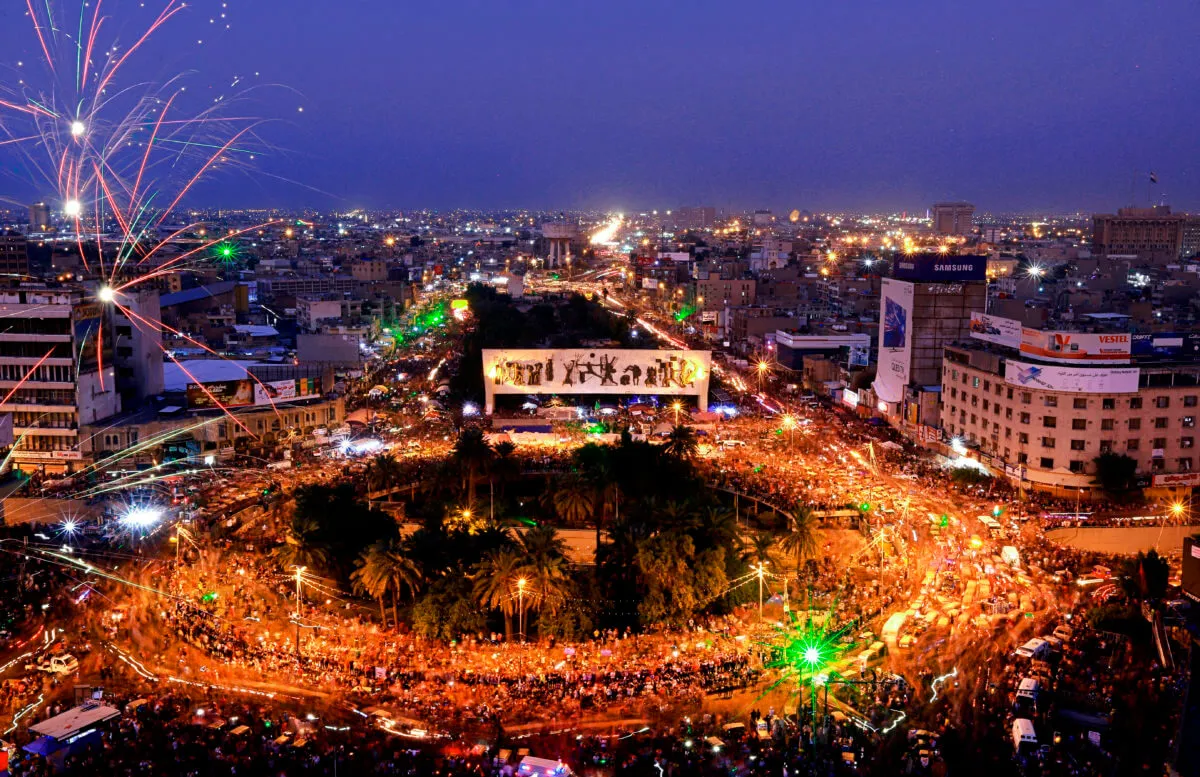
A protest camp in Baghdad’s Tahrir Square in October 2019. (Khalid Mohammed/AP)
The strict limits held by neoliberal thought have been on display during the contemporary moment of protest and revolt in the early 21st century. While the causes of uprising around the world ought be attributed to neoliberal policy, resulting in severe inequality, segregation, and deprivation, the popular dissent that has characterized the years since the 2008 global recession has been deradicalized, largely ignoring any proposals for reconfigured property relations or a fundamental redistribution of wealth and resources. This is not to say that no one or no organization who has participated in the protracted present of uprising has manage to think outside the limits of neoliberalism; the 2011 Egyptian uprising was split, “between systemic and antisystemic opposition groups,” but the victors in the intra-movement power struggles at large have been non-revolutionary elites who co-opt the movements conform to neoliberal strictures. A distinguishing trait of neoliberal capitalism as it spreads through the coercive forces of globalizing financial institutions is the proliferation of non-governmental organizations and the professionalization of political activism.
In the neoliberal era, professional advocacy groups and political elites nearly unanimously speak in the language of the post-World War II western framework of human rights. NGOs engage in work related to women’s rights, youth activism, development, and self-help, backed by international and corporate donors. This neoliberal human rights discourse certainly devotes attention to important issues, but inherently ignores any discussion of economic rights as human rights. Poverty reduction comes in the form of charity or microloans, while refusing to support economic rights such as the right to publicly-funded healthcare, the right for labor to collectively organize, or democratic control over corporate wealth and private industry. The discontent that fueled the 2011 Arab uprisings and the various movements around the world in this past decade can be attributed to neoliberal capitalism, but these uprisings have ultimately failed to articulate that reasoning in a united platform; a, “painful paradox… [of] revolutionary mobilization with a reformist trajectory.” Nearly ten years on from these rebellions, the outcomes in the regional Middle East and North Africa range from new articulations of old political structures to protracted, violent, civil conflict.
And yet, how has neoliberalism affected the way we relate to one another? It is perhaps the ubiquitous pervasiveness of neoliberalism into the most intimate forms of human relationality that has brought about a form of uprising that is not a social movement, but a social space. Almost as if it is in the state of exception, that is the uprising, that ‘the social’ can be realized. If we are inclined to borrow Agamben’s notion of the “state of exception,” and the eventual evolution of the ‘exception’ into the ‘rule,’ then perhaps, if we follow Hage in seeing the uprising as a social space that is realized only when there is an exceptional time of protest, this social space can be normalized and become the rule? In other words, perhaps it is the very unstructuredness and heterogeneity of the revolutions of the 2000s that allow them to speak back to neoliberalism and its pervasive individuating effects.
a form of uprising that is not a social movement, but a social space
If the “desire for the social” is in part a response to the atomizing effects of neoliberalism, how do recent uprisings attempt to undo these neoliberal subjectivities through use of public space? How do uprisings re-imagine social relations and subjectivities? Congregating is itself an act of coming together and a visible rejection of individuation. But the public spaces—parks, streets, sidewalks, buildings, walls, squares, traffic circles—used by the people in protest movements in Cairo, Beirut, Bahrain, Tunis, and so on, have arguably served as more than just the settings of uprisings.
Lefebvre and other scholars in recent decades have criticized the privatization of urban spaces. The “capital-based interests” of authorities, they denounce, result in the “loss of [the people’s] ownership” of public space. This lack of public space creates social fissures and severely limits participation in social and civic activities. In Cairo for instance, the state even before Mubarak neglected to invest in the neighborhoods and public spaces within the city, while the wealthy upper class relocated to private, gated communities. A lack of investment in sufficient housing, in the maintenance of streets and buildings, and a lack of public services such as waste management and clean water, compounded by surveillance and state-of-emergency laws, have prohibited access to and use of public spaces.
Beirut, as Ghassan Hage alludes to, has lost public spaces not to lack of investment, but to privatization. After the civil war, real estate developers and the joint-stock company Solidere bought up the city center and many of the city’s historic buildings that had been severely damaged during the war. These developers’ projects centered on the construction of new highways, modern architecture, private beach resorts, and high-end shopping streets. This commercialization of the city’s space and places of leisure in post-war Beirut’s downtown and coastal areas catered to Lebanese and international elites, rather than to the public.
The language of protesters in these and other cities evoke the sense “loss” that Harb articulates, as they aim to “reclaim” these spaces from the state, financiers, or private developers. In Taksim Square in Istanbul, Başak Ertür considers this rhetoric “something akin to a fantasy of ‘taking back Taksim’… as a driving force.” This notion of “taking back” the space “operates as if the square had once properly belonged to the people.” Ertür argues though that “it is that very as if that testifies to the entanglement of monumental spaces with political imaginaries that yields particular forms of spatial practices.” What then are the “spatial practices” that take place during uprisings? If the spaces themselves are tied to political and financial articulations of power, can the “taking back” of these spaces be read as an attempt to re-articulate and restructure the rules and norms of a state or society?

A graffiti artist paints a caricature of Prime Minister Saad Hariri during the 2019 uprising. ( Alexander Lerche / Al Jazeera )
Whether gathering in Taksim Square, in Tahrir Square, in the streets of Beirut, or writing and painting on the walls of these and many other cities, the protesters made themselves visible, saying and showing that “we are here.” As these gatherings persisted over the course of days and weeks, these protesters also began to practice new ways of living, interacting and being. People of different sects, economic backgrounds, organizations and ideologies, who normally would not have crossed paths, encountered each other and interacted daily in these spaces in new ways. Cooking, offering medical care, creating art and music, engaging in discussions, cleaning, prayer and other daily rituals took place communally. “This new art of living together, of experimenting with different forms of politics, sociality and being, exemplifies what Greene termed ‘accents of protest’ in relation to viewing places themselves as ‘rhetorical tactics in movement towards social change.’”
This communal living perhaps created “social spaces” where people were able to enact alternative social relations and imagine new political horizons during the days of uprising. The realization of new “social spaces” often did not materially endure, though. These sites, whether in Bahrain, Cairo, Tunis, Athens, or Washington, DC, become targets of the state: by barricading, transforming or destroying the physical sites themselves, the state counters these movements and attempts to reassert its power.
Regardless of the fate of the sites themselves, what happens when the protesters leave these spaces? Is this “art of living together” confined to the square and to the particular moment of uprising? Whether or not these new “social spaces” endure, can the realization of these new imaginaries persist even after the protesters are forced to return to their daily lives, which are still often structured by the same neoliberal frameworks they sought to dismantle?
One of the principal tasks faced by scholars analyzing the global uprisings of the present is to develop a way of discussing the commonalities between them without flattening their particularistic demands or positions. While the local contexts of many of the uprisings discussed in the event vary drastically, there seemed in many cases to be common languages, demands, aesthetics, historical perspectives (or rejections of historical determinism), and in some cases even a shared notion of the “global” spaces they inhabit. Such broad questions are difficult to approach without falling prey to a reductive essentialism. And yet, to focus on the different uprisings merely from a comparative standpoint misses the mark by failing to recognize the ways that uprisings and those who participate in them are always already in conversation with other uprisings, present or past.
always already in conversation with other uprisings, present or past.
Of the approaches to these questions, one which was picked up and expanded upon by the panelists and discussant was the idea of inheritance. First mentioned in the talk by Ghassan Hage, inheritance may serve as one entry point into discussions about commonality, geographic scale, and historicity in the time of revolt. But even as it keys us into continuities and commonalities in some places, in others it highlights ruptures and disjunctures. Hage, throughout his work, has a tendency to take tried and tested anthropological concepts and reinvigorate them with a new sort of propulsive power by throwing them into vastly different contexts. His invoking of “inheritance” in the event is one example of this. Inheritance is often assumed to be synonymous with lineage or genealogy, and in this sense can sometimes resemble deterministic teleologies. Writing on the historical straitjacketing of the 2011 uprisings in the Middle East and North Africa, Behrooz Ghamari-Tabrizi details how media commentators for years had tried to craft a discourse around the “Spring” of the Arab world, evocative of the “‘Spring Time of Nations’ in Europe of 1848, Prague Spring of 1968, or Eastern Europe of 1989.” “By naming it the ‘Arab Spring,’” Ghamari-Tabrizi argues, “the uprisings entered a conceptual and discursive universe with a written past and a known future direction.” Such narratives not only pigeonhole these movements, but can also force particular assumptions about who the subjects of these revolutionary movements are to begin with. Despite the social composition of protesters in Lebanon crosscutting class, nationality, or faith, many analyses expunged particular groups from these broad-based coalitions. In a recent Tweet, Mezna Qato noted, “So jarring, but maybe unsurprising, how much unanimity there is in Lebanese popular uprisings as beginning on 17 Oct 2019. As if the uprisings in the [Palestinian] camps that summer, in July, were in another country, another world. As @Hana_Sleiman points out, the non-citizen erased, again.”
However, as Hage noted, inheritance is never quite as stable or all-encompassing as it is often assumed to be. Rather, it is something that can be accepted, rejected, or “negotiated.” What would it mean, then, for uprisings to link themselves to historical conjunctures, geographic locales, or aesthetics and signs other than those accorded to them by commentators–or by History itself? To continue with Ghamari-Tabrizi for a moment, this seems to be exactly what drew Foucault’s interest to the men and women agitating for change during the 1979 Iranian Revolution:
Foucault highlighted in Iran the struggle of a nation asserting itself for both an inclusion (in making history) and an exit (from terminal history). He conceived the indeterminacy of the revolutionary movement in Iran as a possible source of creativity and inspiration rather than an expression of backwardness finally unleashed forward toward progress.
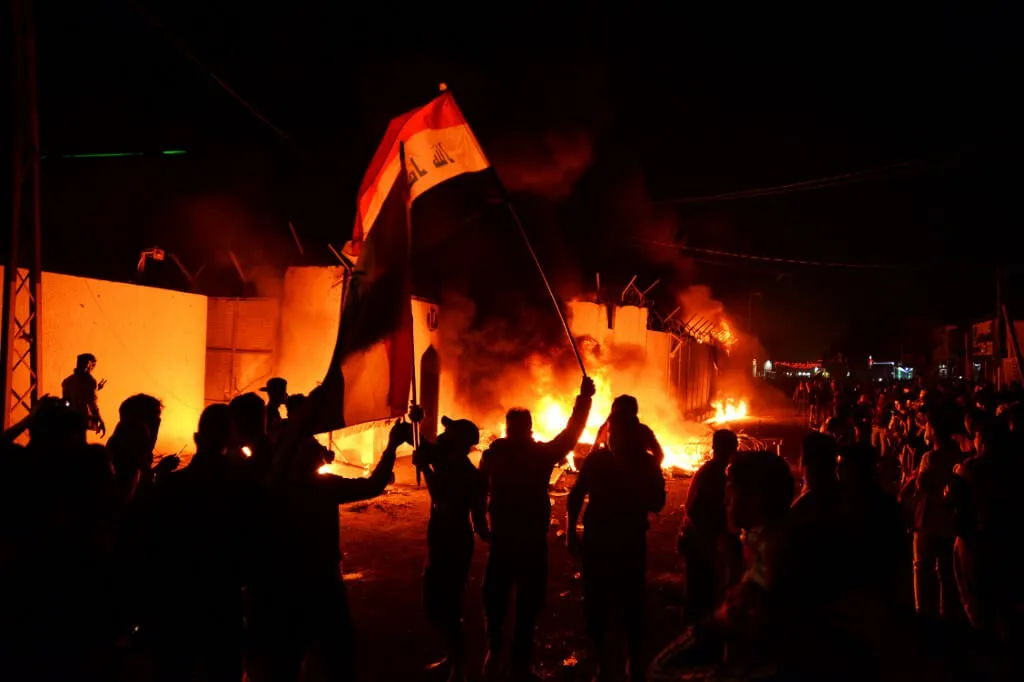
Anti-government protesters gather as the Iranian consulate in Najaf, Iraq burns in October 2019. (AFP)
In short, it is the idea of indeterminately negotiating a historical inheritance which Foucault found most striking. The challenges that these types of movements posed to the contemporary exigency of classification, of establishing historicity, can be seen too in Alberto Toscano’s comments on the idea of the riot. In refusing to articulate a particular set of demands, riots instead serve as impromptu phenomena responding with immediacy to a need for action. Defying the expression of a common platform or an inauguration into History, they can be seen as inherently “anti-strategic” but can be said to pose challenges to teleologies as well, by temporarily suspending history. But do riots not have a history of their own? Are they not in conversation with other spontaneous agitation both past and present?
The spontaneity of “riots” and their associated exceptionalism as episodes rather than sustained, organized movements complicate how they’re inscribed into history and how their inheritance might be negotiated. As Toscano suggests, “riots” have contested, racialized legacies, as evidenced in American history. Riots and rebellions of colonial settlers against the British monarchy are interpreted within a history of American might, bravery and patriotism. The violent riots in response to the Stamp Act in the American colonies in 1765, for instance, are remembered as actions that lead to American liberty from the British. Black Americans striving for liberties, though–whether during the American Revolution, the 1967 Detroit riots, or the Black Lives Matter (BLM) protests since 2014–are smeared as “looters” or “thugs.” In an article about the BLM protests from summer 2020 in The Atlantic, historian Kellie Carter Jackson contends that “Freedom through violence is a privilege possessed only by whites. Seminal moments in U.S. history that historians have defined as patriotic were also moments that denied patriotism to black people.” Writing about George Floyd, Breonna Taylor, and Ahmaud Arbery, and the BLM protests within the framework of rebellions during the American Revolution for American freedom challenges how legacies of riots and revolution are framed, and how these frameworks can be negotiated depending on one’s positionality.
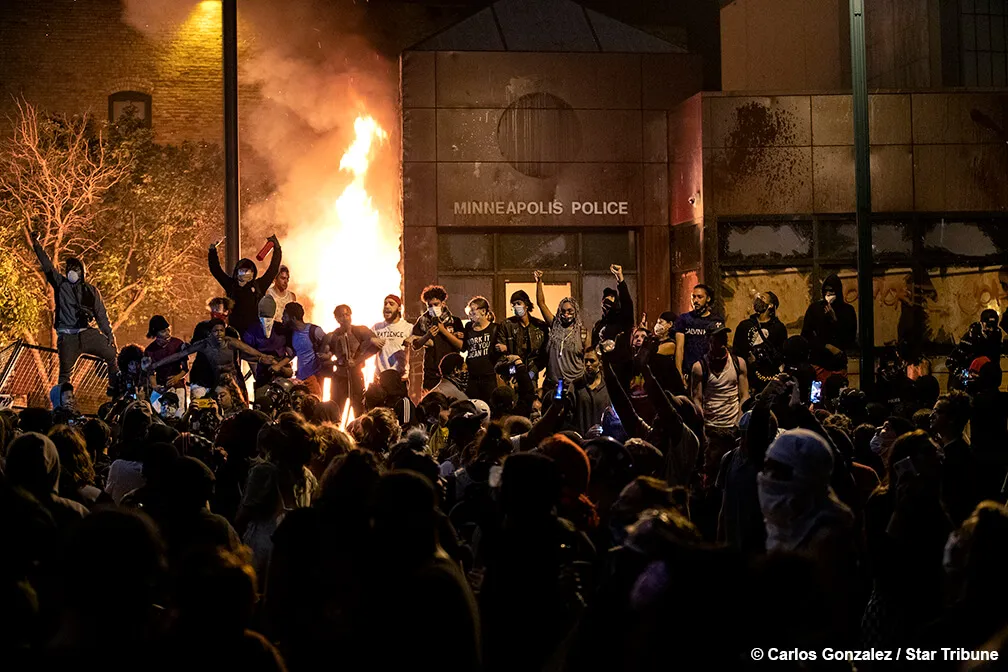
Demonstrators gather outside the burning Minneapolis 3rd Precinct on May 28, 2020 during protests against the police killing of George Floyd. ( Carlos Gonzalez/Star Tribune )
Regardless of a movement’s spontaneity, duration or ideological platform, riots, uprisings, movements, etc. all have multiple historical “reference points” as Lisa Duggan asserts. Depending on the historical lens we choose as the filter of our scrutiny, an uprising’s temporality and legacy can shape-shift. Even though the BLM movement is an organization with a coordinated, nation-wide network, the protests that spread across the US this past summer following the death of George Floyd hold different temporal and historical implications and draw on different sources of inspiration depending on one’s positionality. The Salvage Editorial Collective points to these concurrent temporalities: on one hand, the summer 2020 wave of protests might be viewed as a culmination of years of other local and national BLM uprisings since the August 9, 2014 killing of Michael Brown and demonstrations in Ferguson, MO. George Floyd’s death and the subsequent protests might be read in this case as a tipping point or a turning point toward broader support for concrete policy changes, as banning chokeholds or support to defund police departments have gained traction. On the other hand, the summer 2020 protests across the country marked the “sudden explosion of ‘allyship’” of white Americans. “But what of motive?” the Salvage Editorial Collective asks. Were those participating for the first time in BLM protests in 2020 drawing upon the same reference points, the same inspiration as those who had been organizing and demonstrating for the end of police brutality and racial inequality for years already? Did they, as the article also asks, demonstrate now simply because of the free time allotted to them or new arising concerns due to the pandemic shutdowns? How will these temporalities and reference points get periodized into a longer historical narrative? What are the risks of these varying perspectives or inconsistent temporalities? How do the histories and legacies of uprisings get negotiated and deployed strategically, to serve a particular aim, or even preclude the same event being inherited by multiple actors?
Accepting or refusing inheritance is not always a unidirectional pursuit. States or other counterrevolutionary agents fending off powerful social movements will often seek to intimate certain historical and ideological genealogies in order to discredit or delegitimize their opponents. Those on the American right who wish to raise the specter of “left-wing antisemitism” are quick to note Black Lives Matter’s allegiances to the Palestinian struggle as the expression of a conflated anti-zionism-cum-antisemitism. Elsewhere, Toscano and Nina Power have also highlighted former French President Nicolas Sarkozy’s amalgamating the protests of the European left in 1968 with the 2005 rioting of young banlieusards decrying police brutality. In one turn of phrase, he simultaneously excises both uprisings from state sanctioned readings of French history: “‘In this election,’ Nicolas Sarkozy proclaimed in 2007, ‘we’re going to find out if the heritage of May ’68 is going to be perpetuated or if it will be liquidated once and forever.’”
Indeed, the strategic deployment of inheritance is often within the purview of counterrevolutionary forces, chief among them the state. As forces positioned against the revolution, the state and its ruling class use inheritance in two ways: through family descendants and through the military’s institutional memory. The former can be observed in Syria, Bashar al-Assad inherited power from his father, Hafez al-Assad; in Lebanon, Jumblatt (Progressive Socialist Party), Franjieh (Marada Movement), and Hariri (Future Movement) each inherited party power from their fathers; in Iraq, al-Sadr inherited a popular movement from his grandfather. Here, inherited family legacy functions as a tool for legitimizing the state, when its institutions by design are unable to provide the legitimacy to rule. The latter can be seen in Egypt, Sudan, and Algeria, where the military has a monopoly of violence independent of the countries’ civil leadership. The military thrives on its historical inheritance and fights vigorously again any change that could threaten its position in power. Building on both power and legacy, the army here acts as if it is above the government, producing itself as a ruling class.
It is worth asking, too, what the drawbacks of a concept like inheritance might be in a discussion of commonality and rupture. Is it possible that such a concept places too much of an emphasis on the temporal lag between movements to the extent that it glosses over shared language and aesthetics which appear contemporaneously? What does such a deference to historical thought do to our thinking about the present? In temporal terms, these uprisings keep bubbling to the surface in different states of motion and of time, in that sense, these uprisings–although they commonly reject the inherited status quo–speak to common present circumstances and not just common histories. This applies to the seizure of space from Chile, to Peru, to Belarus, to Nigeria, to Lebanon, to Sudan, and the United States which each have their own local issues but, facing the effects of a global neoliberal order, have some resonance between them too; inheritance could help us comprehend the reasons and causes behind uprisings.
The title of this event was, “The Protracted Present of Uprising.” This requires some decryption. With this present of global uprising, there is a parallel global authoritarian, reactionary backlash. Dynamic authoritarian regimes are able to maintain their positions by containing the power of the uprisings. It is essential to diagnose symptoms of global counterrevolution.
With this present of global uprising, there is a parallel global authoritarian, reactionary backlash
As we approach the 10th anniversary of the 2011 Arab uprisings, we should revisit what has happened since Bouazizi burned himself alive in protest of economic inequality and state repression; his body was not the patient zero that the many observers and analysts consider him to be. He was the hair that broke the back of the camel, the structural and root causes of popular discontent were growing long before Bouazizi’s defiant protest. Ten years later, political, economic, and social circumstances across the Middle East and North Africa hold the people in a precarious position; the continuation of protests signals that the demands of the people have not yet been met. The state, initially trembling before the might of the people, has now digitally and aesthetically rebranded itself while becoming more robust and brutal than ever. Nonetheless, the motivation to protest continues to filter across the region.
Beyond the question of state resilience and the perseverance of demonstrators, we would like to think about what happens when the protester goes home. What happens when we return from the demonstration and go back to our daily lives? What remains of the uprising after we are subsumed back into our jobs, our school work, our mundane lives within this neoliberal capitalist global order?
Abaza, Mona. “ An Emerging Memorial Space? In Praise of Mohammed Mahmud Street .” Jadaliyya . 2012.
Azhari, Timour. “ As protests grow, Lebanese are ‘reclaiming’ public spaces .” Al Jazeera . 2019.
Azoulay, Ariella. “Revolution,” in Political Concepts: A Critical Lexicon . 2012.
Azoulay, Ariella. “ Revolution Is A Language: A lecture ” (2012). YouTube. 2013.
Badiou, Alain. “ Tunisie, Egypte : quand un vent d’est balaie l’arrogance de l’Occident .” Le Monde . 2011.
Bargu, Banu. “ Bodies against War: Voluntary Human Shielding as a Practice of Resistance .” AJIL Unbound. 2016.
Bargu, Banu. Starve and Immolate: The Politics of Human Weapons . 2014.
Bargu, Banu, ed. Turkey’s Necropolitical Laboratory: Democracy, Violence, and Resistance . 2019.
Bayat, Asef. Revolution without Revolutionaries: Making Sense of the Arab Spring . 2017.
Bertho, Alain and Joseph Confavreux. “‘ It’s not just a social movement’: An Interview with Alain Bertho. ” Verso Blog . 2018.
Butler, Judith, Gambetti, Zeynep, and Sabsay, Leticia (eds.). Vulnerability in Resistance . 2016.
Clover, Joshua. Riot. Strike. Riot: The New Era of Uprising . 2019.
Davidson, Mark. “ Editorial: Private is profit and the public is dead? ” City. 2018.
Elyachar, Julia. “ Writing the Revolution: Dilemmas of Ethnographic Writing after the January 25th Revolution in Egypt .” Jadaliyya .
Faleh, Majdi, “ How city squares can be public places of protest or centres of state control .” The Conversation . 2018.
Firat, Begum Özden. “ Patterns of Revolt: On Global Uprisings and Revolutionary Imagery. ” Quaderns de la Mediterrània. 2018.
Ghamari-Tabrizi, Behrooz. Foucault in Iran: Islamic Revolution after the Enlightenment . 2016.
Gordon, Joel and Heba Arafa. “’ Stuck with Him’: Bassem Youssef and the Egyptian Revolution’s Last Laugh. ” Review of Middle East Studies . 2014.
Gordon, Neve and Nicola Perugini. Human Shields: A History of People in the Line of Fire . 2020.
Hage, Ghassan. Alter-Politics: Critical Anthropology and the Radical Imagination . 2015.
Halliday, Fred. Revolution and World Politics: The Rise and Fall of the Sixth Great Power . 1999.
Harb, Mona, “ Why Space Matters in the Arab Uprisings (and Beyond) .” Jadaliyya. 2017.
Harvey, David. A Brief History of Neoliberalism . 2005.
Hracs, Brian J. and Massam, Bryan H. “ Places/Spaces of Celebration and Protest: Citizenship, Civic Conversations and the Promotion of Rights and Obligations .” Canadian Journal of Urban Research . 2008.
Lindblom, Charles. “ The Market as Prison .” Journal of Politics. 1982.
Lisiak, Agata. “ The Ballerina and the Blue Bra: Femininity in Recent Revolutionary Iconography .” View. Theories and Practices of Visual Culture. 2014.
Mouffe, Chantal. “ Artistic Activism and Agonistic Spaces .” Art&Research: A Journal of Ideas, Contexts and Methods. 2007.
Nazzal, Maryam and Chinder, Samer. “ Lebanon Cities’ Public Spaces .” The Journal of Public Space. April 2018.
Naeem, Hani. “ Graffiti and the Arab uprising - Culture & Dialogue .” Trans. Robin Moger. Heinrich Böll Stiftung . 2013.
Perry, Tom. “ Towering gates at Cairo’s Tahrir Square draw criticism .” Reuters . 2014.
Power, Nina and Alberto Toscano. “ The Philosophy of Restoration: Alain Badiou and the Enemies of May .” boundary 2. 2009.
Stacher, Joshua. Watermelon Democracy: Egypt’s Turbulent Transition . 2020.
Werbner, Pnina, Webb, Martin, and Spellman-Poots, Kathryn (eds.). The Political Aesthetics of Global Protest: The Arab Spring and Beyond . 2014.
Winegar, Jessica. “ Taking Out the Trash .” Middle East Report . Summer 2011.
Denning, Michael. “ Wageless Life .” New Left Review . 2010.
Tiqqun. “ Let’s Disappear .” Extract from To Our Friends . 2015.
Salvage Editorial Collective. “ Burn it all Down .” 2020.
“ Mohamed Bouazizi .” Wikipedia.
Lageman, Thessa. “ Mohamed Bouazizi: Was the Arab Spring worth dying for? ” Aljazeera . 2016.
“ Loujain al-Hathloul .” Wikipedia.
“ Prominent Saudi women's rights activist on hunger strike in detention, says family. ” Reuters. 10/27/2020.
Joshua Clover, Riot. Strike. Riot: The New Era of Uprising (New York: Verso, 2019).
Ibid.
See the YouTube video of this event at the top of the page.
Charles, Lindblom “The Market as Prison,” Journal of Politics Vol. 44(2) (1982): 334.
Asef Bayat, Revolution without Revolutionaries: Making Sense of the Arab Spring (Stanford, CA: Stanford University Press, 2017), 23.
Joshua Stacher, Watermelon Democracy: Egypt’s Turbulent Transition (Syracuse, NY: Syracuse University Press, 2020), 124.
Bayat, 25.
Bayat, 154.
Agamben
Mark Davidson, “Editorial: Private is profit and the public is dead?” City , vol. 22:3, 2018:313-320.
Mona Harb, “ Why Space Matters in the Arab Uprisings (and Beyond) ,” Jadaliyya. Feb 16, 2017.
Ibid.
Jessica Winegar, " Taking Out the Trash ," Middle East Report , 259 (Summer 2011).
Başak Ertür, “Barricades: Resources and Residues of Resistance,” in Vulnerability in Resistance , edited by Judith Butler, Zeynep Gambetti, and Leticia Sabsay, 105-106. Durham, NC: Duke University Press, 2016.
Hanan Sabea, “‘I Dreamed of Being a People’: Egypt’s Revolution, the People and Critical Imagination,” In The Political Aesthetics of Global Protest: The Arab Spring and Beyond . Edited by Pnina Werbner, Martin Webb and Kathryn Spellman-Poots. Edinburgh, UK: Edinburgh University Press (2014). 79.
Ertür, “Barricades: Resources and Residues of Resistance,” 109; Sabea, “‘I Dreamed of Being a People’: Egypt’s Revolution, the People and Critical Imagination,” 83-84.
Hanan Sabea, “‘I Dreamed of Being a People’: Egypt’s Revolution, the People and Critical Imagination,” In The Political Aesthetics of Global Protest: The Arab Spring and Beyond . Edited by Pnina Werbner, Martin Webb and Kathryn Spellman-Poots. Edinburgh, UK: Edinburgh University Press (2014). 78.
See also: Ghassan Hage, “Academia in the Revolution,” Lecture, Beirut, 2019; Ghassan Hage “The Arab Social Sciences and the Two Critical Traditions,” in Alterpolitics: Critical Anthropology and the Radical Imagination (Melbourne: Melbourne University Press, 2015).
Behrooz Ghamari-Tabrizi, Foucault in Iran: Islamic Revolution after the Enlightenment (Minneapolis: University of Minnesota Press, 2016), 2.
Ibid.
Mezna Qato, Twitter post, November 3, 2020, 4:03 PM.
Behrooz Ghamari-Tabrizi, Foucault in Iran: Islamic Revolution after the Enlightenment (Minneapolis: University of Minnesota Press, 2016), 3.
See also: Joshua Clover, Riot. Strike. Riot: The New Era of Uprising (New York: Verso, 2019).
“ Liberty! Chronicle of the Revolution: The Stamp Act Riots & Tar and Feathering ,” PBS online, 2004.
Kellie Carter Jackson, “ The Double Standard of the American Riot ” The Atlantic . June 1, 2020.
Ibid.
Salvage Editorial Collective, " Burn it all Down ," June 19, 2020.
Ibid.
Nina Power and Alberto Toscano, “The Philosophy of Restoration:Alain Badiou and the Enemies of May,” boundary 2 36:1 (2009): 27.
Alternatively, for Gadafi in Libya and Saleh in Yemen, uprisings blocked this family inheritance project.
Since the Arab Spring, the protests and dissent have only become more audio-visually mediated with an instantaneity and ubiquity that is never merely ‘formal.’ The mediation and the aesthetics are in many ways also the uprisings themselves. What types of imagery are being captured, circulated, and remade in these moments of conflict—and how do they travel from one site of conflict into others around the globe? What devices, channels of communication, and infrastructures allow and/or impede such exchanges? What sort of visual logics of dissent are emerging across the world through digital practices? How is it changing form - lending itself as material for memes, slogans, and graffiti—but all the while changing one’s view of participation, agency, and belonging? Here, we consider the digital junctions of aesthetics and protest - mediated by a capture, circulation, and reconfiguration that spans the globe.
Amal Khalaf is a curator and artist and currently Director of Programmes at Cubitt, London and Projects Curator at the Serpentine Galleries , London where she has worked on the Edgware Road Project since its inception in 2009.
An Xiao Mina was an affiliate researcher at the Berkman Klein Center for Internet and Society and a 2016 Knight Visiting Fellow at the Nieman Foundation for Journalism, where she studied online language barriers and their impact on journalism.
Rebecca Stein is an Associate Professor of Cultural Anthropology at Duke University researching linkages between culture and politics in Israel in the context of the Israeli military occupation and legacy of the Palestinian dispossession. She is the author of Digital Militarism: Israel's Occupation in the Social Media Age (co-authored with Adi Kuntsman; Stanford University Press, 2015), which studies the ways that social media has altered the Israeli relationship to its military occupation, in both state and civilian contexts; Itineraries in Conflict: Israelis, Palestinians, and the Political Lives of Tourism (Duke University Press, 2008) which considers the relationship between tourism, mobility politics, and the Israeli-Palestinian conflict (to name a few)
Nicholas Mirzoeff is a visual activist, working at the intersection of politics and global/digital visual culture.
Part of the Fall 2020 course Problems and Methods in Middle Eastern StudiesA joint Digital Forays and Global Uprising event
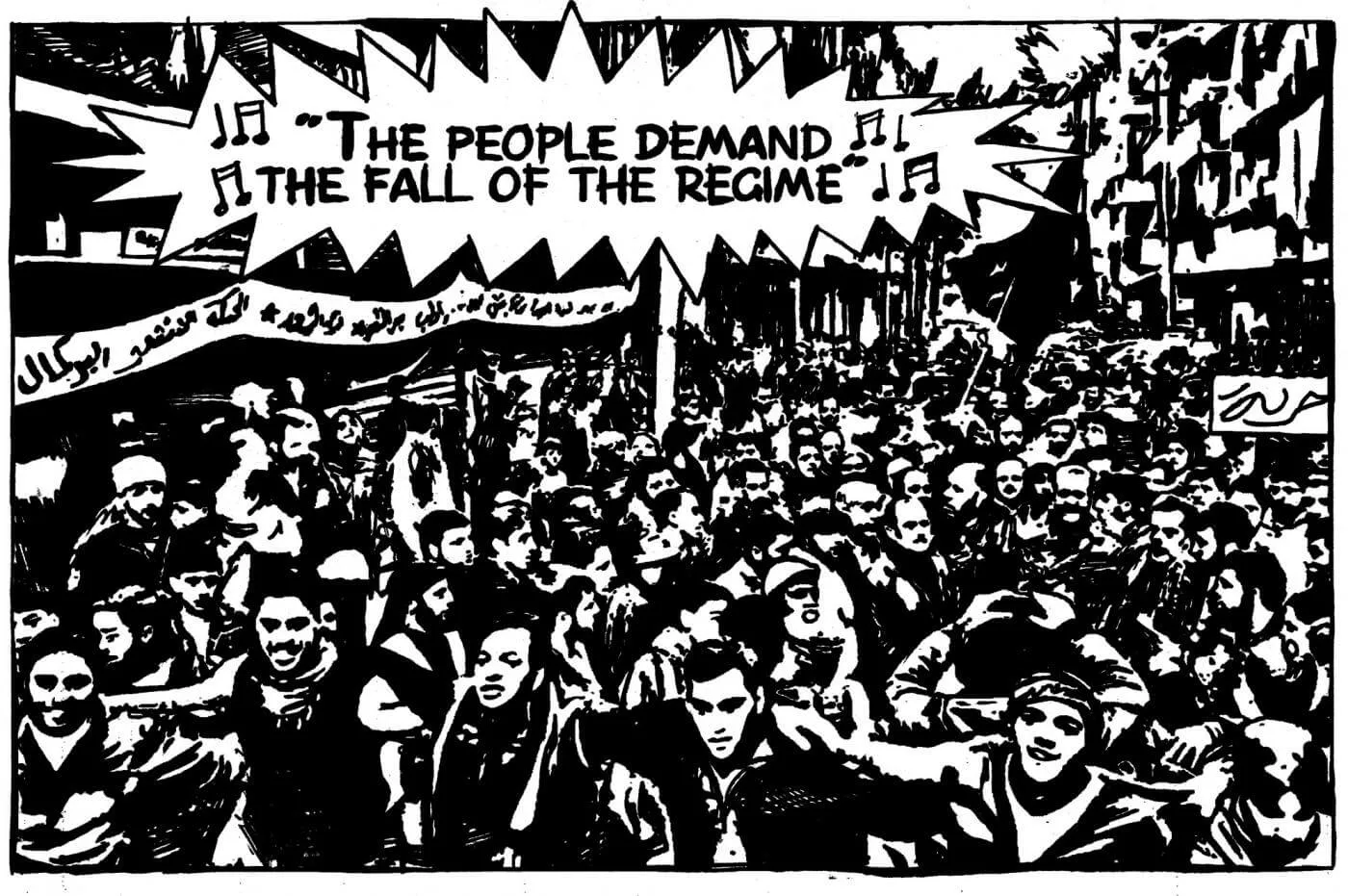
A panel from Syrian illustrator and comic book writer Hamid Sulaiman’s Freedom Hospital. (Source: Hamid Sulaiman/Jonathan Cape/ Middle East Eye )
Inspired by the Kevorkian Center’s Aesthetics of Digital Dissent , this extension uses a selection of images to explore the way that protests have been visually documented, as well as the way protest aesthetics have been replicated and co-opted by various actors. Like public space, digital space is not really public, nor is it “neutral,” and the overlapping modes of power that precede the creation and circulation of an image, and that shape the iterations that an image takes on upon its virality, often represent privatized or localized interests.
Nicholas Mirzoeff drew our attention to the state’s ability to reinforce its violence through the appropriation of the very tactics created and implemented by radical social movements. This appropriation is persistent in the realm of visual culture: from protest signs, memes, and Twitter graphics to corporate advertisements. If visual culture is not outside the operations of state violence, it should then be placed within a theoretical framework that interrogates it. While techno-optimism—in its inability to see state violence and the workings of capitalist accumulation—does not offer the necessary framework for understanding visual culture, neither does a model of techno-pessimism that maintains its own short-sightedness; namely an inability to wield visual culture in a way that furthers a radical agenda against the ongoing enclosure of public space, whether those spaces be material or digital. With this in mind, this extension aims to move beyond the binaristic model of techno-optimism and techno-pessimism by drawing inspiration from Amal Khalaf’s discussion of magic, sorcery and spells.
In expanding Marx’s theory of primitive accumulation, Sylvia Federici writes about the systematic violence against women that accompanied capitalism’s development . Social relations were not merely re-arranged and the commons were not merely enclosed; torture, witch hunts, colonization, witch trials, and sexual violence were all foundational to the process of producing subjects “in the image of capital.” The world is continuously being re-made and re-formed in this image. While female sexuality was “exorcised,” in that it was removed from the context of subversion and re-shaped to work in the interests of capital, the imperial state and other repressive formations approach contemporary radical efforts against enclosure by exorcising and appropriating them, or outright suppressing and eliminating them. In this extension we take up “exorcism,” not as an accompaniment to enclosure and appropriation, but as a strategy of exorcising the motives and meanings embedded in images. By displacing images from interpretations that enact violence and co-option we reconsolidate them within their larger histories, with an eye towards what may be made in common.
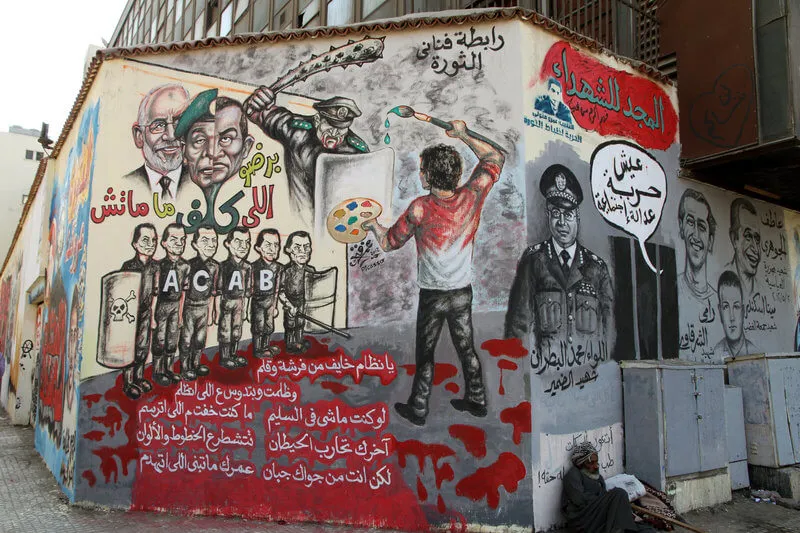
A protest mural at the intersection of Muhammad Mahmud Street and Tahrir Square in Cairo. (Source: Arab American National Museum/ NPR )
The images we exorcise stem from the United States, Southwest Asia, and North Africa. By grounding the conversations presented in various locations, we question what it means to be “polycentric,” as discussed by Ella Shohat and Robert Stam, in the contemporary moment. Without underestimating the importance of international power disparities, or attempting to divorce them from the ongoing conversation, we are interested in the implications of the digital sphere for the “center,” however it is defined. Rethinking polycenters in conversation with the rapidly developing digital present means complicating the “center” beyond geography and toward a more sociopolitical understanding of the weight of both the digitalscape and the participation of various audiences and mobilizers.
Each section in this piece was written by a different person with the exception of the introduction, which was written in collaboration. Accordingly, each section has a distinct voice. Some have more questions than answers while others found footing vice versa. We invite you to read the sections in whichever order you like as we found different sequences to not necessarily be more fluent than others but rather emphasize alternate notes of the assemblage. Ultimately, we find our harmony in carrying a conversation about the relationship between reality, memory, and digital scapes. We encourage you to read these exorcisms as preliminary considerations toward a myriad of perspectives developing and unsettling themselves with every keystroke and click.
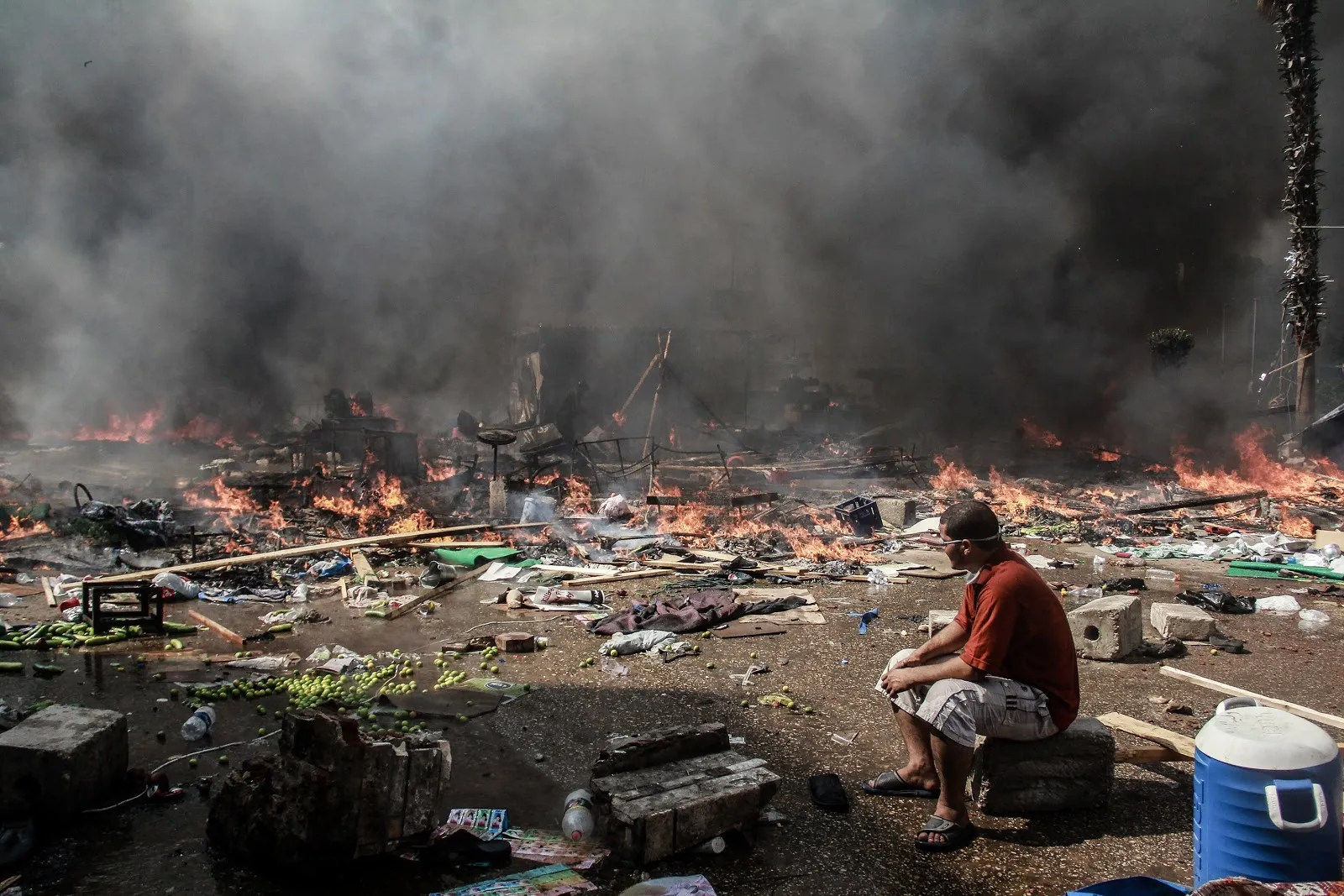
A man sits amidst burning tents in the aftermath [of Rabaa]. (Source: Mosa’ab Elsham/ Time Magazine )
Just over two years after the Rabaa massacre, the square was renamed Midan el Shaheed Hisham Barakat. The announcement came shortly after Barakat’s assasination, on the tails of other manipulations of the square and cleansing of its history: an abstract sculpture that represented the unity of the military, the state, and the people was placed in the intersection; the burned mosque was freshly painted and gated off, indefinitely closed to the public; the roads were smoothed over. Less than a year later, the name of Rabaa al Adawiya mosque itself was also changed to El Shaheed Hisham Barakat. The new names have not stuck, but the specter of Hisham Barakat, the only presence in Rabaa allowed to be a martyr, continues to haunt Egypt.
In August of 2013, what seemed like the worst that the military regime could be capable of was brutally on display at Rabaa. This was the moment when I realized that the worst was soon to become a presence in daily life. The vestiges of the triumphant occupation of Rabaa are just decipherable in this photograph. Cucumbers and lemons that came from one of the many stalls and carts that fed the occupiers are strewn on the ground. Water bottles, clothing, plastic bags, and single use packets of shampoo trace the comings and goings of protestors and what was abandoned in the struggle. The goggles the man in the foreground wears are a reminder of the feeble attempts of protestors to prepare after hearing warnings of impending forcible removal. In truth no one could have prepared for this regime unless we took seriously the absurdity of notions of progress and revolution.
The violence of the military regime was incarnated after Rabaa in the body of Hisham Barakat. Through him, as the judiciary arm of the regime, thousands of dissidents were detained and many were put to death by the state. As I struggle to decipher something through the smoke that looms over this photograph, I imagine it taking on the shape of Hisham Barakat. I cry out to warn this man in goggles that the smoke burning his eyes will remain shrouded over Rabaa, that it had already spread across the country. Even beyond the grave, Barakat is a medium for state violence. Not content with the corporeal violence inflicted on protestors on August 14, the state carried out a cleansing and renaming of public space, followed up by a continuous threat of imprisonment, detention on any grounds, military trials, social media searches, and sudden disappearances.
But there is another spirit implicated in this story, that of Rabi’a al-Adawiyya, for whom the mosque was originally named. Rabi’a, a medieval Muslim woman from Basra, is a Sufi saint who is said to have championed devotion through pure love of God, rather than worship through fear of punishmentor reward. Her spirit was a threat to the regime and Barakat’s name was dispatched to eliminate it.
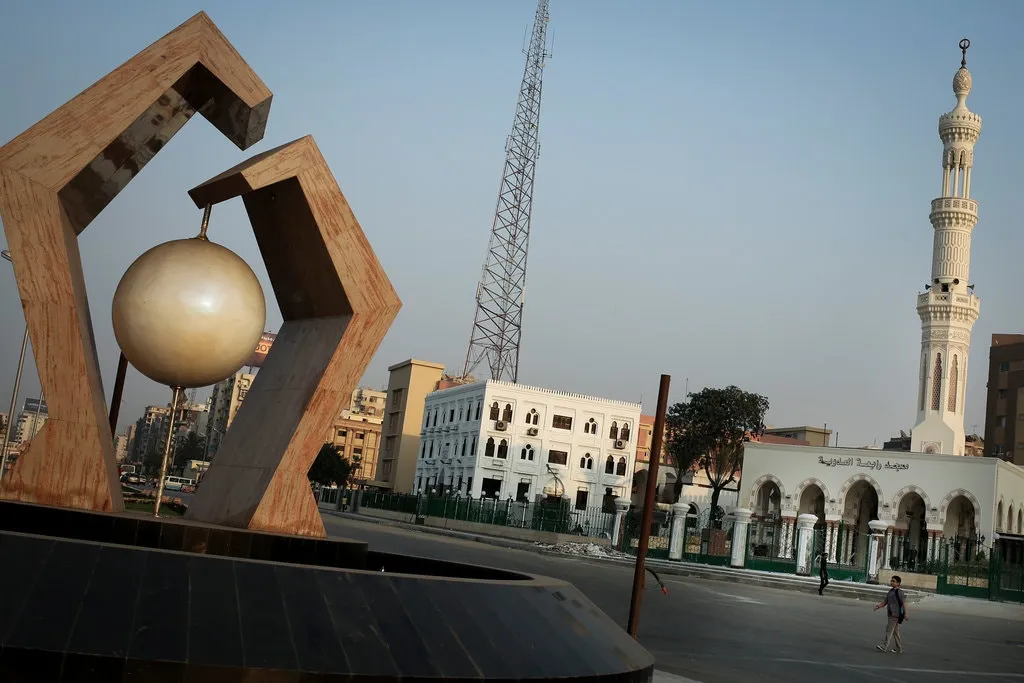
The 2013 renovation and erasure of Rabaa (Source: Tara Todras-Whitehill/ The New York Times )
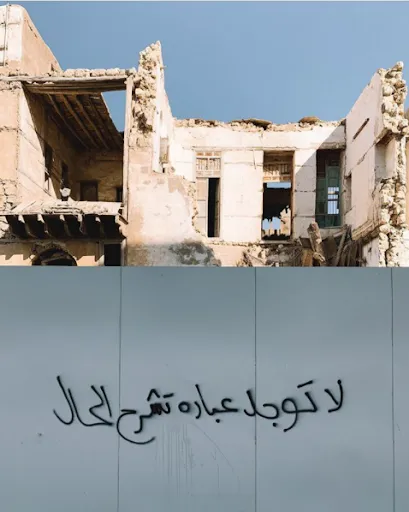
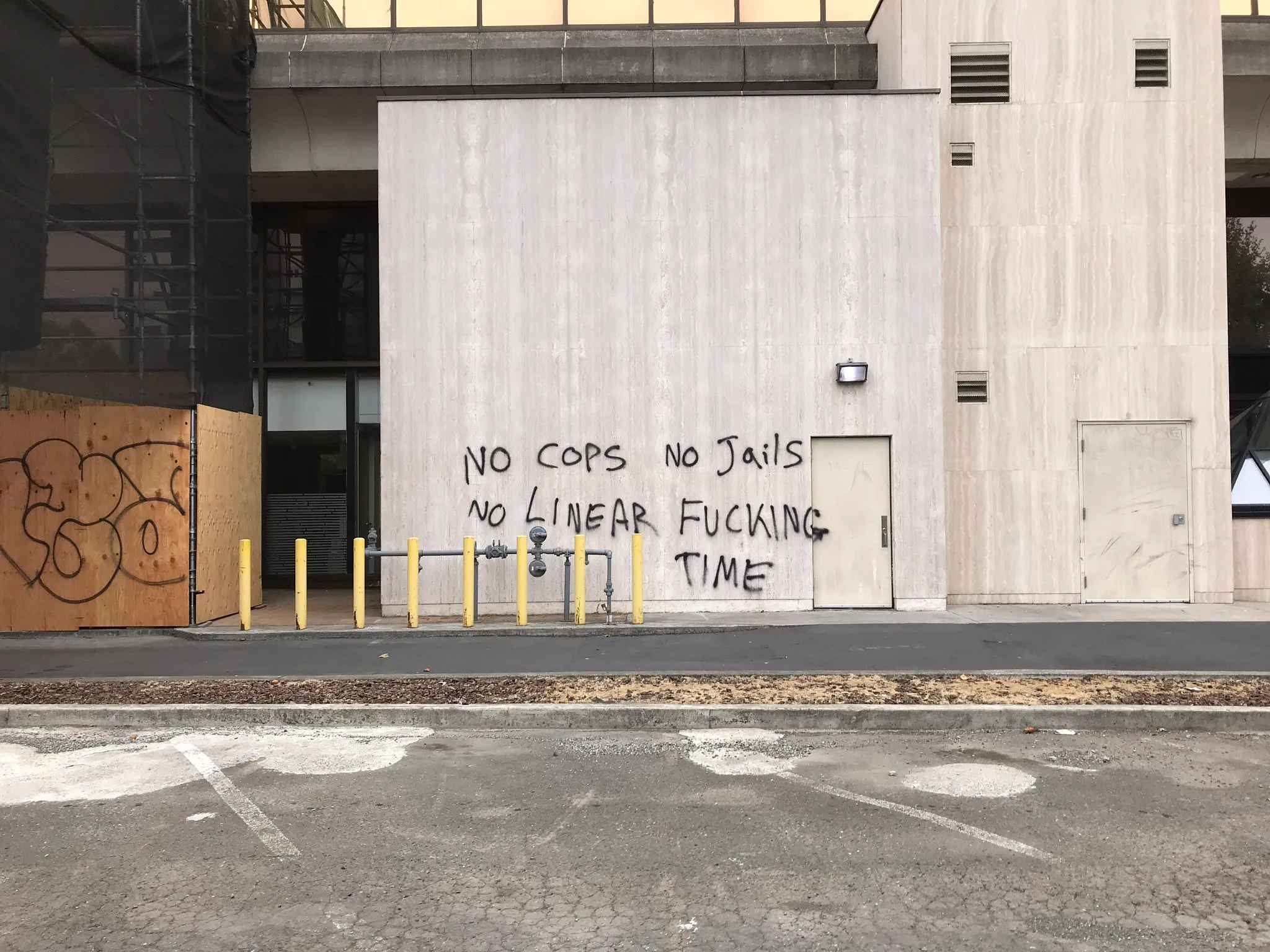
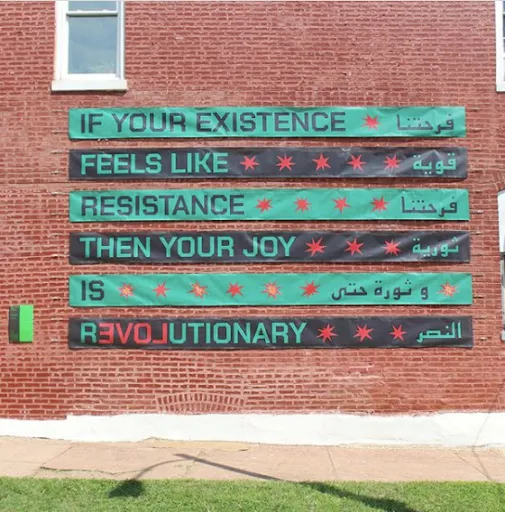
From left to right: Graffiti in Saudi Arabia translates as: “There is no expression that explains the situation/circumstances” (Source: Ahmad Alqahtani/Instagram ); Graffiti (Source: Esmat Elhalaby/Twitter ); A sign in south St. Louis, with Arabic reading: “Our joy is power, our joy is revolutionary, and revolt/revolution until victory” (Source: Kiki Salem/Instagram )
Street art and slogans are bastardized by the state to become transient missteps in a tailored reality. Walls—and public space in general—are supposed to be decorated “appropriately,” in compliance with the image the state curates for itself. Equally as significant, public space can be decorated but not claimed. Space can be pretty, but it cannot be disruptive. Even when they can be pretty, they must be a particular type of pretty that is pleasurable to the “public,” meaning the privileged. Aware of such, neoliberalism creates art that claims to be progressive, revolutionary even! Yet it still operates within the permitted realm; for instance, “girlbosses” and the politicians that embody the idea are touted as emblems of rebellion when they do not actually change anything but the face of power.
As you are reading, I hope you realize what I have realized in the process of writing: there are so many caveats to what is allowed into popular space and conception that the state and its accomplices tailor a particular reality. Living in conditions out of bounds thereby segments life in such a way that existing unashamedly constitutes a significant disruption—what many would consider everyday revolutions. Consequently, it tracks for the state and its accomplices to obscure undesirables out to be almost supernatural.
After all, how do you act when you are no longer real? What credibility does a voice that only comes through in seances under the name of diversity initiatives carry? Most of all, what blood is there to be shed if you are all just ghosts? To digitize and circulate moments of breaking through the now supernatural veil is part of a new method of mobilizing. There is very clearly not only resistance, but full and happy lives in the shadow of the state. Perhaps we do not think of joy and anything more than the bare minimum of survival as only resistance, but perhaps we recognize the disruption it causes while simultaneously understanding that joy lives a life of its own. Digitizing and circulating instances of reclaiming public space reminds us that the state’s supernatural does not only become real in hindsight; it reminds us that we are living history, we are part of an eternal present, and we are quickly becoming our own future.
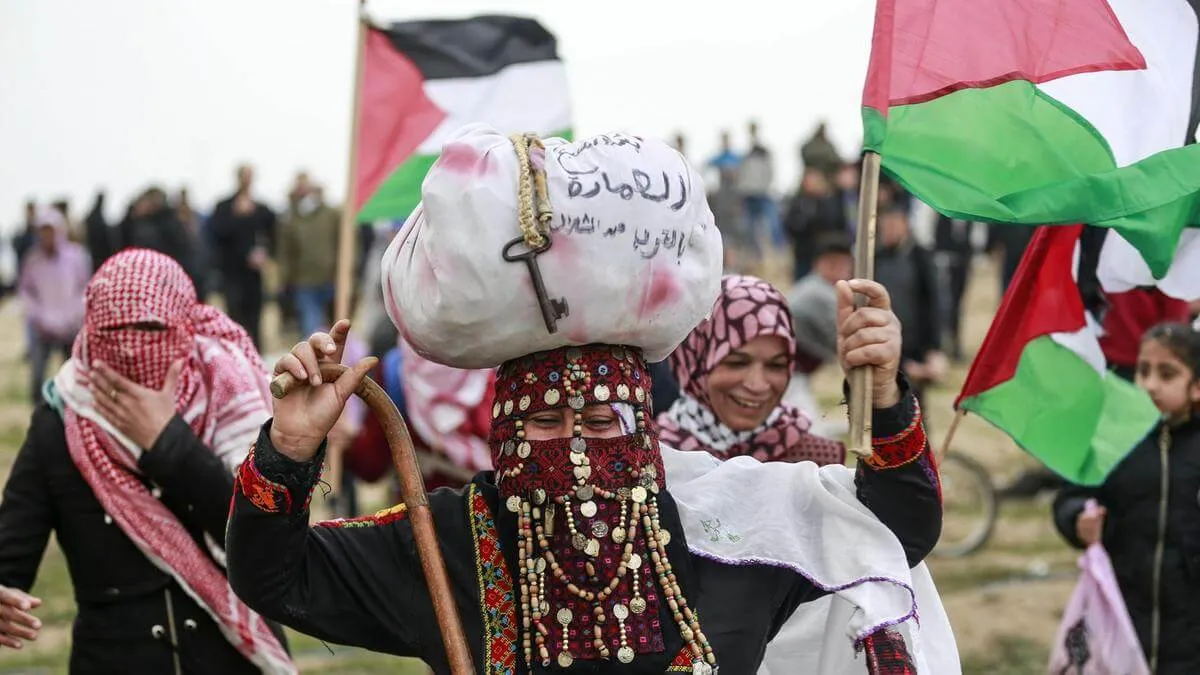
Demonstrators on the first anniversary of the March of Return protests near the Gaza border with Israel, 3/30/2019 (Source: AFP/ The National )
Dr. Stein described the migration of conspiracy theory from the margin (of blogsites) to the center (of Israel’s narration of images of Palestinian death). The video of Mohammed al-Durrah’s murder is a case in point: the state responds by charging Palestinians with performance. In their confrontation with the settler-imperial colony, Palestinians are accused of skillfully executing their very own production: “Pallywood.” It’s as if they have, through deceit and staging, convinced the world that Israel is the bad guy.
Of course, a significant majority of the world does not need convincing. Those not committed to American Zionist exceptionalism know very well that the state tortures, confines, exiles, kills, separates, imprisons, destroys, encloses, maims, assassinates, exploits…and as the list goes on it wages this very violence in digital space. The beautiful Razan al-Najjar was killed by Israel as she aided Palestinians marching for their return. The IDF turned to Twitter & wrote that she was “incited by Hamas to give up her life for their goals.” As Hamas is transformed into a conniving producer and Razan into a manipulated prop, the centrality of return conveniently disappears. What do we do with this colonial narrative and its digital warfare?
Some track the variations and iterations of the state’s management of digital economies. Others feel compelled to respond to the state’s claims, to counter settler aesthetics with “proof,” with more photos of Palestinian death and more statistics to qualify these photos. But what is foreclosed when well-meaning analyses take as their point of departure the terms established by the settler state? What aesthetics of resistance are skimmed over and strategically erased? What modes of knowing are dismissed as infantile rage?
If there is something we call a settler-aesthetic,
what methods of analysis and modes of creation are necessary…
to un-settle it,
to shatter its very foundations?
In A State of Siege , Mahmoud Darwish writes:
“The soldiers measure the distance between being and nonbeing
with a tank’s scope
We measure the distance between our bodies
and mortar shells … with the sixth sense.”
There are senses imperceivable to the state—forms of knowledge produced & cherished by those struggling against enclosure and siege. The insistence on returning un-settles. It un-settles precisely because its insistence on land unravels the state’s foundational myth, its ongoing conspiracy theories, for what they most fundamentally are: abstractions derived from imperial rot.
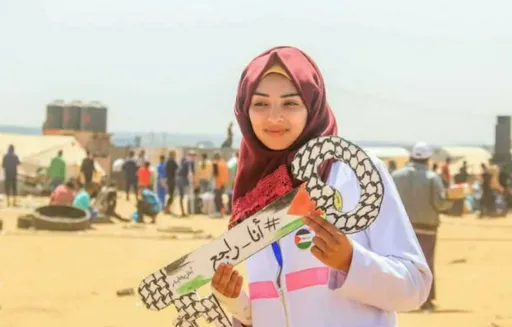
Razan al-Najjar carrying a key that reads “أنا راجع” “I will return” (Source: Palestine Live/ Mondoweiss )
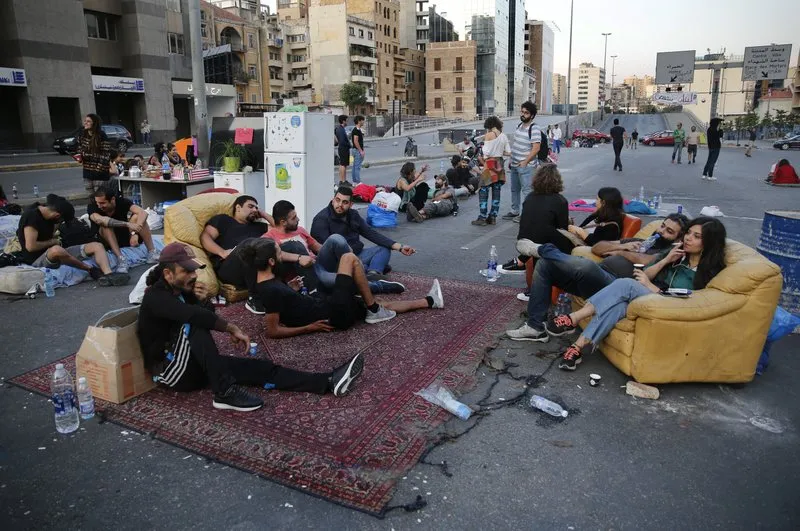
Anti-government protesters in Beirut on October 28, 2019 (Source: Hussein Malla/AP Photo )
Public space in Beirut is a prime site where Lebanese people face securitization and control over violence by state officials. The environment within which people live is dominated by omnipresent levels of state violence, which interrupt the ideal function of public space. This became even more apparent during the recent 2019 Lebanese protests, when the control of public space became a key demonstration of power between protesters and the government.
However, the intrusion of the public’s conceived space through shifts in the visual order and increased representation of the government’s power on the everyday lived space has occurred throughout Lebanese history. During the Lebanese Civil War (1975-1990), snipers symbolised the state’s violent control over public space. The snipers took aim from buildings such as the Holiday Inn, looking out over areas once used by the Beirut population for leisure. So too did the strongmen wielded by the zayem and politicians perform a role of public control, curtailing freedom of movement and preventing access to public space through threats and violence. Today, the sniper and strongmen manifest in different forms, appearing as security guards, barriers, checkpoints, convoys, and the average valet parking. As well as digitally, through strongly partisan leanings in Lebanese news media, censorship, and paid social media bots and trolls. These mechanisms seek to instill a pervasive psychological fear as violence has become diffused and inherent within the spatial and social order.
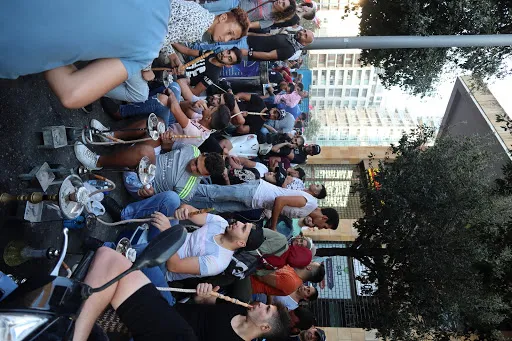
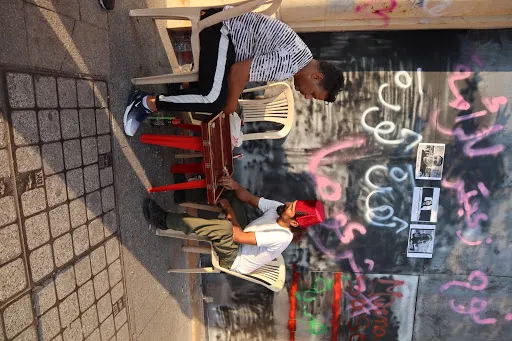
Riad Al Solh Square in Beirut on October 20, 2019 (Photos: the author)
One of the most notable gains made by the 2019 Lebanese demonstrations was the activation of the public space’s intended social and political role in facilitating social interaction and forming public opinions that are parallel to the political power. Protesters in Beirut reclaimed highways, squares, and abandoned space in a transgressional manner, overturning the state’s intended function for them and transforming it into another. The resurrection of abandoned and forbidden spaces, like the Grand Theatre and “The Egg”, invited a new generation to engage with the capital’s buried demons as they considered the city’s uncertain future. The revitalization of the rigid commercial centers allowed for a reimagining of how space in Downtown could be differently conceived and then lived. And the performance of leisure activities on Beirut’s squares and the highway known as “The Ring”, later renamed the “House of the People”, became a symbolic spatial translation of the political role of the people as the source of decision-making and authority.
Yet, more than a year after protestors first took to the streets, Lebanese authorities continue to deny the people basic social and economic rights, civil rights, protection from non-state armed actors, and even the right to live. Despite the different apparatuses Lebanese authorities employ to curb dissent, people will not stop demanding accountability, repair, and reconciliation. And Beirut’s contested sites offer protesters room to have dynamic negotiation with space and place—conjured and lived, preserved, reconstructed, and always in flux.
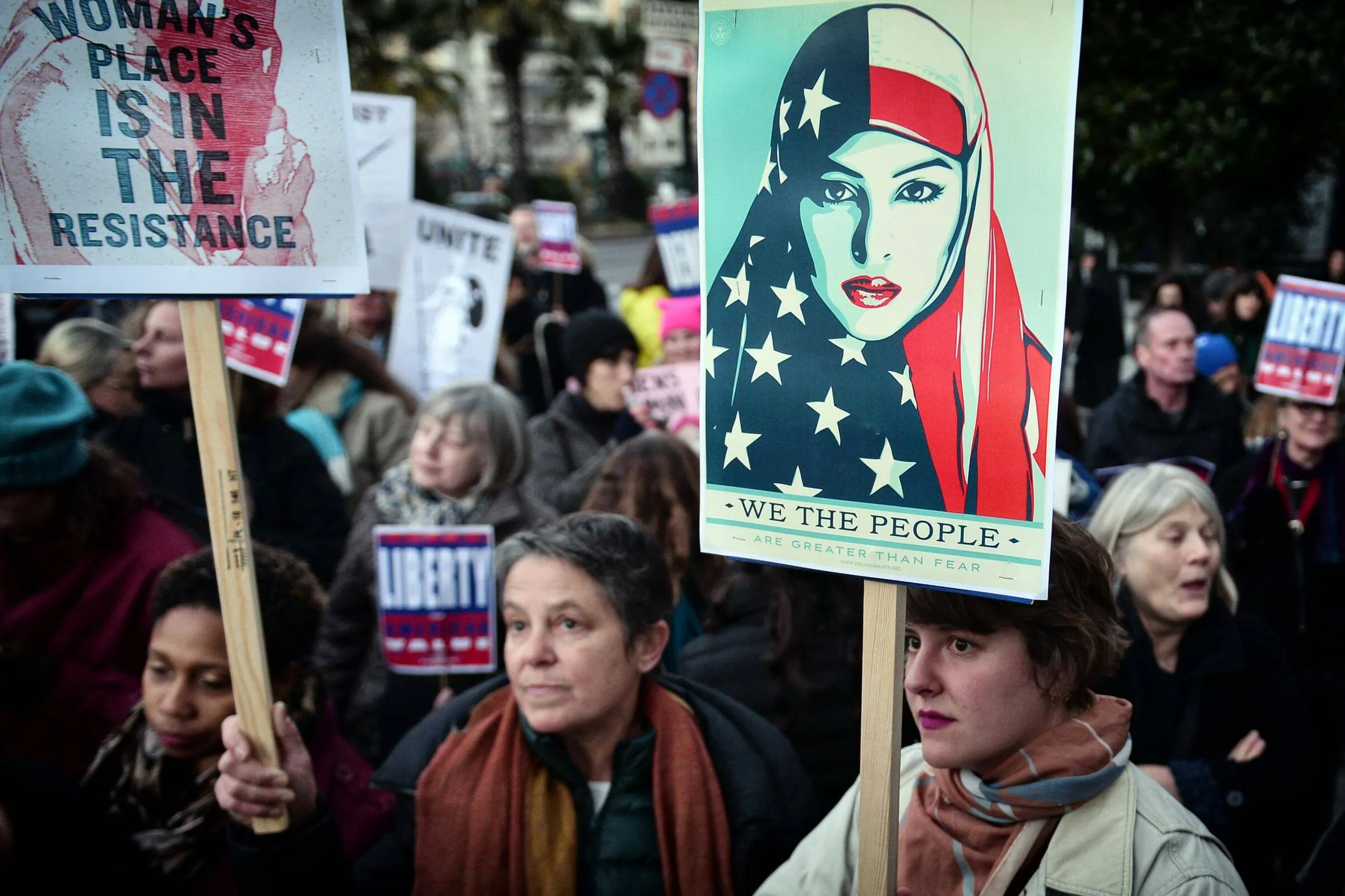
Women hold signs at a demonstration n front of the US embassy in Athens, Greece in 2017 (Source: Louis Gouliamaki/AFP/Getty Images )
In collecting images of dissent and resistance that had gained prominence in digital spaces, we noticed a number featured flags. Physical pieces of cloth, dyed various colors, imbued with history and meaning by those who claim them and those who oppose them.
An utterly visual symbol, a flag represents an identity, a nation; it represents people. While certain flags are also tied to space, it is ultimately people, within and without, who give meaning to the symbol. In representing people, flags easily become symbols of exclusion—of defining who is in and who is out—as the identities represented are predicated on the exclusion or the definition of the self in opposition to the external other. But who they represent, and who is deemed legitimate, is not clear-cut.
Without borders, certain flags are able to represent visions of the world that are more expansive, that transgress and resist the existing international (dis)order.
Most of the flags observed do not represent states recognized within this order, yet, situated in public space none of them were far off from the pervasive reality of state violence. As An Xiao Mina put it when speaking of the internet—in which the images of these flags have been immortalized and re-mobilized—as a public space: “public squares have always been sites of contention, sites of resistance, but also sites in which power is […] seeking to control that resistance.”
In the lead up to Canada150 in 2017, the Canadian-Muslim Vote ran a campaign to erect a Canadian flag in front of every mosque in the country. The group, which advocates for civic engagement, saw the initiative as a way for Muslims in Canada “to take strides towards [becoming] a unified and integrated community.” The flag was seen, quite genuinely, as an antidote to the hate crimes and Islamophobia that had seen a sharp increase in the wake of the American election. As if unchecked nationalism—pledging allegiance to a settler-colonial state with genocide on its hands, ongoing broken promises of upholding ideals of truth and reconciliation—was the solution to an epidemic of white supremacy and bigotry that the myth of multiculturalism had fought (not) so hard to cover up.
The 2016 election ignited a particular fear and outrage from a constituency that had not prior felt, or been bothered, by the violence of American imperialism, particularly within its own borders. This fear engendered a performance of collectivity among Americans for whom this was the defining moment of injustice, of inhumanity. The poster of a woman in an American flag hijab surfaced as a symbol of the “melting pot” (that had ostensibly boiled over) in an effort to gesture that difference should not matter. But it does matter, and it is the reason why some people are detained and deported, some people are targets of police brutality and drone strikes, and some people are embraced in patriotic propaganda but threats to national security when they exist and pray . More insidious, perhaps, is the persistence of Islamophobia veiled by this sanctimony. In the words of Iman AbdoulKarim on the tense silence that blanketed the Women’s March in Boston when greeted with as-salamu ‘alaykum wa-rahmatu-llahi wa-barakatuhu: “Why would a crowd carrying thousands of posters and fliers with an image of a Muslim woman in an American flag hijab be made to feel so uncomfortable with such a simple statement?”
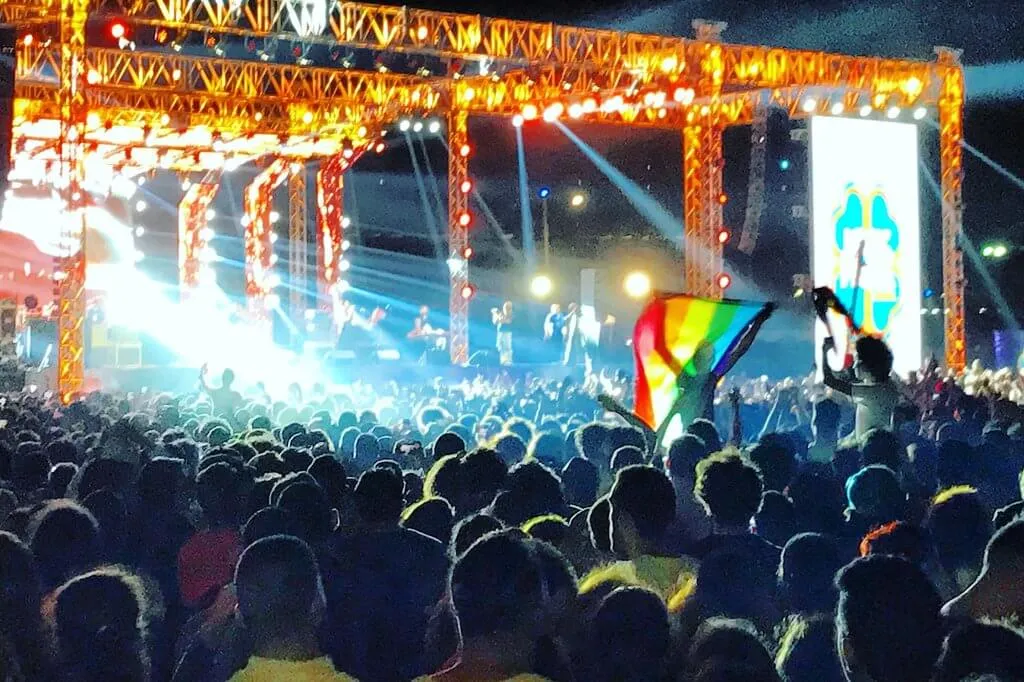
Concertgoers wave a rainbow flag at a Mashrou’ Leila show in Cairo in 2017 (Source: Benno Schwinghammer/Picture Alliance/Getty Images/The New York Times )
Sarah Hegazi was arrested, detained, and brutally tortured by the Egyptian state for raising a pride flag, at a Mashrou’ Leila concert in Cairo in 2017. A queer activist, a staunch communist, a revolutionary , Sarah’s public expression of joyful resistance to the heteronormative capitalist order, in wielding a rainbow-colored flag, was enough of a threat to the order necessitated by the regime. While the act was public, it was the digital inscription and dissemination of Sarah’s image that led to the violation of her dignity and life. The violence perpetrated by the ostensibly liberatory image was exponential: in her detention, torture, and exile, and the de-radicalization and appropriation of her image/memory after her death.
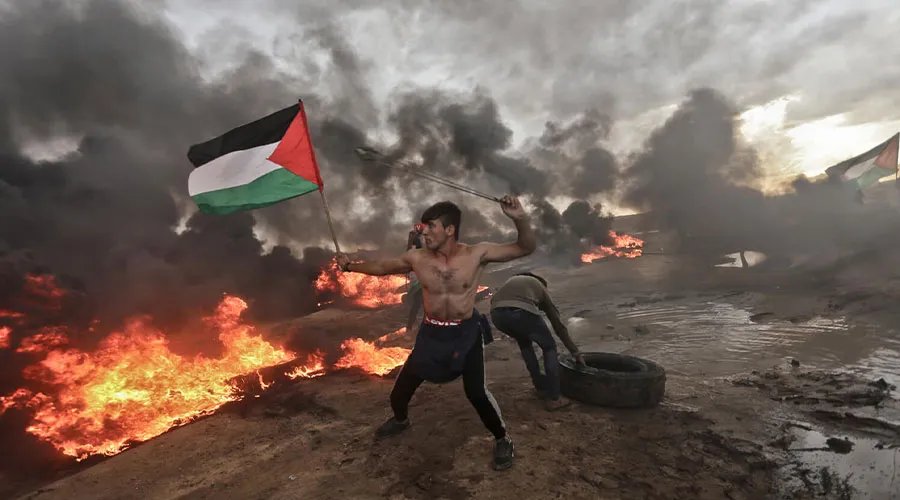
A Palestinian man carries a slingshot and flag at the Great March of Return protests on the Gaza border in 2019 (Source: Mohammed Asad )
“Our graces are white,
our battles are black,
our meadows are green
and our swords are red."
-Safi al-Din al-Hilli (d. 1349)
What we recognize today as the Palestinian flag was the flag of the Arab revolt against the Ottomans in 1916, and it was one of at least three motifs proposed to represent the Palestinian identity. According to Tamir Sorek , the four-colored flag was victorious as its competitors represented the interests of a few, were disconnected from revolutionary moments, and lacked historical relevance. During the March of Return (2018-2019) and acts of resistance prior, the flag, which is far older than the occupation itself, was ubiquitous. Even though it has been symbolically recognized and permitted to fly alongside that of its occupier’s, the power of the flag lies in its incessant reminder of the resistance of those it represents, of those who claim the struggle, in the face of the ongoing violence of apartheid and dispossession.
A white supremacist state, America was built on genocide, stolen land, and the violence of enslavement. From 1861 to 1865, the Confederacy was characterized by a desire to uphold white supremacy and the institution of slavery. In 1961, the Confederate flag was raised outside the South Carolina statehouse in opposition to the civil rights movement. Reflecting on scaling the flag pole and removing the flag, artist and activist Bree Newsome stated: “When the Confederate flag came down people were like, ‘Oh, man. We won.’ It’s this victory and it feels really good in that moment. It is a victory, but we still got a lot more battles to fight. We just got to pace ourselves.”

Activist Bree Newsome scaled a flagpole to take down a Confederate flag in Columbia, South Carolina in 2015 (Source: Adam Anderson Photo/Reuters/The New York Times )
A still from Ariana Grande’s 2020 “Positions” music video (Source: Cosas )
In the opening scene of Ariana Grande’s “Positions” music video , released on October 23rd of this year, we are presented with Ariana Grande’s version of the Oval Office. She sits at the head of the table, channeling the ghosts of first ladies past in white gloves and a matching pillbox hat, and surrounded by a “Cabinet” of attractive, diverse people—including a hijabi, a Black woman in braids, a queer person in a manbun, etc. Although the portrait of one of Grande’s dogs in the background underline the fact that this is a spoof, the careful liberal optics of Grande’s Oval Office, coupled with the celebrity’s well-known voting registration efforts , send a message about the limits that such a celebrity and her team (including millionaire director Dave Meyers) can offer in terms of our imagined futures. In Grande’s White House, six-inch heels are allowed on the table, and foreign wars are orchestrated by women of color and queer people.
While this pop culture example is not as immediately offensive as other, more poorly executed corporate attempts to co-opt the aesthetics of political dissent—for example, the infamous Kendall Jenner Pepsi ad of 2017, in which Jenner crosses the picket lines of a protest to offer a cop the drink in question—it is still part of a circulation of images that invoke the talk of resistance without walking the walk. Or perhaps more gravely, judging from the media pushback on the Jenner ad, and the lack of discourse around the Grande video, talking the talk wrong. If Jenner had joined the protest, in which swarms of diversity carried hilariously vague signage (prominent signs read “Peace,” “Love,” and “Join the Conversation” written in multiple languages), the ad would not have made a mark on the media landscape. Perhaps the inclusion of the obligatory hijabi—in the case of the Pepsi ad, the diversity-signifier is a photographer and not a politician—would have instead inspired some tweets of admiration about the power of representation.

A still from a 2017 Pepsi ad featuring Kendall Jenner (Source: Pepsi/BBC )
Foucault warns us of the ability of language to obscure, and it has since become clear that digital images have the power to do the same, if not with more detrimental effects due to their ability to circulate instantly. When capitalism invokes the language and imagery of resistance to perpetuate itself, it strengthens its own project while making resistance weaker (compromising the signifiers attached to it, like protests). Another theoretical parallel here can be made in the world of prison abolition. Ruth Wilson Gilmore draws a distinction between the prison reforms she seeks to problematize (reforms that seem meaningful but actually help perpetuate the carceral system) and “non-reformist reforms” (reforms that materially help achieve a prison-free future). In a similar vein, we should perhaps draw a distinction between resistance as optics, and resistance as material (i.e. resistance that necessarily threatens the capitalist system.)
All Monuments Must Fall: A Syllabus
Azoulay, Ariella. The Civil Contract of Photography . 2008.
Bergman, Carla and Nick Montgomery. Joyful Militancy . 2017.
Chun, Wendy Hui Kyong. “ On Sourcery and Source Codes ” in Programmed Visions: Software and Memory . 2011.
Doostdar, Alireza. The Iranian Metaphysicals . 2018.
Federici, Silvia. Witches, Witch-Hunting, and Women . 2018.
Fleetwood, Nicole R. with Rachel Kushner. “ Carceral Aesthetics .” Artforum . September 2020.
Fleetwood, Nicole R. Marking Time: Art in the Age of Mass Incarceration . 2020. [“ Marking Time ” at MoMA PS1 through April 4, 2021.]
Golan, Galia and Walid Salem. The Non-State Actors in the Middle East: New Media . 2014.
Gopnik, Adam. “ The Information: How the Internet Gets Inside Us .” The New Yorker . February 2011.
Katebi, Hoda. “ Please Keep Your American Flags Off My Hijab .” January 2017.
Khalaf, Amal. “ The Many Afterlives of Lulu .” Ibraaz . February 2013.
Khayyat, Rola, eL Seed, Basma Hamdy and Selim Mawad. “ Art and Representation Amid Crisis .” Panel. Columbia Arab Alumni Association . November 2020.
Lynch, Marc. “ The Rise and Fall of the New Arab Public Sphere .” Carnegie Endowment for International Peace . December 2015.
Ma, Tracy, Natalie Shutler, Jonah Engel Bromwich, Shane O’Neill. “ Why Protest Tactics Spread Like Memes .” The New York Times . July 2020.
McGarry, Aidan, Itir Erhart, Hande Eslen-Ziya, Olu Jenzen, Umut Korkut. The Aesthetics of Global Protest: Visual Culture and Communication . 2019.
Mina, An Xiao. “ When Internet Memes Infiltrate the Physical World .” The Atlantic . May 2017.
Mirzoeff, Nicholas. The Appearance of Black Lives Matter . 2017.
Mirzoeff, Nicholas. “ Visual Activism and the Snapchat Generation .” M+ Stories . November 2017.
Shade, Colette. “ Self-Help Hacks at the End of the World .” The New Republic . 2020.
Stein, Rebecca L. and Adi Kuntsman. “ Selfie Militarism .” London Review of Books . May 2013.
Taylor, Vanessa. “ NAZAR .” 2020.
Zuckerman, Ethan. “ The Case for Digital Public Infrastructure .” Knight First Amendment Institute at Columbia University . 2020.
Gumbs, Alexis Pauline. “ A Breathing Chorus with Alexis Pauline Gumbs .” How to Survive the End of the World . 2017.
“ Digital Deception in the Middle East .” Arab Digest . 2020.
If social media was hailed as crucial to the start of the Arab Spring, what has the last 10 years brought in terms of increasing cellphone connectivity, usage, and entwinement in our lives? A flood of research pinpointed changing digital access/practices as linchpins of the Arab Spring (perhaps overly simplistically, or correct) - but what is our perspective looking back over the last 10 years? How do/did we archive the “Arab Spring” and the other swells of protest and dissent across the region? Looking back on what/how we “save,”what do we learn about documentation, memory and access? The speed, scope, and prevalence of various technologies has expanded exponentially, yet how are we activating/archiving current protests as they now occur? This panel looks back on many connected waves of protest, but also zooms out to our global present to explore dissent, smartphones, and the digital ephemera that overflow from an ongoing Global Uprising. What does this tell us about the current moment - but some future direction of digital visuality and digital dissent
Omar Al-Ghazzi is Assistant Professor in the Department of Media and Communications at LSE.
Jasmina Metwaly is an artist and filmmaker based in Cairo and Berlin, and a member of the Mosireen video collective.
Isra Ali is a Clinical Assistant Professor in Media, Culture, and Communication at NYU Steinhardt and a feminist scholar who writes about militarism, citizenship, Islam, and culture. Her current project looks at how Muslims engage the question of citizenship online, in the era of War on Terror militarism.
Marie Grace Brown (PhD, University of Pennsylvania) is a cultural historian of the modern Middle East, who specializes in questions of gender and alternative historical texts. Her award-winning first book, Khartoum at Night: Fashion and Body Politics in Imperial Sudan (Stanford University Press, 2017), argues that Sudanese women used fashion and their bodies to mark and make meaning of the shifting sociopolitical systems of imperial rule. Continuing her interest in sensory experience, Brown’s current project, Sex on the Edge: Adventures in Romance in Imperial Sudan , claims that romance and play were dynamic means through which individuals understood and moved across the British Empire. Her research has been supported by the American Association of University Women, the Social Science Research Council, and the Woodrow Wilson National Fellowship Foundation. Brown is an Associate Professor in the Department of History at the University of Kansas.
Part of the Fall 2020 course Problems and Methods in Middle Eastern StudiesA joint Digital Forays and Global Uprising event

Doge.
Grumpy cat.
Distracted boyfriend.
Tide pods.
In the digital era, it has become nearly impossible to step onto a social media platform without coming across a meme. Whether a cleverly captioned image on Instagram or a satirical clip on Tik Tok, the internet meme has become a universal phenomenon that allows people--irregardless of distance or social boundaries--to make sense of, poke fun at, or speak back to a particular cultural moment. In this way, memes have come to serve two fundamental purposes: they are a form of participatory practice that has facilitated increased access to public discourse, as well as a tool for the meaning-making and negotiation of these very discourses.
What is a meme and where did it come from? Richard Dawkins first coined the term in his 1976 book, The Selfish Gene . Dawkins defines the meme as an emerging unit of replication - the cultural equivalent to a biological gene - whereby ideas or practices are transmitted from person to person in a process of evolutionary change. He says “Just as genes propagate themselves in the gene pool by leaping from body to body via sperms or eggs, so memes propagate themselves in the meme pool by leaping from brain to brain via a process which, in the broad sense, can be called imitation” (192). In simple terms, Dawkins’ meme is a spreadable idea.
How does this definition compare to what we think of today as an internet meme? Is a meme anything that goes viral? Shifman (2011) differentiates between viral content and memes: the former is something propagated from one person to another with little or no changes, while memes are altered through combined elements of imitation and “remix,” or alteration. Goriunova (2013) defines the internet memes as follows: “memes are digital images, often superimposed with text (known as an image macro), separate pieces of text, formulaic behaviours, animations and sometimes memetic hubs of videos (a viral video is not necessarily a meme unless it exhibits memetic features) which emerge in a grass-roots manner through networked media and acquire a viral character, becoming globally popular.” She posits that a meme owes its virality to two factors: its universality and its changeability. A meme only becomes popular if it can move through and be consumed by a diversity of online channels and contexts; concurrently, the meme must be adaptable and shapeable. In this way, Goriunova sees the meme not just as the object being shared, but as the human behavior or performance of sharing and adapting the content on a widespread, diverse scale. The meme’s very essence is how it is individualized by whoever creates or recreates it. By this definition and in concurrence with Shifman’s work, a meme is always viral, however viral content is not always a meme.
How are memes situated within the broader context of digital culture? Internet memes began circulating in the 1990s as more people started using the internet; by the 2000s, memes had become widely popularized, especially on sites like 4Chan and 9GAG ( Denisova 2019 ). What began as expressions of comedy, entertainment and parody have expanded to include any and all kinds of social and political commentary. Memes are remarkable both in their ability to exist and pass between various online spaces, and their capacity to bridge diverse contexts and narratives ( Esteves and Meikle 2015 ). The intertextuality of memes has become increasingly apparent: seemingly extraneous memes will relate to one another in complex and humorous ways (across cultures, languages, etc.), adding to political and cultural commentary and mixing dialogues (Shifman 2011). Memes are not merely a new medium of communication: they have become a genre of digital culture that operates with its own rules and behaviors which challenge the classic consumer-producer binary ( Wiggins 2019 ).

A series of memes featuring US Senator Bernie Sanders.
Sources from top: Sanders as French president Emmanuel Macron meets Lebanese singer Fairouz ( @habib_b/Twitter / TheNewArab ); in the band accompanying Egyptian singer Umm Kulthum ( @dardishi/Twitter ); with Turkish street cat Tombili (@PieroCastellano/Twitter/ TheNewArab ); in the Egyptian comedy movie El-Limby ( @outcontextbernie/Twitter ); at prayers ( @KhaledBeydoun/Twitter ).

As the internet meme has increased in popularity since its inception in the 1990s, so, too, have the sources of content through which they pull inspiration from.
Perhaps the most unlikely candidate for proliferation by the humorous pop-culture phenomenon, politics, has in recent years been the meme’s most popular (and influential, for better or for worse) target. Indeed, with the onslaught of two “firsts” in the 2016 election cycle--the first female and first reality-TV star nominees for major political parties--the online community soon found the novelty of the race for the presidency to be a goldmine for memes . Politicians themselves, catching wind of the meme’s popularity with younger generations, used it as part of their marketing strategies; after a photo of Clinton wearing dark sunglasses and holding a Blackberry phone became a viral meme in 2012 (even getting its own website, “ Texts from Hillary ”), the former Secretary of State made the photo her Twitter icon during her campaign. Trump, on the other hand, was retweeting memes created by alt-right supporters. Whereas politics was once considered highly inaccessible to young adults, they now had an outlet for political expression--and their opinions held stake.
The enhanced notoriety of internet memes within the political sphere has led to a growing body of research in which academics debate their implications not only on the candidates themselves, but also the people they seek to represent. Questions of concern range from whether memes play a role in reducing the legitimacy of presidential nominees (Ross and Rivers 2017) to the dangerous potential of memes, as inherent modifiers of original content, to exacerbate the spread of misinformation (Bauckhage 2011). To this end, the 2020 election cycle was proof that political memes had not only advanced in numerical scale, but also in reach and influence. For perhaps the first time, young people across the globe, and particularly in the Middle East, were engaging with the outcome of an American election using culturally-specific references. The questions guiding our group’s inquiry into political memes, then, are specific to this multilateral phenomenon:

An image of Hillary Clinton texting became a meme in 2012 (Source: Reuters/Politico )
1. To what extent do memes make American politics accessible to other parts of the world?
2. What do the memes that people abroad have made about the 2020 election say about their thoughts on the presidential outcome, specifically, and U.S. foreign policy in general?
3. What particular social media platforms are used to share political memes and what might be the significance, if at all, of these mediums?
4. What might the ephemerality of memes suggest about the potential for impact of political memes on domestic and global civic participation?
Our interest in memes, and the questions they inspired, cull from the November 5th joint Digital Forays and Global Uprising event, “Archiving a Revolution: Smartphones, Social Media, and Protest,” with Omar Al-Ghazzi, Jasmina Metwaly, Isra Ali, and discussant Marie Grace Brown. As the panelists examined the role of social media in the ways we experience and archive protests, we were particularly struck by Ali’s comments about the communal nature of archives and the role users have in taking ownership over particular narratives through their digital interpretation of events. Specifically, she suggests that the onslaught of phones has made it possible for archives to move across space and time, where they are no longer sights that must be visited but rather ones that come directly to us. In this vein, archives are increasingly dependent on the digital platforms whose users now have the power to circulate information through “informal and non-institutionalized” ways. She offers Muslim youth’s creation of memes about their experience as antagonized minorities during the “War on Terror” era as an example of the ways in which people can speak back to, and even mock, existing narratives.
As prolific consumers of memes ourselves, and the timely overlap of the presidential election with this panel, we were interested in analyzing Ali’s ruminations about archives and social media against the digital narratives circulated during this consequential political event.
US President Donald Trump announced the withdrawal from the JCPOA deal in 2018 with a mock Game of Thrones poster (Source: CNN )
Memes, alongside their production and consumption, change banal reality into a fictionalized existence. Trump is a uniquely “memable” president, not only by literally a Game of Thrones meme when declaring the American withdrawal from the JCPOA , but also that he has had many moments that cross into the absurd. Take the infamous “glowing orb” photo , where Trump joined King Salman of Saudi Arabia and President Abdel Fattah el-Sisi of Egypt, in the opening of a new anti-extremist center. This appropriately generated endless discussions and image macros about its symbolism.
Yet this method of interpreting politics has exceeded Trump as well. Take Biden’s statement of “inshallah” during the presidential debate . Endlessly debated on Twitter until the Biden campaign confirmed it, scholars, activists, Twitter pundits all piled on to offer their own interpretations of what it meant and the implications. Without meme culture, it’s likely that Biden’s usage would have been seen as something unique to the gaffe prone candidate. Yet the alacrity and the reach allowed the meme to exceed the original, suggesting that scale and speed are the two most important factors of a meme.
US President Donald Trump with President Abdel Fattah el-Sisi of Egypt, King Salman of Saudi Arabia, and Melania Trump in 2017 (Source: Saudi Press Agency )
The production of memes is an inherently artificial process. This is not to say that the creativity behind memes are artificial, but rather they are artificial constructs and rely on a distinct “original”. Memes are always about this “original”, but add rich context. The humor of memes then arises from this context. It is unremarkable, for example, that a US president visit a civil service center in Riyadh, but to do it with King Salman, Sisi, and for that US president to be Donald Trump? The context here is the history and ideology of these three men, and it is the fusion of this context with the image that gives the meme its humor. Irony is created when the emotional, historical context fails to align with the rational reality. This is why humorous memes are almost always ironic and difficult to manufacture, the image macro and video itself are technically simple, but the ironic framing gives the meme its potency.
This compression of information into a single, low-quality image is what makes American politics so digestible. Non-americans would never suffer through seasons of West Wing or House of Cards, but a single image is digestible. In this way, memes become universalized and transmitted, every day on the campaign trail becomes compressed onto a single tweet. The election, although in reality is a polarity contest between two parties, finds new life and new audiences through the meme as an interpretive structure.

To understand how foreign countries made the 2020 U.S. election legible through the meme, we can turn to Iranian Twitter as our case study.
To understand how foreign countries made the 2020 U.S. election legible through the meme, we can turn to Iranian Twitter as our case study. Iranian social media users were self-conscious about their political proximity to the course of the U.S. election. They knew the stakes were high: The Trump administration terminated its participation in the JCPOA in 2018 and implemented a stranglehold regime of sanctions which has gravely injured economic life in the country. Iran’s currency has plummeted and its oil revenues have contracted. Access to medications from Tylenol pills to chemotherapy drugs is scarce, as the United States continues to block vital imports. Basic goods have become too expensive across the country, as fruit sellers in the poorer neighborhoods of Tehran now stock discount aisles of rotting fruit for those who can longer afford fresh produce . Both state officials and regular Iranians looked to the 2020 election, and the possibility of a Trump defeat, as a potential lifeline.
As votes were being tallied in the United States, Iranian Twitter users discussed the election in nervous anticipation and excitement. Memes, unsurprisingly, emerged as some of the most noteworthy and effectively circulated content within the U.S. election discourse in Iran. The meme allowed for Iranian users to interpret and communicate their feelings concerning the election through humor—humor sometimes mocking, sometimes dark, always situated within popular culture references with wide currency among those who circulated them. To Iranian users, the meme made U.S. politics legible in the days following November 3 legible. These users hinted at the bitter humor of their investment in an election so far away, and they understood the anxieties of their own geopolitical situation vis-à-vis the turmoil ensuing in the United States.
(Source: @Parhami__/Twitter )
Many of the memes expressed optimism in the face of the high stakes of the U.S. election. The perceived importance of the outcome of the election led Iranian users to quickly acquire an intimate knowledge of U.S. electoral politics, and some poked fun at the American system’s antidemocratic distribution of electoral votes. Highlighting Iran’s investment in the outcome of the U.S. election, as well as his amusement with the electoral college, one user tweeted a monochromatic map of Iran’s provinces, joking that Iran’s 32 electoral votes had been called (see the image to the right).
After Biden had been declared the winner on November 7, Iranian users produced memes communicating their excitement and optimism for the future. One meme producer likened the magnitude of Trump’s defeat to Mohammad Reza Pahlavi’s famous departure from Iran during the 1979 revolution, after which a celebrator famously held up the newspaper headline reading: “The Shah has gone.” In this meme, the newspaper headline reads: “Trump has gone” (see below).
“Trump Has Gone” (Source: @hdagres/Twitter )
(Source: @mo_hashemi/Twitter )
Another user turned Trump’s November 2018 Games of Thrones-inspired “Sanctions are Coming” meme against him. Here we see a side-by-side version of the meme with the text under Javad Zarif, the Iranian foreign minister and negotiator of the JCPOA, reading: “Sanctions are Ending.” The Trump administration’s belligerent approach to Iran had marginalized Zarif, who was now expected to bring about a renewal of diplomacy with the Biden administration. It remains to be seen how feasible the re-opening of diplomatic channels will be in the aftermath of the assassination of Mohsen Fakhrizadeh, Iran’s chief nuclear scientist.
(Source: @seyyedreza/Twitter )
Some took Trump’s defeat as an opportunity to mock him, achieving some catharsis for the past four years by poking fun at the man perceived on the international stage as a self-serious bully. Here Trump is portrayed as dutifully preparing nazri, or food distributed to guests with the intention of attaining religious blessings, in the hopes of salvaging victory in the face of inevitable odds. Melania Trump is also present, dressed in a black chador, helping decorate the sholeh-zard (saffron rice pudding). The meme translates Trump into terms legible within the Shi’i Iranian discourse, with the humor stemming from the irony of his positioning therein.
The meme above references the American film The Matrix and its concepts of the “blue pill” and “red pill,” respectively. It has become a common trope in English-language popular culture that “taking” the blue pill amounts to maintaining one’s blissful ignorance, whilst taking the red pill brings one face to face with harsh truths, which are a deliverance to a higher state of understanding. In this meme, “Iranians” seemingly are offered the choice of the blue and red pills, with blue representing Trump and red representing Biden. Taking the blue pill would yield more misery. But the red pill, the meme explains, would also bring about the same misery but this time with a strawberry flavor. The meme’s author alludes to a broader historical understanding that conditions in the Islamic Republic have suffered under both Democratic and Republican administrations, and that the arrival of Biden cannot be seen as a panacea, as Obama’s was in some circles 12 years earlier. Biden’s victory, then, offers only a superficial remedy to the country’s structural ailments.
The frustration conveyed in this Matrix meme is comparable to that within the November 24 viral tweet that read: “Would be kinda cool if Biden never actually did anything but instead just tweeted shit like ‘We are the people. This is us. This is America. We are back.’ for the next four years straight.” Under the cover of platitudes and identity politics, these tweets suggest, promises of real change will go unfulfilled by the self-celebratory Democratic elite.
(Source: @hdagres/Twitter )
(Source: @lilsasquatch66/Twitter )
One meme expresses such pessimism through religious imagery, depicting Biden in the embrace of what is assumed to be a bloodied Imam Husayn, the third Shi’i Imam whose martyrdom at the hands of the Umayyad caliph Yazid in 680 is publicly commemorated in Iran every year during the month of Muharram. The caption here also mocks viewing Biden as a panacea for Iran’s troubles. It reads:
Miraculously, one week after America’s elections and the ascendance of the old man [Biden], the Coronavirus vaccine has arrived and been approved by the World Health Organization, Nasrin Sotoudeh [the Iranian activist] has been released, the price of the dollar keeps falling, racial discrimination is fading away as blacks are being seen as whites, and I also think that the Mahdi [Messiah] is coming this Friday, what a turn of events!
The caption tries to capture a number of the social problems ailing Iran and the globe in sequence, with that sequence devolving into the absurd by its end. Biden’s victory, the meme caption artist suggests, is being seen in Iran as a triumph of sacred magnitude, with appreciation for the president-elect seemingly elevating him to the status of Shi’i sainthood. His election, he muses, is being seen as solving all of Iran and the world’s problems, from the COVID-19 pandemic to political imprisonment to economic crisis to global racism. The excitement is so pervasive that the meme artist likens it to anticipation of the return of the Twelfth Imam, a central doctrine in Twelver Shi’ism. Being that excitement, however, is a certain naïveté that the meme cautions against.
(Source: @Roshanaeii/Twitter )
These memes provide a snapshot of political sentiments among Iranian Twitter users in the days following the election. They circulated within Iran on Twitter as well as other platforms, such as Telegram and WhatsApp. And they certainly made their way through international networks to members of the Iranian diaspora, including in the United States, attentive to the significance of the U.S. election for their perceived homeland. These memes gained so much traction that they were picked up by prominent outlets, including Ajam Media Collective, whose goal is to challenge conventional media perceptions of the Middle East in Euro-American discourse. The Washington Post also published a story about foreigners understanding the U.S. election through memes; their article foregrounds the Iranian coverage while underscoring the political stakes.
These memes should not, however, be taken as a comprehensive representation of Iranian political sentiments. Twitter remains banned in Iran, a fact made ironic by the presence of Iranian state officials on the platform, including Supreme Leader Ali Khamenei. Twitter usage in Iranian persists nevertheless, owing to access to VPN systems and “censor-breaking” (filter-shekan) software. These softwares are of course limited to those who can afford them, which remains a subset of the Iranian population. From this online Iranian population, we further reduce our enquiry to the subset who engage in memes, and it is through these users that we have suggested understanding this political event.

(Source: Twitter)
Memes, by nature, are ephemeral. Their reliance on another event as a gestation point creates a simulacrum of reality in the digital space. What was once a highly polarized contest acquires a raft of new audiences in this space, proliferating a series of new narratives. Take the election between the Democrats and Republicans, which without the digital space has only two audiences: democratic and republican voters. When the election is moved online, a series of new audiences is acquired, such as the Iranian meme creator participating in Twitter, forming new narratives along the way. These narratives have a democratizing effect by bringing in new audiences into the debate, shifting the “center of gravity”.
Yet memes, in constructing alternative narratives, have an intoxicating effect. Unconstrained by the two party structure and the reality imposed by the US political system, memes acquire a certain mystical, quasi-religious quality, allowing people to shortly live in a different reality. Some Iranians used the meme to escape into the future—a future without sanctions, skyrocketing prices, and perpetual crisis politics. Others used the meme to reflect pessimistically on the present, highlighting the differences between what people feel on the ground and official discourses from above. The two party structure serves to channel and contain discussion within the frame of reality, but memes are unshackled from this. The rise of Trump, and communities like QAnon, alongside Shi’i religious memes are all but a small sample of the future.
Beskow, David M., et al. “ The Evolution of Political Memes: Detecting and Characterizing Internet Memes with Multi-Modal Deep Learning .” Information Processing and Management. 2020 .
Dawkins, Richard. The Selfish Gene: 40th Anniversary Edition . 2016.
Denisova, Anastasia. Internet Memes and Society : Social, Cultural, and Political Contexts . 2019.
Goriunova, Olga. The Force of Digital Aesthetics: on Memes, Hacking and Individuation, The Nordic Journal of Aesthetics . 2015.
Mina, Xiao An. Memes to Movements : How the World’s Most Viral Media Is Changing Social Protest and Power . 2019.
Penney, Joel. “‘ It’s So Hard Not to Be Funny in This Situation’: Memes and Humor in U.S. Youth Online Political Expression .” Television & New Media . 2020.
Ross, Andrew S., and Damian J. Rivers. “ Digital Cultures of Political Participation: Internet Memes and the Discursive Delegitimization of the 2016 U.S Presidential Candidates .” Discourse, Context & Media . 2017.
Shifman, Limor. Memes in Digital Culture . 2013.
Wiggins, Bradley E. The Discursive Power of Memes in Digital Culture : Ideology, Semiotics, and Intertextuality . 2019.
How do cultivation, contractors, culture, and cosmopolitics relate to land rights struggles in Palestine and Hawaiʻi? This panel will reflect on growing ecological crises, displacement from land, and alienation from heritage through potential strategies or antidotes presented by education and cultural projects that bridge art, science, and agriculture. Through the practice of two working artists and two academics we will think through linkages of land, lineage, and laws.
Through tactical acts of technical and conceptual détournement, much of Nida Sinnokrot ’s work aims to subvert various technologies of control that give rise to shifting social, political and geographic instabilities. His films, installations, and sculptures often transform ordinary objects or actions into sensory experiences that reveal the hidden complexity of relationships trapped within the mundane. Nida is a co-founder of Sakiya – Art | Science | Agriculture , an international residency program and farm with an emphasis on fostering and developing sustainable practices across disciplines and is a faculty member of MIT’s program in Art, Culture and Technology Program (ACT) in the School of Architecture and Planning in Cambridge, Massachusetts.
Sean Connelly (b.1984), an artist-architect from O'ahu. He directs his work through an independent studio practice named After Oceanic Projects for Architecture, Landscape, Infrastructure, and Art . His combined work (2010 - 2020) strives to promote justice-advancing futures that address the dynamics of human geography today. Sean’s work theoretically is about advancing an architectural history and theory of urbanism from Hawai‘i. His built conceptual works have included sculpture and video works exhibited at venues such as ii Gallery, Honolulu Museum of Art, Foster Botanical Gardens, and Luggage Store Gallery. Sean’s most recent studio-driven works include O'ahu 2450—the first 3D map of United States militarization of O‘ahu from 1887-Present; and Ala Wai Centennial Memorial Project—a social practice in architecture about the history and future of Waikīkī, that runs from 2021-2027. Current client-driven projects include a 1600 acre landscape plan for Mālama Loko Ea Foundation to restore the historic fishpond Loko Ea, located in Hale‘iwa, Hawai‘i.
'Ilima Long was born in Hilo, raised in Washington and returned to her one hānau in 2003. She lives in Makiki with her 10 year old daughter and is slowly tackling her PhD in Political Science at UH Mānoa. Her entry point into activism was on the Boeing picket line in Everett, Washington where her dad worked and was a member of the machinist union. In Hawai'i she has been involved with various aspects of Hawaiian sovereignty organizing and in doing so, works to connect struggles across oceans.
Nasser Abourahme is a Faculty Fellow at the Hagop Kevorkian Center for Near Eastern Studies at NYU. He completed his PhD at Columbia University in 2018, was most recently a fellow at the Princeton-Mellon Initiative in Architecture, Urbanism, and the Humanities at Princeton University, and is currently working on a book manuscript titled, The Time Beneath the Concrete: Camp, Colony, Palestine .
Part of the Fall 2020 course Problems and Methods in Middle Eastern Studies
Source: 4KRelaxationChannel/YouTube
Indigeneity, Land, Heritage: Hawai’i and Palestine brought together Nida Sinnokrot (Artist), Sean Connelly (Artist/Architect), ’Ilima Long (UH Mānoa), and Nasser Abourahme (NYU). The aim was to understand indigenous experiences and representations of the right to land and heritage, both in scholarly and artistic terms. Most importantly, the event aimed to highlight some of the crossovers and points of relation between Hawai’i and Palestine.
We aim to build on these discussions by considering a number of topics: we begin with framing settler colonialism specifically in relation to Palestine and Hawai’i. The second part of our exploration of the event relates to specific issues of nature and local living, partly examining how settler colonialism and militarization impacts the landscape and the livelihood of the native people. Another aspect of native identity that is threatened by settler colonialism is language, and we subsequently explore this in relation to the formation of the nation state as well as the infrastructure of the state. The final section aims to explore convergences between Hawai’i and Palestine in artistic forms by exploring the poetry of Mahmoud Darwish and Haunani-Kay Trask.
Modern English dictionaries define “colonialism” as the practice of political control over another country so as to benefit from local economic resources. However, the effects of colonialism may vary relative to different geographies and historical periods. It may not seem possible to identify a common definition or practice of colonialism. Yet, if we talk of particular colonialisms in particular contexts, such as, “settler colonialism,” we find ourselves amid a contemporary political crisis around the world. In the age of global uprising, studies in the context of settler colonialism increasingly focus on the binary struggle relationship between colonizers and colonized, or settler and native.
During the long 19th century, the formation of the modern state, involving industrialization and urbanization, provided European powers with a new approach to identify themselves. On the one hand, citizens of the modern state became a “civilized population” that requires industrial development. On the other hand, non-industrial geographies were rendered territories defined by the lack of civilized people capable of owning land. Generally, indigenous people were assumed to possess lower cultural and primitive social structures and their elimination and removal from the land was legitimated in these terms (Bateman and Pilkington 2011, 2).
Those instances of colonialism in which native peoples were removed or eliminated and replaced by large numbers of colonists have come to be referred to as settler colonialism (Ibid, 1). The colonization of Palestine is a case in point. The declaration of Israel in 1948 and the extended occupation of Palestine’s land in 1967 opened a new chapter in the Middle East and studies in settler colonialism. Initially, Israel began to systematically eliminate the Palestinians’ presence in the territory, since 1948 (Barakat 2018, 351). Furthermore, Zionist movements have politically imposed their version of history and Hebrew as a language to dominate Palestinian land “by the hegemony of Zionist frameworks” after 1967 (Ibid, 358). As a new colonial state in Palestine, Israel has politically conducted the systematic elimination of Palestine’s population. Colonial states in essence colonize indigenous people and profit from the economic domination of the occupied territory, whereas settler colonists become the native population of the newly declared state.
In this narrative, not only does Israel displace and dispose Palestinians from their own land, it also eliminates Palestinian historical and cultural claims. Israel’s effort as the ongoing settler colonization put an embargo on, for instance, the academic fields in the US. As a Palestinian-American scholar, Steven Salaita is epitomized of banning academician. In 2014, Salaita was fired from his tenure track position in the American Indian studies program at University of Illinois, reported journalist Robert Mackey in the New York Times . Salatia attracted social media’s attention to the war between Israel and Hamas in July 2014. He posted a vast number of tweets including harsh criticism of Israel’s attitude during the Gaza war. Thus, he was protested as anti-semitist by the Pro-Israeli faculty , students and donors (Zahzah 2019, 220).
The case of Salatia starts new discussion about settler colonial movement, especially the United States’ support for the Zionist project.
Steven Salatia examines the connections between Indigenous America and Palestine through the concept of settler colonialism in his 2016 book, Inter/Nationalism: Decolonizing Native America and Palestine (Ibid, 222). In this book, Salatia turns the light on Israel and America’s strategic partnership. Despite the social and cultural elimination of American Natives and Palestinians, America and Israel share military tactic and security technologies as militarized settler states. While Israel supports American hegemony in the Middle East, America supports the Israeli occupation in Palestine building on its history with the native peoples. Furthermore, Israel and America both justify their settlement through religious overtones (Ibid, 214).
Likewise, as an activist and scholar at the University of Hawai’i at Mānoa, Illima Long highlighted how settler colonial activities have striking parallels between Hawaii and Palestine (Long 2020). She pointed to the historical resonances. The First Zionist Congress had already convened in Switzerland to discuss the Israeli State when the US began to illegally annex Hawaii in 1897, and the United Nations recognized the presence of Israel as a state in Palestine and the US in Hawai’i at the same time in the mid-20th century. Furthermore, the conflict resolution convention, named “Apology Resolution,” between America and native Hawai’ian population was held at the time of the Oslo Accords’ process that aimed to peacefully resolve Israel and Palestine’s conflict in 1993. In both places, the logic of settler colonialism takes shape through a cultural elimination of the indigenous population that is deeply connected to the military control of both the land and its people.
The questions of land, nature and ecology are at the forefront of settler colonial studies. How does the connection of natives to land and land use change after settlement? How is the ecological environment implicated in both the colonization process and in the resistances to it? Lengthy answers to these questions can be given; here we’ll provide a few examples from the Hawai’ian and Palestine experiences.
During the event Sean Connelly discussed the past and present impacts of American urbanism on the Hawai’ian islands, which has endangered the lives of local communities. The project, titled Learning From Lea’hi, focuses on these impacts and is a form of testimony for justice-advancing architecture. While introducing the project, Connelly provided an in-depth discussion on how the construction of the US military bases damaged the natural resources in Hawai’i during this critical period of climate change. To further his discussion and to indicate the severity of the situation, he presented the case of the island of Kaho`olawe, which became a military testing and training zone. In general, with the Second World War, Hawai’i became a central military headquarters for the US. Because “the entire island was used as a weapons range with no restrictions on target locations,” the local population demanded the island be solely preserved for the following purposes:
Preservation and practice of all rights customarily and traditionally exercised by the native Hawaiians for cultural, spiritual, and subsistence purposes
Preservation and protection of its archaeological, historical, and environmental resources
Rehabilitation, revegetation, habitat restoration, and preservation
Education
Moreover, the locals demanded that commercial uses were going to be strictly prohibited (Kahoolawe 2020).
Sean Connelly also focused on the construction of the Ala Wai Canal and its detrimental effects on nature. To extend his points, he stated that “through the territorial construction of the canal, the United States systematically displaced Hawaiians, immigrants and other farmers of color cultivating the area” (Connely 2020, 8). Moreover, the U.S military filled Waikiki resulting in the destruction of the rich fishponds and large portions of the Pi’inaio stream. In turn, militarization in Hawai’i destroyed food security and native land use. Moreover, life expectancy adjacent to military training areas became ten years lower than other regions. Similar issues emerged in a faraway land, in Palestine, yet often from a set of similar reasons. The actors differed but the impact on nature and local life remained similar.
In Palestine, the Israeli government devastated a number of Palestinian villages under the seemingly benign policy of afforestation. This practice, which has endangered the lives of hundreds of Palestinans, can be seen as a war crime: “the JNF [Jewish National Fund] has performed an active role in the erasure of Palestinian villages in Israel by afforestation, defining the involvement as a war crime” (Braverman 2009, 351).
Israel implemented afforestation policy by planting pine trees,in part for their symbolic value. The supposed greening of the land by Jewish labor was an ideal long-held in Zionist discourse. For instance, Theodore Hetrzl noted in his article published in 1898 that the land is poor and neglected in Palestine, but there are oases where the Jewish settlements exist (Ibid, 335). Similarly, the first president of Israel, Chaim Weizmann argued that “God has covered the soil of Palestine with rocks and marshes and sand, so that its beauty can only be brought out by those who love it and will devote their lives to healing its wounds” (Ibid). Triggered by those ideals, the Israeli state, particularly the Jewish National Fund (JNF) has planted over 240 million pine trees as shown by a study conducted in 2004 (Ibid, 318). However, the main target, it seems, was far from simply afforestation for the sake of nature or recovery. A large portion of the trees were planted on the border to prevent return by displaced Palestinians. Moreover, these forests were built over demolished Palestinian villages to futher prevent return. To get a sense of this, consider that from the “418 villages depopulated and demolished during the 1948 war, almost half (182 villages) are situated in various nature sites such as parks, forests, or nature reserves” (Ibid, 350).
Israeli policies to own the land through plantation was so obvious that these spots became the targets of attacks by Hezbollah. For example, Hezbollah responded to the Israeli policies by pine burning as a counter-national act in 2006. As a result, contrary to the general assumption that land redemption usually takes place with legal and administrative means, it can be sometimes smelled, touched by hand or foot on a plowed furrow” (Ibid, 333).
As well as the afforestation, the construction of the Gaza Wall is worth mentioning when discussing these issues. The construction of the wall, which resulted in the demolishing of adjacent houses and trees, has caused ecological devastation as well. “The wall zone cuts through the western part of the West Bank and runs north to south grabbing the most fertile agricultural land and natural reserves” (Abdallah and Swaileh 2011, 544). It has harmed the biodiversity in the region that has a crucial impact on food security, health improvement, income, and the ecosystem. In more direct terms, many Palestinains have been cut off from the cultivated land that was their main source of income, not to mention the loss of water resources. Non-human life was also affected. Animals were prevented from seasonal migration and reaching water resources. In both contexts, the transformation of nature, be it canal digging or afforestation, is at the heart of the settler project.
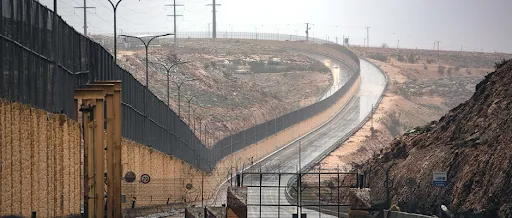
Source: Olivier Fitoussi/ Haaretz
All in all: nature, the locals’ connection with nature and their land use must be discussed when looking at the effects of settler colonialism. Focused and specific studies are able to indicate that even the most decent-looking works might have carried covert intentions resulting in harmful conditions for others. Hawai’ian Ala Wai Canal and Israeli forests are crucial but inadequate examples of this. More research is indispensable to bring attention to such crimes that are undoubtedly as devastating in the long run as wars are to people and the world they live in.
Source: i drive Israel/YouTube
Another problem to consider in this discussion of settler colonialism is language policy and planning. The significance of such research is crucial to understand the social status of the indigenous population by considering, amongst other things, the status of their native language, to which they have a sentimental attachment (Eastman, 1-26).
According to Eastman (1983), “Language planning focuses on the decision-making that goes into determining what language use is appropriate in particular speech communities.” It also “looks at the choices available to a speech community and at possible recommendations of language policy for adoption by that community” (Ibid, 1-2). In that sense, the choice of an official language in a multilingual society is a political decision (Ibid, 33).
In the case of Palestine, Hebrew and Arabic have been perceived as two official languages (together with English) since the British Mandate on Palestine in 1920. According to Article 82 in the Palestine Order, it is “the obligation of the Mandate authorities to use English, Arabic and Hebrew in their official publications, and the right of all persons to use one of these languages in government offices and in the courts” (Deutch 2005, 265). Even when the official use of English was repealed in 1948 in the Israeli Declaration of Independence, Section 15 (b), Arabic remained an official language as there was no explicit abolition of the Arabic Language by the newly declared State of Israel (Ibid, 266).
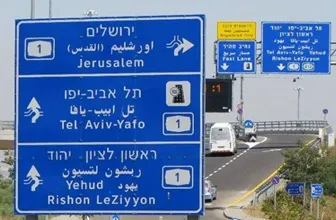
Highway 1 from the Ben Gurion Airport area to Tel Aviv. Source: Go-TelAviv
However, because Arabic is the native language of the indigenous Palestinian population, and hence is considered a national symbol of cultural identity in a new settler colonial state, the official use of Arabic has been seen as a contradiction to the Jewish and Zionist identity Israel is said to represent. According to Arraf-Baker (2019), the status of Arabic as an official language cannot be envisioned because:
Israel has not recognized the Arabs as a “national minority.” Such recognition would mean that Arab citizens are indigenous to the land, a matter that would contradict the Zionist narrative. Therefore, with the establishment of Israel, Israeli citizenship was imposed on Palestinians who remained on their land, and they became officially included in the category of non-national “minority.” The official status of the Arabic language was retained alongside Hebrew. But according to Israeli law only Hebrew is considered the national language of the country, enjoying all privileges (Arraf-Baker 2019, 182) .
Thus, although the official status of Arabic remained alongside Hebrew, only the latter was implemented in the educational and jurisdictional system in the State of Israel. According to Rubinstein (1996, cited in Deutch, 2005: 267), the primacy of Hebrew is derived from the “statutory principle enunciated in section 24 of the Interpretation Law (1981)”, which states that “the binding text of any law is the text in the language in which it was enacted”, which makes Hebrew the only binding text because all the laws in the Knesset are enacted in Hebrew (Rubinstein 1996).
In addition, all formal education is conducted in Hebrew in Israeli universities and colleges, and hence it is mandatory for all Arab students to learn Hebrew to be admitted in higher education. On the other hand, Arabic is not maintained in the same way as Hebrew, so, for instance, Arabic language classes in Israel are not taught in Arabic, a policy that has been challenged by Arab professors:
Of the few Arab professors that teach Arabic, some recently started to challenge the official policy and offer classes in Arabic; the practice does not pass without objection or criticism from students. Nor was the establishment of an Arab university allowed, because--according to Israeli policy--it would contribute to enriching the Arab society linguistically and intellectually. In the absence of an Arab university in Israel, Arab students enroll in Israeli or foreign universities, especially in cases where they are unable to obtain entrance for medical or legal studies, which often happens (Arraf-Baker, 183-4).
Accordingly, the declining status of Arabic in Israel is connected to the policy of maintaining Israel’s Jewish identity and persecuting its Arab population, which, through expulsion from their own land and absorption of new Jewish immigrants, has been transformed from a majority to a minority with no equal language rights.
Comparable to Palestine is Hawai’i, which provides another instance of an indigenous population that has undergone subordination to a language enforced by a colonial state in judiciary and legislative institutions. However, in the case of Hawai’i, the indigenous language is one of twelve languages spoken in daily interaction alongside a pidgin, which is a mixed language of English and other local languages, and the subjugation of Hawai’ian was recognized even before the annexation of its land to the US in 1900 (Asensio 2010, 10). Philipson (1992: 47) defines this English dominance as “linguistic imperialism” which is “asserted and maintained by the establishment and continuous reconstitution of structural and cultural inequalities between English and other languages” (Phillipson 1992, 47).
Languages spoken in Hawai’i. Source: Quora
Unlike Israel, which repealed English as an official language in its Declaration of Independence, the government in Hawai’i implemented English as a language of education. However, similar to the declination of Arabic in Israel, Hawai’ian was banned as a medium of education since 1896 “as part of the colonization process” (Wilson and Kamanā 2001). In Israel, Arab students cannot receive formal education without proficiency in Hebrew. Similarly, Hawai’ian students will need English proficiency to pursue their higher education. In both cases, the lower social status of the indigenous population is underlined by the subjugation of their indigenous languages to an official language enforced by the settler state.
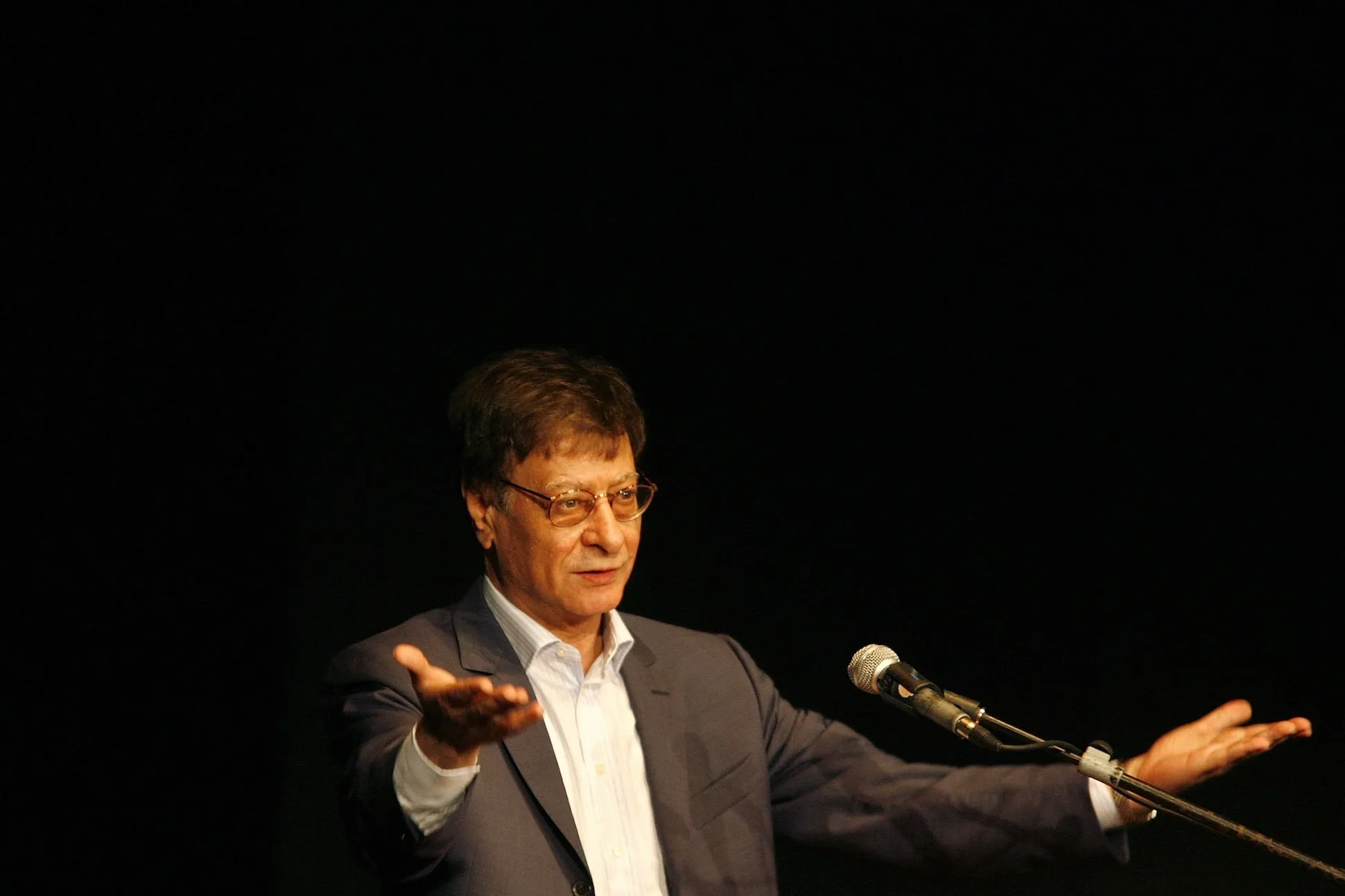

The work of Sean Connelly and Nida Sinnokrot testifies to the ability of art to resist the erosive powers of settler colonialism and reaffirm the relationship between indigenous peoples and their lands. In relation to this, indigenous poetry can also offer a space away from the violence of settler-colonial states as well the opportunity to record this violence and undo the coherent narratives of the state. In this section, the poetry of Mahmoud Darwish (1941-2008) is read in relation to the poetry of Haunani-Kay Trask (1971–). From this exercise, we hope to uncover some of the connections between these struggles and continue to open up the question “What does it mean today to think about Palestine and Hawai’i together?”, which was posed by Nasser Abourahme during the event.
Mahmoud Darwish is known as the National Poet of Palestine, his eclectic works, which include poetry, prose and everything in between, have gained popularity across the world, and hence many of his works have been translated into English and other languages. Darwish’s family was one of the many who lost their homes to the 1948 Nakba , his family fled from their home in al-Birweh (which would later be demolished by the settler-colonial state) to Beirut and upon their return they found that they had been declared as ‘present-absentees’ in what is now occupied Palestine. This term “present-absentees” would come to occupy most of Darwish’s life and would also make frequent appearances in his work. Indeed, as a poet in exile, the homeland and the plight of Palestine could not be separated from his poetic work. Over the course of his poetic career, his work changed and developed to embody the struggles of exile and occupation in various ways, including the use of myth, history, epic as well as religious texts. One of his most acclaimed works is titled ‘The “Red Indian’s” Penultimate Speech to the White Man’ (1992), in which Darwish, a victim of settler colonialism, takes on the voice of another victim of a similarly destructive force.
Haunani-Kay Trask is a native of Hawai’i and has authored Eros and Power: The Promise of Feminist Theory (1984), From a Native Daughter: Colonialism and Sovereignty in Hawai’i (1993), and two works of poetry, Night Is a Sharkskin Drum (1994) and Light in the Crevice Never Seen (1999), the former of which will be considered alongside Darwish’s aforementioned poem. Throughout her career as an academic, author and activist, Trask has been a “critical voice in what she called, ‘the modern Hawaiian movement’ and the broader Hawaiian sovereignty movement”, as well as an advocate for “resisting gender-based violence against women and supporting indigenous nations; the relationships between indigenous peoples, particularly Native Hawaiians, and the United States” (University of Hawai’i News 2019). Part of her work as a tenured member of the Faculty at the University of Hawai’i Mānoa involved the founding of the Kamakakūokalani Center of Hawaiian Studies. Trask has emphasised the relations of solidarity between oppressed peoples. Speaking on the connection between the military training of the US Navy in both Vieques, Puerto Rico, and Kahoʻolawe, Hawai’i she states:
People in Vieques helped us understand that we had so much in common. So that every time, for example, I gave a speech or I was in a rally, I would always bring them up, and it’s kind of like comradeship. You become part of somebody’s struggle because you’re suffering under the same conditions (Trask 2020).
Using this comment from Trask, as a departure point, it seems that a link can be drawn between her own poetry and the work of Darwish considering the similarities between the struggles of the Palestinian people and the indigenous people of Hawai’i.
The very topic of Darwish’s poem suggests that he too had begun to draw connections between global struggles against settler-colonialism. In this poem, he considers specifically the crimes committed against the Native American people, opening with an epithet from Duwamish Chief Seattle:
Did I say, The Dead?
There is no Death here,
there is only a change of worlds.
While taking on the voice of the Native American Darwish’s poetic persona also seems to draw on the painful experiences of the poet himself. This poem affirms the connection of the indigenous people to the land, a trope which appears in many of Darwish’s other works. In this poem the poetic person addresses the coloniser:
In a little while
you will erect your world upon our world: from our cemeteries
you will open the road to the satellite moon.
(….)
There are dead and settlements, dead and bulldozers, dead
and hospitals, dead and radar screens that capture the dead
who die more than once in life, screens that capture the dead
who live after death, and the dead who breed the· beast of civilization as death,
and the dead who die to carry the earth after the relics …
Where, master of white ones, do you take my people … and your people? (Darwish, 76)
The repetition of ‘death’ in this excerpt ensures that the violent practices of the settler-colonial state are cemented in this poem, challenging any attempts by the state to re-write or forget this blood-soaked history. Here, the reader is also reminded that settler-colonialism is a continuous event in the sense that it does not just begin and end with the dispossession of land, but the subsequent infrastructure and settlements constructed on the land continue that process as it enters a phase of constructing a new history and space for the settlers. However, Darwish seems to be suggesting that the dead are still present in this space and will haunt the present of the settler’s time. In a similar way, Trask also details the atrocities committed in Hawai’i. In the poem ‘Sovereignty’ she writes:
At midday
gargantuan blades
dismember our peace:
twin-engine Americans,
amphibious marine assassins
(…)
Before the conquerors
could finish their duty
all the children
lay dying
from the pox
or the sword;
all the women
lay silent,
mouths
stuffed with their own
breasts; all the men
had fallen, in pieces,
to savage hounds. (Trask 25-6)
Although Trask is not necessarily addressing the colonial forces in a direct manner as Darwish is, her provocative language has the power to conjure vivid images of violence, that are of course rooted in real events, and the presence of American military forces. The destruction wreaked on Kahoʻolawe from as early as 1820 is reminiscent of this; part of this history involves the actions of the U.S. Military which ordered underwater explosions to take place by the island:
By 1967, Kaho`olawe was a testing and training range for the air war over Vietnam. The need for protection from North Vietnamese surface-to-air missiles led to the construction of surface-to-air targets and target airfields on the island. The entire island was used as a weapons range with no restrictions on target locations. (Protect Kaho’olawe)
Both Darwish and Trask are able to mobilise language and poetry to bring attention to marginalised history, the preservation of this collective history that stands in opposition to the re-writing of history by the Israeli state becomes the object of some of Darwish’s work and is also present in this poem:
We memorized our oral history, we used to promise you innocence and daisies,
you have your god and we have ours, you have your past and we have ours,
and time is a river, when we stare into the river time wells up within us . . .
Will you not memorize a bit of poetry to halt the slaughter? (Darwish 74)
The divide here between “ours” and “yours” present explicitly the unequal scales between the indigenous people and the settlers, and that ultimately it is the settler who is the position to cause the slaughter and “halt the slaughter”. This imbalance between the indigenous people and the settler is taken up by Trask in various works, for example in the poem ‘Dispossession of the Empire’ she writes:
In the city, immigrants
claiming to be natives;
in the country, natives
without a nation:
The democracy of colonies.
For the foreigner, romances
of “Aloha,”
For Hawaiians,
dispossessions of empire. (Trask 2002, 36)
The divide between the settler and the indigenous people noted here is made evident with the use of the word “native” and the division of land (here we read of the city-country divide), Emma Scanlan writes:
The racialization of Hawaiians has its roots in the nature of the transition of land use from traditional structures to private ownership, and the relationship between the three main groups on the islands: white, Hawaiian and Asian. Hawaiians were racialized as “Native” and subjected to similar beliefs that Native Americans had been. (Scanlan 2017, 984)
Systems and structures of racialization can be considered a salient feature of colonisation, in the case of Hawai’i and Palestine this also translates into the containing of indigenous people to limited parts of land, the continuing annexation of land by the Israeli state is one example of this. While these poems testify against the settler-colonial state, they also affirm the demand and right to land of the indigenous people, and within them we also are able to feel the spirit and experiences that connect global indigeneous struggles.
Balibar, E., and Wallerstein, I. Race, Nation, Class: Ambiguous Identities . 1991.
Bateman., F. and Pilkington, L., eds. Studies in Settler Colonialism : Politics, Identity and Culture . 2011.
Cabin, R. J. Restoring Paradise: Rethinking and Rebuilding Nature in Hawai’i . 2011.
Calvet, L., & Petheram, M. Language Wars and Linguistic Politics . 1998.
Chomsky, N., and Pappe, I. Gaza in Crisis: Reflections on Israel’s War Against the Palestinians . 2010.
Hallel, M., and Spolsky, B. “ The teaching of additional languages in Israel .” Annual Review of Applied Linguistics, 13: Issues in second language teaching and learning , ed. W. Grabe et al. 1993.
Haugen, E. “ The implementation of corpus planning: theory and practice ,” Progress in language planning: international perspectives , ed. J. Cobarrubias and J. A. Fishman. 1983.
Salaita, S. Inter/Nationalism: Decolonizing Native America and Palestine . 2016.
Soueif, A., and Hamilton, O. R. This is Not a Border: Reportage & Reflection from the Palestine Festival of Literature . 2017.
Weizman, E. Hollow Land: Israel’s Architecture of Occupation . 2007.
Abdallah, T. and Swaileh, K. “ Effects of the Israeli Segregation Wall on biodiversity and environmental sustainable development in the West Bank, Palestine ,” International Journal of Environmental Studies . 2011.
Barakat, R. “ Writing/righting Palestine studies: settler colonialism, indigenous sovereignty and resisting the ghost(s) of history ,” Settler Colonial Studies . 2018.
Braverman, I. “ Planting the Promised Landscape: Zionism, Nature, and Resistance in Israel/Palestine ,” Natural Resources Journal . 2009.
Brenzinger, M. and Heinrich, P. “ The return of Hawaiian: Language networks of the revival movement ,” Current Issues in Language Planning . 2013.
Fellman, J. “ Concerning the ‘revival’ of the Hebrew language ,” Anthropological Linguistics . 1973.
Garrison, R. “ Hawaiian Sovereignty and Island Knowledge: Interview with Dr. Haunani-kay Trask ,” Hemispheric Institute .
Le Guin, U. K. “ The Carrier Bag Theory of Fiction, “ The Anarchist Library .
Manna, J. “ Where Nature Ends and Settlements Begin ,” e-flux . 2020.
Scanlan, E. “ Decolonizing the Light: Reading Resistance in Native Hawaiian Poetry ,” Interventions . 2017.
Silverman, J. L. “ Imposition of a western judicial system in the Hawaiian monarchy ,” Hawaiian Journal of History . 1982.
Spolsky, B. “ Multilingualism in Israel ,” Annual Review of Applied Linguistics . 1997.
Tollefson, J. “ Planning Language, Planning Inequality, “ Studies in Second Language Acquisition . 1991.
Wong, C. F. “ Conflicts, Occupation, and Music-Making in Palestine ,” Macalester International . 2009.
Zahzah, O. “ Special Issue Review Essay: The Intelligentsia In Dissent: Palestine, Settler-Colonialism and Academic Unfreedom in the Work of Steven Salaita ,” Transmotion . 2019.
Hasson, N. “I srael Impounds Palestinian’s Cows Grazing On Nature Reserve, Ignores Settlers’ Cows .” Haaretz . 18 November 2020.
“ Israel Creates ‘nature reserves’ in Occupied West Bank .” Al Jazeera. 15 January 2020.
Rinat, Z. “ As Town Near Jerusalem Expands, This Palestinian Village Could Lose Its Spring .” Haaretz. 10 November 2020.
Sayegh, N. “ Music as a Form of Resistance in Palestine .” TRT World . 12 September 2018.
A Brief Guide to Kanaka Maoli (Native Hawaiian) Poetry
Darwish, M. “ The ‘Red Indian’s’ Penultimate Speech to the White Man .” tr. F. Joudah, Harvard Review . 2009.
Maui Time, Four Hawaiian Women Poets
“ Mahmoud Darwish by Raja Shehadeh .” BOMB Magazine. 2002.
Pacific Islander Poetry and Culture
Kanzai, R. “ Until It Isn’t .” Resistance Words. 2015.
Reyes, B. J. “ Haunani-Kay Trask, Night is a Sharkskin Drum .” Poetry Foundation . 2002.
Kamakakūokalani Center of Hawaiian Studies
Most agree that rampant inequalities, which even policymakers are admitting constitute a “new great divergence” not seen since the Industrial Revolution, are at the heart of protest movements everywhere. If this has been only intensified by a global pandemic that might be taking us from recession into depression then the stakes seem only heavier. But how far do we need to understand the uprising as not only movements against inequality, but as more systemic expressions of a refusal of modalities of accumulation? That is, as revolts against dispossession and extractivism? How far is the crisis of capital that underpins these uprisings also a crisis in the nexus between extraction and finance? How central is the question of land in these uprisings? How do we come to terms with the language of looting, theft, plunder that so neatly inverses the subject of dispossession? How far do we need a colonial or settler-colonial historical account of accumulation and inequality to come to terms with the present? How have apparatuses like policing itself in many places become tools of primitive accumulation?
Brenna Bhandar is a Senior Lecturer in the School of Law at the School of Oriental and African Studies , University of London. Her Bhandar’s primary research has centred on the colonial foundations of modern law, taking property (broadly conceived) as its main focus. This research culminated in the publication of Colonial Lives of Property: Law, Land and Racial Regimes of Ownership (Duke University Press, 2018), which excavates the co-emergence of racial subjectivities and modern property law in various settler colonies. Brenna takes a fundamentally transdisciplinary approach to her research, and draws upon critical race and feminist theory, critical indigenous studies scholarship, post-colonial theory, political philosophy and legal history.
Julia Elyachar is an Associate Professor of Anthropology and the Princeton Institute of International and Regional Studies at Princeton University. She is the author of Markets of Dispossession: NGOs, Economy Development and the State (Duke University Press, 2005; Arabic revised edition forthcoming 2020); Thinking from the Levant: Colonizing Commerce, Exterritoriality , and The Common (for review 2020); Diaries of a Palestinian Jew (in the process), and co-editor of Thinking Infrastructures (Emerald Press, 2019). She is a member of the editorial collective of Comparative Studies in South Asia, Africa, and the Middle East , and on the editorial boards of the Journal of Cultural Economy and Critical Historical Studies .
Sherene Seikaly is Associate Professor of History at the University of California, Santa Barbara. Seikaly's Men of Capital: Scarcity and Economy in Mandate Palestine (Stanford University Press, 2016) explores how Palestinian capitalists and British colonial officials used the economy to shape territory, nationalism, the home, and the body. Her forthcoming book, From Baltimore to Beirut: On the Question of Palestine focuses on a Palestinian man who was at once a colonial officer and a colonized subject, a slaveholder, and a refugee. His trajectory from nineteenth-century mobility across Baltimore and Sudan to twentieth-century immobility in Lebanon places the question of Palestine in a global history of race, capital, slavery, and dispossession. Seikaly is co-editor of Journal of Palestine Studies , senior editor of Arab Studies Journal , and co-founder and co-editor of Jadaliyya .
Manu Goswami is an Associate Professor of History at New York University. Her research and teaching center on nationalism and internationalism, political economy and the history of economic thought, social theory and historical methods. Her book, Producing India: From Colonial Economy to National Space was published in 2004 by the University of Chicago. It was the inaugural volume of an interdisciplinary book series, Chicago Studies in the Practices of Meaning. She is currently working on an intellectual and political history of colonial internationalisms during the interwar decades. Her longer-run research interests include the place and status of empire in the work of major classical and neo-classical economists during the nineteenth and twentieth century. She has worked with graduate students in modern European history, Chinese history, Atlantic World, African history, and the joint MEIS program as well as in American Studies, comparative literature, and sociology. She was a 2010-11 Fellow in the Institute for Advanced Study, and currently serves on the editorial board of Public Culture.
Part of the Fall 2020 course Problems and Methods in Middle Eastern Studies

Source: N.O. Bonzo/ CrimethInc.
Dispossession has primarily been understood as processes of exclusion and marginalization and this is, of course, correct. Indeed, as Robert Nichols writes, “To speak of dispossession is to use a negative term. It is ‘negative’ both in the ordinary language sense (i.e., pejorative), but also in the more philosophical sense, in that it signals the absence of some attribute” (Nichols 2018 11). However, dispossession presupposes an initial possession . This is true whether or not the dispossessed individuals conceived of these a priori relations as ones of “property” and “ownership.” The implication of this, for Nichols, is that dispossession “names not only the forcible transfer of property but transformation into property, albeit in a manner that is structur- ally negated for some, i.e., ‘the dispossessed’” (Ibid, 5). Dispossession at once “alienate[s] [people] from their means of subsistence,” and inscribes them into a new regime of property through a “mode of property-generating theft” (Wang 2018, 102; Nichols 2018, 22).
Like we see in Nichols’s work, the interventions from the panelists help us see how dispossession operates beyond the level of mere exclusion. Through the examples given by the panelists and the works they draw from, we can come to see how ongoing plunder also operates as a form of “predatory inclusion” which inscribes certain subjects into capitalistic relations, systems of global finance, property regimes, and legal codes which ultimately facilitate their dispossession.
Rather than appearing at the margins of the global capitalist system, these peoples’ incorporation into global capitalism, by way of plunder, is at its very core. Responding to claims that American capitalism is a “broken system,” Luke Savage argues that “‘broken’ is ultimately a poor description when a system is working the way it was intended…the American economy is a system of naked plunder that fails to provide for the basic needs of millions while depriving the vast majority of people a share in the wealth their labor creates” (Savage 2019). Similarly, in her intervention Brenna Bhandar cites Costas Lapavitsas: “it’s hard to exaggerate what an extraordinary fact this is, that the catalyst of 2007-2008 was speculative mortgage lending to the poorest workers. In the 19th century, it was impossible to imagine global disruption of accumulation that materialized because of debts incurred by the workers, individuals, and the poorest”(Lapavitsas 2013, 792).
This plunder may occur at the limits of global capitalism, at its frontiers, but it is no less than central to its perpetuation or its conditions of possibility (Mezzandra 2018). This “incorporation” of peoples into systems of global capital need not always present themselves as frontiers in the strict sense that they entail the encounter between the capitalist and non-capitalist societies. This limit can exist in a less rigid sense. Expanding on Marx’s original conception of “so-called primitive accumulation” in the neo-liberal era through the notion of “accumulation by dispossession,” David Harvey details how “capitalism can either make use of some pre-existing outside (non-capitalist social formations or some sector within capitalism—such as education—that has not yet been proletarianized) or it can actively manufacture it” (Harvey 2003, 145).
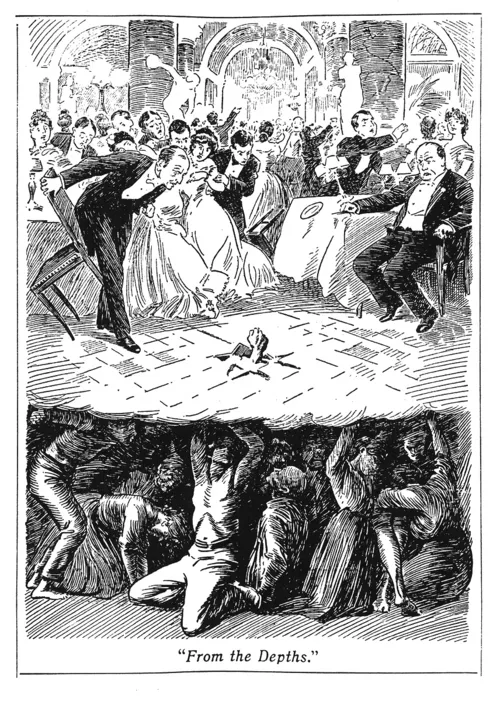
Source: J.A. Mitchell /Appeal to Reason (1906)
Summarizing Rosa Luxemburg, scholar Jackie Wang offers two crucial takeaways:
1) Capitalism is inherently expansionary, as it seeks to realize an ever-increasing amount of surplus value;
2) There is no reason why surplus value need be realized within the formal capitalist sphere when realization can be secured through violence, state force, colonization, militarism, war, the use of international credit to promote the interests of the hegemonies, the expropriation of indigenous land, predatory tariffs and taxes, hyper-exploitation, and the pilfering of the public purse (Wang 2018, 107).
Primitive accumulation is forcible, violent, and expropriative, with colonization coming to be seen as an answer to the problem of the “stationary state” in the quest for unyielding growth, as Julia Elyachar notes in her talk . And, this process of expropriation often “relies on a logic of differentiation that reproduces racialized (as well as gendered) subjects” (Wang 2018, 101) In doing so, it often inaugurates new legal statuses, hierarchical structures, and institutionalized relations. In Nichols’s work, this takes the form of property-generating theft , as discussed above. For Brenna Bhandar, it can be seen in the legal incorporation of First Nations in Canada by way of an identity-property nexus which perpetuates ongoing dispossession (Bhandar 2018, 149-79). We might also look at Julia Elyachar’s work which describes the process by which Cairene workshop owners experience dispossession by way of their very inclusion into microfinance schemes run by International Organizations and NGOs (Elyachar 2005). On top of this we might add Bhandar’s example from the talk of financialization and “financial relations proliferating in the economic life of workers and households in general” in conjunction with the work of Jackie Wang on race and the debt economy (Wang 2018, 99-150).
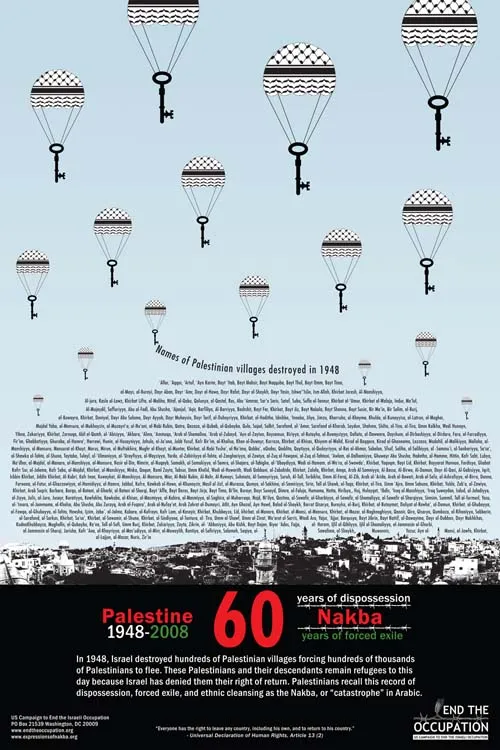
Source: “Parachutes Falling.” Source: Ildiko Toth / US Campaign to End the Israeli Occupation / Palestine Poster Project
This mode of “predatory inclusion” not only obfuscates the act of plunder on the part of the state or financial actors by inscribing individuals into a system in which they appear only retroactively to have always been a part, but it also narrows perceived opportunities for moral redress such that many see their only opportunities for recourse existing through the very systems which facilitated their dispossession.
In Palestine, this tension is often played out in the context of litigation. Many NGOs and legal advocacy organizations seek to challenge the injustices of occupation through the court system. However, as Elian Weizman notes, “An inherent paradox is embodied in litigation as a practice of resistance: the question of legitimacy. Indeed, the dilemma is how to gain justice through the state’s legal ideology without granting legitimacy to the state, which constitutes that ideology” (Weizman 2013; See also Hajjar 2005; Kedar, Amara and Yiftachel 2018). Litigation, inevitably, responds to the immediacy of the situation but challenging the injustices of settler colonialism through the settler’s court leaves the larger system, beyond each individual case, undeterred. Additionally, this process can serve to further retrench the Palestinians into the juridical categories accorded to them by a settler colonial state. We can recognize this tendency elsewhere in the pitfall identified by Nichols regarding the challenge of Native peoples’ responding to dispossession in a way which does not reinforce the very property regimes which facilitated dispossession (See also Nadasdy 2002, 247-261).
How can we think about claims for moral and material redress in light of the challenges posed by this type of “predatory inclusion” and by plunder more broadly? What methods of recourse remain which do not legitimize inclusion in these “predatory” systems?
In a world dominated by the neoliberal market and a society dominated by an ideology of self-improvement, what praxis of resistance can be imagined (Lazzarato 2013)? Can the totalizing debt economy be upended? Do the global formations of accumulation through dispossession have points of vulnerability? If dispossession has replaced the function of exploitation in the capitalist system of wealth accumulation, and labor is no longer the primary form of anti-capitalist subjectivization and no longer has the potentiality of rupture, what praxis is able to target the evasive power of dispossession?
The picture seems quite grim, and yet there are continuous efforts by various organizing initiatives across the globe which seek to object the logics of dispossession and cultivate a new common sense (Clover 2016). The campaign to cancel student debt, for example, has garnered unprecedented support and attention, with nearly one million people signing a petition to cancel student debt by executive order (Morris and Macgowan 2020). Not only debt, but students are also targeting the very financial business model of their universities. This December student organizers for Columbia Young Democratic Socialists of America gathered support of more than 3,000 students for a tuition strike planned for January, which would be the largest tuition strike in American history (Bennett 2020). The students have turned to tuition strike after the university refused to address the demands of several campaigns for a radical change in the University investment portfolio and a tuition reduction during the pandemic. The tuition strike has brought the demands of these campaigns together, and is clear in its message: a demand for a radical divestment from real estate investment and financial growth in favor of investment in students, staff, and faculty. These campaigns are not only unprecedented in their popularity, but they also undermine the very moral foundation of the financialized debt economy: the first is that debts must be paid, and the second is that economic growth is the ultimate condition for society to prosper.
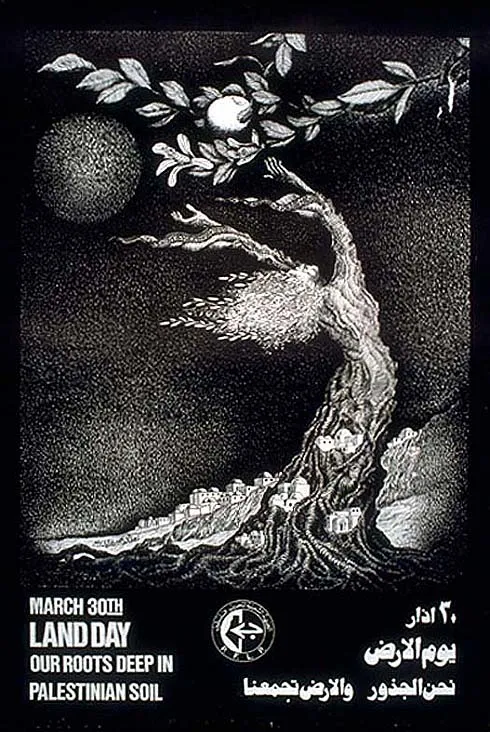
“Call of the Homeland.” Source: Zuhdi Al Aduwi/Popular Front for the Liberation of Palestine (PFLP) /Palestine Poster Project
Sherene Seikaly projects a series of maps onto her shared Zoom screen. First, political maps of the United States that visualize political divisions. But beneath these dots of red and blue, she reveals the layers of dispossession—the map as a “palimpsest” of dispossession, as a “result” of dispossession. Dispossession is not temporally fixed or merely a discrete event of the present, but carries with it the threat of a foreclosed future, the erasure of history and culture. People, events, and places might be rendered invisible, occluded, renamed, but beneath our present veneers, they are present.
Seikaly refers to 1948 Israeli emergency regulations that rendered Palestinians “present on the land, but absent in law.” Her great-grandfather, Naim Cotran (1877-1961), though he survived the Nakba, produced land deeds, and followed bureaucratic procedures, failed to prove the legitimacy of his presence on his land. Despite his once prominent position and his respect of law and bureaucratic procedures, he was dispossessed. The denial of legal presence and appropriation of land illustrate the pronounced, the visible methods of dispossession enacted upon Naim. But in methodologies of history today, dispossession takes on other forms. His presence in history has been obfuscated. The writing of history privileges the use of state archives, the objective voice, and the narrative of the powerful or so-called “worthy.” “If we follow the warning that historical memory can never be recovered,” Seikaly reflects, “and that no memory is ‘pure, unmediated or spontaneous,’ then Naim can never be resurrected” (Seikaly 2018, 17-8). By taking on her research and forthcoming publication on her great-grandfather, she tries to upend these norms of history writing; she strives to uncover Naim’s story and to declare his presence.
What does this do—this “declaration of presence”? Gail Lewis offers this concept as a means towards “decolonizing political praxis.” Thinking through the presence and absence of “‘the black woman’,” she untangles the ways in which Black women and minorities are both present and absent. “‘Presencing’,” she explains, “is an epistemological and ontological praxis of emergence based on felt connection among human and non-human; ancestral and contemporary life. It contests and has the potential to detoxify the effects of colonial discourse (historical and contemporary) in which Indigenous peoples are rendered invisible and/or insensible” (Lewis 2017, 2-4).
By naming, reckoning, writing into history these individuals and lived histories, can we challenge the persistence of dispossession, whose effects accrue in invisible ways through generations? How can we counter the trauma, haunting and marginalization that persist despite the passage of time and now-normalized maps?

Activist and author Kimberly Jones speaks in June 2020. Source: David Jones Media/ CARJAM TV
This summer, a video of activist and author Kimberly Jones went viral, and for good reason. In the video, Jones speaks outside a boarded-up street in the midst of Atlanta’s civil unrest and the BLM protest. The video speaks for itself. The argument Jones offers in regards to the “Looting Question” is not focused on “what the looters get,” it centers on the “why” side in order to understand the bigger issue at stake. There is a lot to unpack in the clip: At first, she presents two arguments made by some, related to the socio-economic dimensions of the civil unrest. One argument, by rich Black people, is that protestors should not be rioting, looting, tearing up their communities. Another argument she brings up is the refusal to spend money, blackout days, to hit the economy where it hurts.
Although she agrees with both methods, she explains that Black people could not burn down their own communities because “we don’t own anything.” She continues:
“When you have civil unrest like this, you have the protestors, there are rioters, there are looters…What is the gain from looting?…As long as we are focusing on the “what” we are not focusing on the ‘why’.…Why in this country, 2020, the financial gap between poor blacks and the rest of the world is such a distance that people feel like there only hope and opportunity to get some of the things that we flaunt and flash in front of them all the time is to walk through broken glass and get it, that they are so hopeless getting that necklace…or whatever that they gonna get. In that moment when the riots happen and if they present an opportunity, that’s there the only opportunity to get it. We need to be questioning ‘why.’
Why are people that poor?Why are people that broke?
Why are people that food insecure?
Why are people clothing insecure?That their only shot by walking through a broken glass window to get what they need,
That we must never forget that economics was the reason that Black people were brought to this country.
We came to do the agriculture work in the South and the textile work in the North…You broke the contract when you killed us in the streets…You broke the contract when for 400 years, we played your game and built your wealth…As far as I’m concerned they can burn this bitch to the ground and it still wouldn’t be enough. And they are lucky that what Black people are looking for is equality and not revenge.”
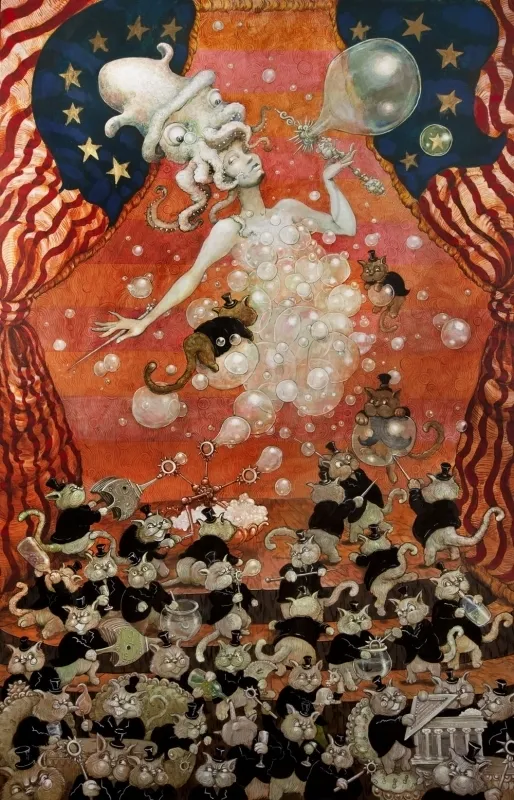
“Shell Game” (2013) Source: Molly Crabapple
The Marxist geographer, David Harvey, emphasises the importance of distinguishing between primitive accumulation and accumulation by dispossession. These two ideas are closely related, and are perhaps adjacent to one another in the conceptual category of dispossession at large, but ought not be conflated as they ultimately gesture to two different phenomena. Primitive accumulation was first famously described by Marx in Part VIII of Capital Volume I . This final part of Marx’s critique of political economy seeks to identify the original sin of bourgeois political economy: how labor-power became a commodity and thus how capital came to be. Marx pushes up against the traditional bourgeois story of a frugal people who accumulated the wealth that was to become capital and the lazy, riotous folk who eventually had nothing to sell but their labor (Marx 1861, 873). Instead, he describes a history of conquest, enslavement, robbery, murder, and force as the primary or original accumulation of capital. In essence, primitive accumulation describes the process of incorporating non-capitalist people, land, and resources into the capitalist mode of production: the alienation of people from the means of their subsistence (Ibid, 874-5).
Accumulation by dispossession, as opposed to primitive accumulation, describes a process that is entirely within the boundaries of capitalism. According to Harvey, primitive accumulation, “forces people off the land, encloses the commons, and leads to the creation of a wage labor force,” whereas accumulation by dispossession refers to, “the way that already accumulated wealth is being appropriated or stolen away by certain sectors of capital without any regard for investing in production” (Harvey 2020, 319). Accumulation by dispossession, in Harvey’s terms, is a parallel form of capital accumulation to accumulation by the exploitation of labor.
In the orthodox Marxist conceptualization of accumulation, capital acquires surplus-value through the exchange of the self-valorizing commodity, labor-power, in the production process. Marx was describing the dominant form of capital in his time, industrial capital, but the landscape of capitalism has since shifted. In the era of neoliberal capitalism, finance capital has become dominant to industrial capital and accumulation by dispossession has become a more popular method for capital accumulation than accumulation by exploitation.
Accumulation by dispossession describes the form of capital accumulation in which a firm acquires the capital of others through a number of strategies, such as the use of mergers and acquisitions (Ibid, 321). Marx hinted at this alternative form of accumulation in his discussion of the laws of concentration of capital; “Capital grows to a huge mass in a single hand in one place, because it has been lost by many in another place” (Marx 1861, 777). In other words, in the perfect competition of liberal political economy there is a vast number of small firms, but Marx presents a centripetal force of capitalism which leads to the concentration of capital in the hands of a monopolistic firm.
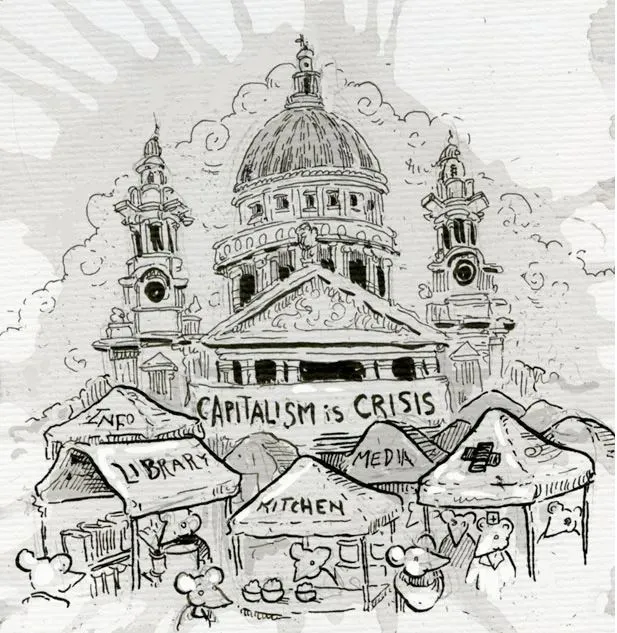
Source: Molly Crabapple/ The Nation
One way in which a larger firm is able to acquire the capital of a smaller firm is through the credit system. Small capital can be forced into bankruptcy if they are cut off from the flow of liquidity and are not able to roll over their debt. Large capital can then acquire the bankrupt capital at a low cost and earn a profit when liquidity is restored (Harvey 2020, 322). It should be obvious that this accumulation by dispossession, now under neoliberalism the dominant form of accumulation, is also a non-productive form of accumulation. To paraphrase the words of Brenna Bhandar, it is a form of profit unrelated to the creation of surplus-value. She notes that, “the underlying asset might bottom out or be liquidated, but profit has been generated on the exchange of the financialized asset, which is exactly what we saw with the [2008] subprime mortgage crisis.” Harvey concurs with Bhandar, recalling that during the housing crisis:
“Owners could not pay their mortgages and a vast number of houses had to be sold off at cheap foreclosed prices. In steps a private equity company… to buy up the foreclosed houses at fire-sale prices… As the housing market recovers… you can sell them off at a vast profit. This is a very large segment of the economy, which is run on the basis of an accumulation process that has nothing to do with production. It is all about profiting upon the trading of asset values… under conditions in which the asset values are forced into devaluation at a certain historical moment by mechanisms in the market. The assets are subsequently revalued and it is the private equity companies that can capitalize on the revaluation” (Ibid, 432).
It should not be assumed that this contemporary version of dispossession, accumulation by dispossession, is in some way an evolution of primitive accumulation, a historical form of dispossession. Intellectuals such as Rosa Luxemburg have corrected Marx’s original formulation of primitive accumulation as historical by commenting on the ongoing processes of colonization and imperialism that violently open up new lands and populations to the capitalist system, although Luxemburg too does not adequately distinguish between primitive accumulation and accumulation by dispossession (Luxemburg 1913). What truly distinguishes the era of neoliberal capitalism and especially the protracted present of uprising against structural inequality in the second decade of the 21st century is the simultaneity of accumulation by dispossession and primitive accumulation side by side. With the exception of only a few pockets, the world market system has infiltrated nearly every corner of the world, ensnaring a vast majority of the world population to commodify their labor-power and the land on which they stand. In the same breath, already-existing capital continues to flow towards a tiny number of elite, leaving less and less for the general population to live. Sooner rather than later, these two phenomena will inevitably directly confront their own contradictions as capital runs out of new markets to serve as a spatial-fix and as the laboring masses are increasingly and untenably immiserated.
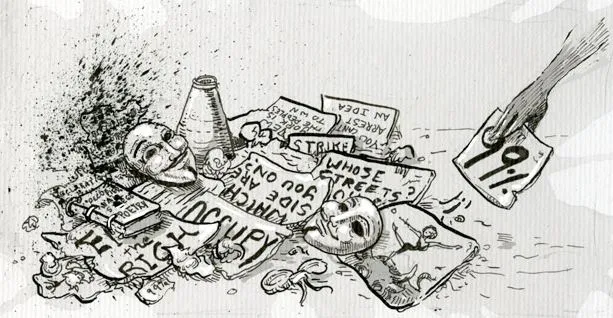
Bennet, Emmaline. “ Columbia University’s Tuition Strike Is Only the Beginning .” Jacobin , December 16, 2020.
Bhandar, Brenna. Colonial Lives of Property: Law, Land, and Racial Regimes of Ownership . 2018.
Clover, Joshua. Riot. Strike. Riot . 2016.
Dawson, Michael C. “ Hidden in Plain Sight: A Note on Legitimation Crises and the Racial Order .” Critical Historical Studies . 2016.
Elyachar, Julia. Markets of Dispossession: NGOs, Economic Development, and the State in Cairo . 2005.
Fraser, Nancy. “ Expropriation and Exploitation in Racialized Capitalism: A Reply to Michael Dawson .” Critical Historical Studies . 2016.
Hajjar, Lisa. Courting Conflict: The Israeli Military Court System in the West Bank and Gaza . 2005.
Harvey, David. A Companion to Marx’s Capital . 2018.
Harvey, David. The Anti-Capitalist Chronicles . 2020.
Harvey, David. The Limits to Capital . 2018.
Kedar, Alexandre, Ahmad Amara, and Oren Yiftachel. Emptied Lands: A Legal Geography of Bedouin Rights in the Negev . 2018.
Lapavitsas, Costas. “ The financialization of capitalism: ‘Profiting without producing ’.” City . 2013.
Lazzarato, Maurizio. The Making of the Indebted Man: An Essay on the Neoliberal Condition . Semiotext. 2013.
Luxemburg, Rosa. The Accumulation of Capital , trans. Agnes Schwarzschild. 2003.
Marx, Karl. Capital Volume I . 1861. Translated by Ben Fowkes, 1976.
Mezzadra, Sandro. “ Marx in Algiers .” Radical Philosophy. 2018.
Morris, Willem and Macgowan, Ben. “ Students at Columbia and the University of Manchester Are Rejecting Austerity in Higher Ed .” Jacobin , December 17, 2020.
Nadasdy, Paul. “‘ Property’ and Aboriginal Land Claims in the Canadian Subarctic: Some Theoretical Considerations .” American Anthropologist. 2002.
Nichols, Robert. “ Theft Is Property! The Recursive Logic of Dispossession .” Political Theory . 2018.
Robinson, Cedric J. Black Marxism: The Making of the Black Radical Tradition . 2000.
Savage, Luke. “ The US Economy is a System of Plunder .” Jacobin, October 8, 2019.
Seikaly, Sherene. Men of Capital: Scarcity and Economy in Mandate Palestine . 2016.
Wang, Jackie. Carceral Capitalism . 2018.
Weizman, Elian. “ Palestinian Family Unification in Israel: The Limits of Litigation as Means of Resistance .” Critical Legal Thinking . 2013.
Peyman Jafari will moderate a conversation with panelists Narges Bajoghli, Manata Hashemi, and M. Ali Kadivar on recent protests in Iran. They will reflect on the social makeup of the protests, nature of the grievances, and the State’s harsh repression of the protest movements. The panelists will also reflect on Iran's protests in relation to global protests and the rise of social justice in the region.
Narges Bajoghli is an Assistant Professor of Middle East Studies at the School of Advanced International Studies at Johns Hopkins University. Narges' academic research is at the intersections of media, power, and military in the Middle East. Specifically, her research mainly focuses on regime cultural producers in Iran and is based on ethnographic research with Basij, Ansar-e Hezbollah, and Revolutionary Guard media producers. The resulting book, Iran Reframed: Anxieties of Power in the Islamic Republic , was published by Stanford University Press in September 2019. Outside of academia, she has written for the New York Times Magazine, the New York Times, Guardian, and the Washington Post, and has appeared as a commentator on NPR, PBS, and the BBC. She is the director of the documentary The Skin That Burns , screened at The Hague, Hiroshima, Jaipur, and film festivals throughout the United States.
Manata Hashemi is a sociologist and the Farzaneh Family Assistant Professor of Iranian Studies in the Department of International and Area Studies at the University of Oklahoma. In her research, she explores how people’s moral understandings influence their behaviors and life outcomes, particularly in low-income contexts in the Middle East. Her work can be found in the International Journal of Urban and Regional Research, Qualitative Sociology, the International Journal of Middle East Studies, the British Journal of Middle Eastern Studies, and The Muslim World among others. She is also the author of the forthcoming book, Coming of Age in Iran: Poverty and the Struggle for Dignity (New York University Press, 2020), which examines how a group of economically disenfranchised youth attempt to move up the social ladder in Iran.
M. Ali Kadivar is an Assistant Professor of Sociology and International Studies at Boston College. His work contributes to political and comparative-historical sociology by exploring the interaction between protest movements and democratization. He has examined both the internal organization, tactics, and perceptions of pro-democracy movements as well as their success or failure in gaining and sustaining democratic improvements. Kadivar’s research has been published in the American Sociological Review, Social Forces, Comparative Politics, Socius, and Mobilization.
Peyman Jafari is an associate research scholar with the Mossavar-Rahmani Center for Iran and Persian Gulf Studies at Princeton University, where he is writing a book on the history of state, capital and labor in the Iranian oil industry from 1973 to the present. Previously, he was a visiting scholar at SOAS, University of London and Columbia University. His articles have appeared in various peer-reviewed journals, including Labor History, International Labor and Working-Class History, Workers of the World - International Journal on Strikes and Social Conflicts.
Part of the Fall 2020 course Problems and Methods in Middle Eastern Studies
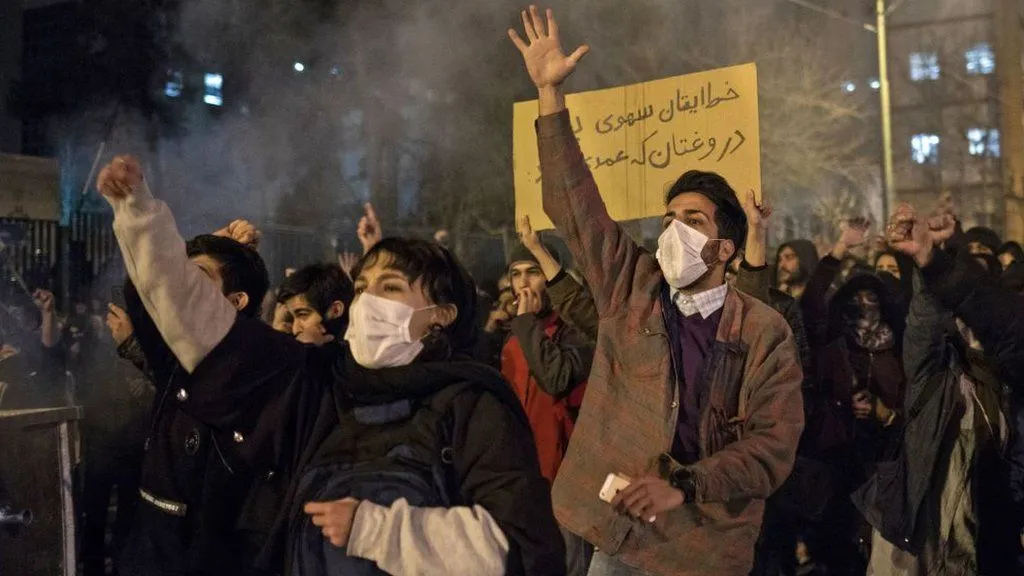
Protestors at an anti-government rally in Tehran on January 11, 2020. Source: AFP/ VOA
Neoliberalism and neoliberalization are two topics that barely need introduction. Neoliberal policies affect everyday lives of most people across the world. Neoliberalization the process, broadly identified to be coincident with the rise of the Bretton Woods institutions and the dominance of a globalized financial system, has faced dramatic upheaval since the fall of the Soviet Union. No introduction to these topics is possible without mentioning Francis Fukyama’s “The End of History?” and John Williamson’s “The Washington Consensus.” But these are two different things; neoliberalism consists of ideas, while neoliberalization consists of policies. As a result, neoliberalism is hard to pin down, while neoliberalization is far easier to see.
Source: Amazon
Here, we will attempt to define neoliberalism through an examination of the neoliberalization policies of Iran. Iran presents an unique lens to understand neoliberalism due to its position relative to the United States and Europe, the two key drivers of the post-Cold War neoliberal consensus.
When Fukyama wrote “The End of History,” he lived at the apogee of neoliberal triumphalism. With the fall of the Soviet Union consigning the model of planned economies into dust, neoliberal policies developed two decades prior were left, or as Margaret Thatcher put it, “There is no alternative.”
The Reagan/Thatcher era policies, continued through successive administrations, pioneered the Washington Consensus. Privatization of national resources combined with deregulation became the leading export of Washington and London to the Global South. Helmed by international organizations such as the International Monetary Fund (which is always de facto lead by a European) and the World Bank (whose president is de facto an American), these policies cohered under the umbrella of “structural adjustment,” or demands that states privatize and deregulate in exchange for loans and technical support.
Hence, we identify the term “neoliberalism” with economic scientism and opposition to state intervention in the economic sphere, as well as concomitant World Bank- and IMF-planned structural adjustment programs, austerity measures aimed to reduce social welfare spending and protections for labor, the privatization of domestic industries and firms, and efforts to attract foreign capital investment. Our concern now is to try to make sense of the history of neoliberal policies under the Islamic Republic, in order to shed light on these interrelated issues of austerity and corruption circa 2019-2020.
Scholars of modern Iranian political economy generally agree that the Islamic Republic took a turn toward neoliberalization in its second decade, after the end of the long war with Iraq. The war era (1980-1988), however, tells a different story. Peyman Jafari aptly describes the economic philosophy of the revolutionary government in its first decade as “ populist state capitalism .” This was a form of state integration with and management of the economy with a broad-based developmentalist orientation. The Islamic Republic sought to industrialize, and quickly. It implemented policies such as import-substitution to protect domestic industries, and it nationalized a large number of factories. The working class was the beneficiary of many of these state-led industrialization policies, which were accompanied by a new labor law that established a minimum wage, 48-hour workweeks, and some job security. The Labor Law did not legalize unions and strikes, but as Saira Rafiee has noted, during the war era, about 90 percent of workers enjoyed permanent contracts . The regime also issued ration cards for basic foodstuffs and directly or indirectly subsidized fuel, water, sanitation, and electricity. A quarter of the annual budget during this period was allocated to these subsidies. These redistributive measures won the Islamic Republic support during the troubled war years and led to dramatic modernization across Iran’s regions and the sectors of its economy (Abrahamian 2008, 176-180).
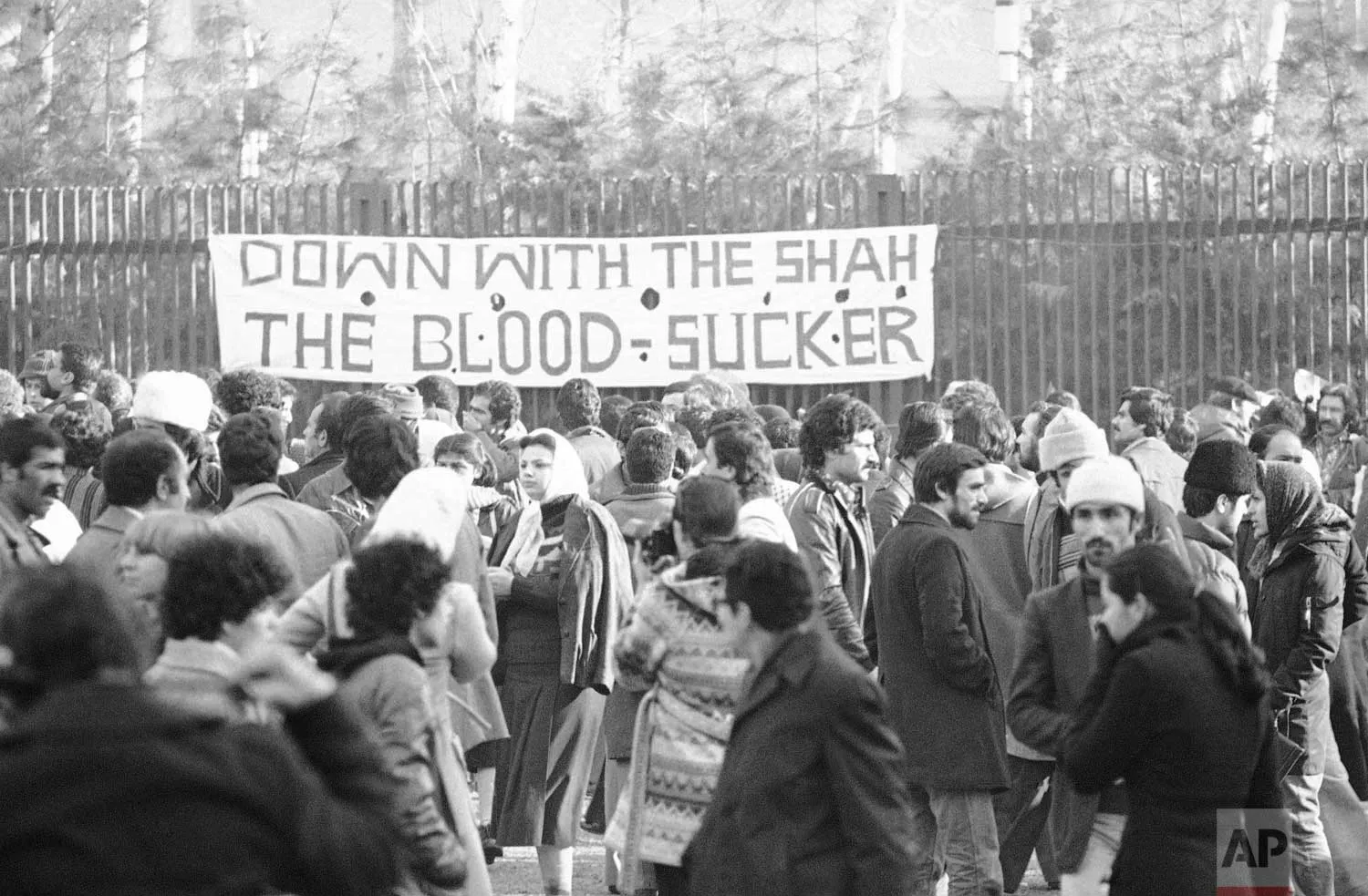
A banner denounces Shah Mohammad Reza Pahlavi at Tehran University on January 13, 1979. Source: AP Photo/Bernhard Frye
The economic philosophy undergirding the Islamic Republic during its first decade can be seen as its attempt to fulfill the revolutionary promise: a populist-driven effort toward social and regional equality in response to the precarity of the Pahlavi years. Economic migrants from the countryside to Iran’s cities were, after all, an important force in the revolution’s marches, drawing light to poor urban conditions and uneven modernization in the country’s rural areas . Yet it must be emphasized that despite its populist orientation and embrace of state intervention in the economy, the early Islamic Republic explicitly distanced itself from the Left and leftist ideas. In his seminal Khomeinism , Ervand Abrahamian advances the argument that the Iranian Revolution effectively produced a new bourgeois state, given that for Khomeini and his followers, the concept of private property remained central and worthy of defense in religious terms. Khomeini, Abrahamian also shows, closely linked the Islamic Republic’s longevity and legitimacy to support from the bazaar and middle class during these years and thereafter (Abrahamian 1993, 39-59).
Hence, observers argue that the postwar transition away from populist state capitalism was to be expected, given the loyalty to private property at the heart of the regime’s economic philosophy. The Rafsanjani presidency (1989-1997) merely brought this philosophy to fruition, as his administration pursued policies of economic liberalization as Iran’s postwar reconstruction strategy. In 1990, Rafsanjani delivered to the Majles (Parliament) a budget animated by the proposition that the central government was too intrusive in economic affairs, and that its involvement over the past decade had caused inefficiencies in the market. This notion of government being the problem rather than the solution, we can tentatively suggest, was one of the markers of Iran’s neoliberal turn (Axworthy 2016, 309).
Central to Rafsanjani’s reconstruction program was the privatization of over 800 factories and businesses—as well as agricultural land—that had been nationalized following the revolution. Rafsanjani sought capital investment to stimulate Iran’s economy, and privatization seemed the best pathway to growth (Ibid). His administration courted investment from abroad—including an oil concession to an American firm—as part of the drive to liberalize the economy in the 1990s. What is more, Rafsanjani sought to relax Iran’s Labor Law in order to make factory ownership more profitable (at the expense of worker protections), and to cut subsidies for food, fuel, and gasoline (184-5).
Akbar Hashemi Rafsanjani visits workers. Source: IRNA Archive
Many of Rafsanjani’s proposals were opposed by Supreme Leader Ali Khamenei and the Guardian Council, however, who wanted to maintain Iran’s economic independence by refusing to integrate into the U.S.-led global markets. And the Majles, Iran’s most democratic body, vocally rejected these neoliberalizing policies; in 1994, the Majles voted to cripple much of Rafsanjani’s privatization scheme by stipulating that its beneficiaries had to be war veterans. The Majles in fact both blocked future privatizations and annulled previous ones (320-1).
But the neoliberal turn had begun, even if the trend toward it was gradual. We can see this in government policies to end rationing, relax price controls, downsize the bureaucracy (unsuccessfully), as well as to balance the budget, which is always a political decision. And we can see this in the regime’s rhetoric as well: the Supreme Leader distanced Ali, the first Imam in the Shi’i tradition, from his image in the revolutionary and war eras as a warrior-champion of the downtrodden. Now Imam Ali was cast as a pious plantation owner who would retire to his private property after the war, signalling the contemporary government’s desire to relieve itself of economic stewardship in favor of market liberalization (183).
Hence, the three decades that have since the war have followed a different course: what Jafari calls a shift toward “ neoliberal state capitalism .” Key to this shift was Rafsanjani’s establishment of a “free market” think tank intended to educate the next generation of Iranians in the “science” of economics. The Institute of Planning and Management Education and Research—commonly known as the Niavaran Circle, referring to its location in the elite neighborhood of northern Tehran— promoted the neoliberal policies outlined above and advocated a turn toward integrating Iran in the global economy by attracting streams of foreign capital . One of the Circle’s directors, incidentally, was Hassan Rouhani, a future implementer of Rafsanjani’s economic policies in his (current) stint as president of Iran.
Although some scholars prescribe caution in the blanket extension of the term “neoliberalism” to describe Iran’s political economy in the past thirty years, Rafiee instructs us to recognize Iran’s policies for what they were and have been . Rafsanjani, she stresses, courted and received World Bank and IMF expertise during his administration, and he implemented many of the anti-social spending, pro-market liberalization policies associated with the Structural Adjustment (SAP) era. Other scholars, such as Ali Kadivar, Azam Khatam, and Zep Kalb , note that the political-economic history of the Islamic Republic has been more of a gradual shift from state-interventionism to neoliberalization. On this point, Kalb criticizes the Left for its fixation on the term “neoliberalism” to describe Iran, in what she calls their idealization of the state-guided populist policies of the war years. And Khatam, for instance, stresses that it was not until 2006-07, under the Ahmadinejad administration, that the major achievements of the privatization scheme were realized. Nevertheless, Rafiee reminds us that the course of modern Iranian political economy is as such: 90 percent of employment contracts were permanent during the war years, whereas 90 percent of these contracts are now temporary, and thus precarious.
“to gain a better understanding of Iranian politics, it is necessary for us to think about the often-conceptually separated categories of state, economy, and society as linked and interrelated”
One further clarification comes from Jafari, who complicates the narrative of Iranian neoliberalization by pointing out that much of the privatization scheme has been state-adjacent, rather than a full release of capital into the private sector. Actors with close ties to the regime have benefited the most from privatization. Namely, semi-state institutions such as the ostensibly charitable foundations for the poor and veterans (bonyads) and the Iranian Revolutionary Guard Corps now control a significant portion of Iranian industry and agriculture . These institutions, moreover, lack democratic oversight, and increasingly concentrate wealth in the hands of the few with access to power. We can draw a further lesson: to gain a better understanding of Iranian politics, it is necessary for us to think about the often-conceptually separated categories of state, economy, and society as linked and interrelated. The bonyads and other semi-state institutions that have benefited from neoliberalization show us this (Mitchell 1991, 77-96).
This, then, is how we arrive at the present. The current Rouhani administration has proposed austerity budgets year after year . The Rouhani government has slashed social spending and liquidated government assets such as gold and foreign currency reserves to the benefit of the well-connected elite. Iran’s economy increasingly revolves around precarious real estate speculation, as U.S.-led sanctions continue to strangle oil revenues and domestic industry, which are far sturdier foundations for growth.
Iranian President Hassan Rouhani submits an austerity budget in 2019. Source: Financial Tribune
As we will see in the remainder of this analysis, the sanctions regime plays a major role in the debilitation of Iranian economic life. But as Ismael Hossein-Zadeh argues, the dynamics of the sanctions regime are inexorably tied to those of Iran’s current economic policies, which put the country at the mercy of hostile foreign powers such as the United States . Rouhani’s paramount foreign policy goal has been to engage Western powers through the JCPOA negotiations, trading Iran’s nuclear energy program for integration into the global economy and thus, the reception of foreign capital investment. Yet the foreign investment that came at the expense of Iran’s forfeit of its nuclear energy program has been minimal, especially so after the Trump administration reneged on the United States’ commitment to the deal. For under the JCPOA, Iran’s economic success is chiefly dependent on the United States allowing it into the global economy as a market ripe for foreign investment. When this investment has predictably not come, Iranians have suffered, and austerity has continued to be the stopgap “remedy.”
Leftist observers of Iranian political economy argue that the Islamic Republic would be better off distancing itself from the hostile arenas of global capitalism and reflecting inward, prioritizing domestic industrialization and increasing subsidies and social spending to uplift the ever-growing poor . If not, they warn, discontented Iranians will reach a breaking point, as the frequent and dramatic protests of recent years show. Instead, however, the Rouhani administration has become the advocate-par-excellence of neoliberal policies in Iran. And, as we will suggest, a key component of the smokescreen used to mask the failures of this neoliberal scheme are the current administration’s anti-corruption drives.
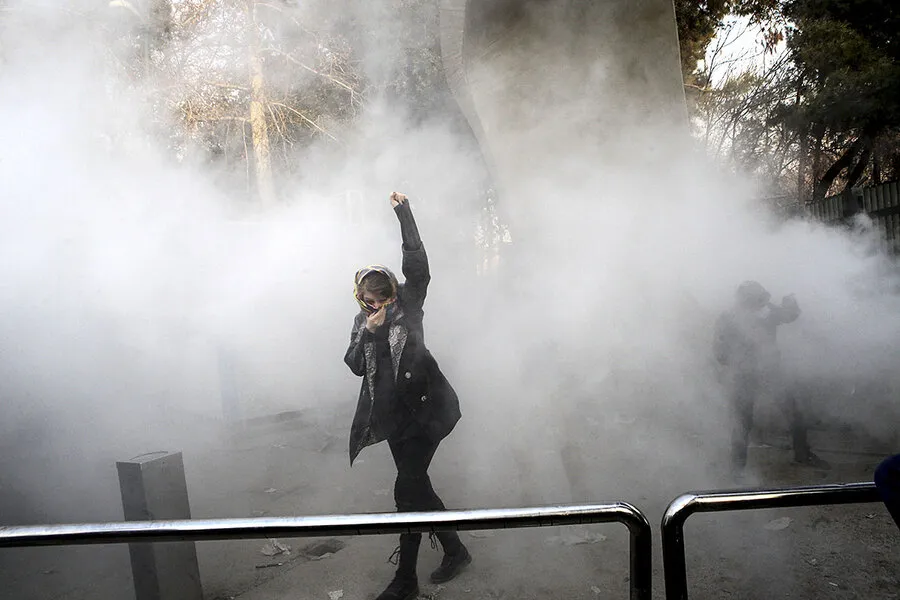
An anti-government protestor at Tehran University walks through a cloud of smoke in December 2017. Source: AP/ The Christian Science Monitor
Iran has never been too far from the center of discussion—if not directly in the middle of it—among U.S. politicians and internet hawks, most of whom have always sought to capitalize on the regime’s internal corruption. Indeed, Secretary of State under President Trump, Mike Pompeo, has become notorious for making scathing accusations against the Islamic Republic, whether it be condemning the regime for “ wasting natural resources on military adventurism ” or outrightly accusing its leaders of ruling under “ 40 years of kleptocracy .” Similar sentiments can be found on Iranian “ news ” websites, whose headlines seem to all exclusively focus on one or another aspect of Iran’s civil rights abuses and economic instability. And while there’s certainly state interests and political agendas motivating such descriptions of Iran, it’s important to note that they are not exactly wrong.
Corruption is generally defined as the dishonest conduct by those in power for direct or indirect personal gain; it’s an inevitable phenomenon that exists within all countries, albeit at different scales. According to the World Bank and Transparency International, Iran consistently ranks high as one of the countries with the most corruption, and has currently been battling its “deepest economic and legitimacy crisis” since the inception of the Islamic Republic directly following the 1979 revolution (Azadi 2020, 1-3). Their corruption can be delineated into five broad groups: political, coercive, administrative, non-governmental, and favoritism.
Fig. 1: Pooya Azadi. The Structure of Corruption in Iran. Source: Stanford Iran 2040 Project
In light of this structure of corruption in Iran, a large population of its citizens are currently living under the international poverty line while the value of their currency continues to decline, problems that have only been exacerbated by the extreme onslaught of—and poorly executed warnings against—the COVID-19 pandemic. Accountability is a key factor in handling corruption, but enforcing accountability has been difficult in Iran when those responsible for observing the rules and regulations are part of the elite taking advantage of the system. Indeed, as the figure above indicates, legal institutions are ill-prepared to address the country’s corruption when they, themselves, are riddled with nepotism, influence peddling, and conflicts of interest; the undemocratic nature of elections in Iran, too, make it impossible for its citizens to even vote out its corrupt leaders. Compounding such issues are poorly defined rules that allow these large state powers to abide by their own discretion without being held responsible. Corruption coming from the regime and its key players should be seriously considered and criticized, for it is indicative of the foundational, underlying issues that arise from Iran’s liberalized market. And yet, Iran’s corruption is not an issue that solely lies within state borders; in fact, it has largely been propagated by U.S. foreign policies aimed at the Islamic Republic.
Conservatives in the US continually propagate the notion that Iran’s economic problems are solely a product of internal corruption. This masks both the harm of neoliberalism in Iran generally, and the pronounced role the US has played in deepening Iran’s economic devastation through its use of sanctions.
Fig. 2: Economic growth in Iran as affected by U.S. sanctions. Data from BBC (2019)
As shown in the graph above, the two steepest periods of decline in Iran’s GDP occurred between 2011 and 2014, and from mid-2018 to present-day. These two periods correspond tellingly to the height of US sanctions on Iran. In examining the data, it is undeniable that sanctions play a crucial role in Iran’s economic devastation. They also disproportionately harm the lower strata of Iranian society, as opposed to the regime’s elite that they are supposedly targeting. Most Iranians have seen a decrease in purchasing power concurrent with rising inflation and unemployment . Despite this reality, the narrative of US conservatives consistently positions corruption as the principle cause of Iran’s economic problems (Davari 2019).
Source: Twitter
Secretary Pompeo’s analysis of the situation in Iranian borders on Orwellian: he completely disregards the debilitating effects of the US sanctions on the very statistics he is quoting.
Further, as Ali Kadivar notes, the US sanctions—coupled with pressure from the US and strained relations with Saudi Arabia—have actually strengthened the Iranian political elite that Pompeo critiques.
This narrative extends far beyond Pompeo. In a 2016 Congressional briefing , the following suggestion was made: “U.S. policymakers and European counterparts and others should publicly identify Iran’s self-imposed financial problems….The strongest and most credible strategy to highlight Iran’s need to improve its financial transparency and accountability is for technical experts to point out the problems in the anti-money laundering, counter-terrorist financing, counter-corruption, and prudential financial stability domains that Iran must address” (Elizabeth Rosenburg, Center for a New American Security). In this way, the US is positioned as a helpful outsider that can offer Iran guidance on how to solve the self-induced financial issues that stem from corruption. Many Iranian expatriates are also quick to point to Iran’s “ corrupt and brutal system ” as the source of the country’s financial troubles.
The argument here isn’t that corruption in Iran doesn’t exist, or that it isn’t a contributing factor in the country’s economic issues; on the contrary, the very real existence of corruption in Iran has been discussed above. However, corruption tends to take center stage in the US’ narrative around Iran; it is identified as the absolute source of Iran’s economic problems. This narrative obscures the underlying economic structure of neoliberalism that corruption is symptomatic of and belies the central role the US has played in crippling the Iranian economy.
The Iranian regime has attempted to restructure the corruption narrative that the U.S. has promulgated through a variety of internal measures, albeit to no real effect. Such actions include the institutionalization of different anti-corruption bodies, preventive policies and the enforcement of anti-corruption laws (Habeeb and Jafari 2020). As part of global efforts to minimize corruption, Iran joined the United Nations Convention against Corruption in 2003, as well as several international organizations including the Convention on Combating Bribery of Foreign Public Officials in International Business Transactions, United Nations Office on Drugs and Crime, United Nations Convention against Trans-national Organised Crime and Interpol. Upon the urging of these international bodies, anti-corruption measures were distinguished under preventative policies, detective measures, and punitive measures.
“The blame is cast off onto external enemies and to the dominant narrative that these other states would like to see Iran demolished”
Preventative policies include the establishment of a code of conduct for all government employees, distribution of salary by bank account for all private and public officers, the declaration of assets and income of public officials, and non-operation of anonymous bank accounts. Detective measures include “the Financial Intelligence Unit (FIU), Centre for the Fight against Money Laundering, Supreme Audit Institute (SAI) and General Inspection Organization (GIO)” (81). Punitive measures are stipulated in a legal framework that seeks to dole out punishments based on the implementation and enforcement of anti-corruption legislation to dissuade future corruption and send a clear message that the state will not tolerate criminality. Punishments run the gamut from jail time to execution. While these measures seem exemplary of a state intent on eradicating corruption from within, there is an alarming lack of performance reviews that adequately measure the effects of these anti-corruption initiatives. There is little to no accountability to increase transparency of the insitutitions charged with monitoring the effects of policies, as well as a generally closed administrative system. This is a result of a pervading sense of suspicion and paranoia on behalf of the Iranian government that corruption is primarily identified by opposition groups from outside the country. This fear is not entirely unfounded, as we have seen an almost single-minded determination by multiple external actors, including the US and Israel, to discount and delegitimize Iran on the basis of corruption. Consequently, independent media within Iran rarely investigate or report on corruption.
In an effort to assert that corruption is properly addressed from within and in response to public condemnation of the ability of the revolutionary courts to pass down appropriate judgement, the government did respond. In the summer of 2018 , a series of special anti-corruption courts were established by Ayatollah Khamenei, designed to crack down on corruption amidst growing discontent. The tribunals resulted in a number of high-profile executions, like that of billionaire Babak Zanjani and a few notable currency traders who were found to be withholding gold coins in the midst of the trial’s most catastrophic plunge. In this way, public anger was slightly dissuaded while at the same time reinforcing a narrative that corruption comes not from within the Iranian government but is a consequence of an economy destroyed by sanctions and ripe for exploitation. The blame is cast off onto external enemies and to the dominant narrative that these other states would like to see Iran demolished, effectively disguising any internal issues under this tried and true discourse. As such, any concerns over austerity measures, corruption, and a failing neoliberal model get decentered by these actions, confusing the blame between an economy ruined by sanctions rather than by home-based actors.
The 2019 wave of protests that erupted in Iran, following an abrupt hike in gasoline prices, is considered to be Iran’s “ deadliest political unrest since the Islamic Revolution ,” with varying death count estimates. Amnesty International reported a death toll of at least 304, while Reuters reported a number reaching 1500, alongside thousands of injured individuals. The internet blackout that quickly followed clearly indicates the Iranian government’s (failing) attempt to control media coverage over its violent and bloody crackdown of the protest, an approach that reveals its own corruption.
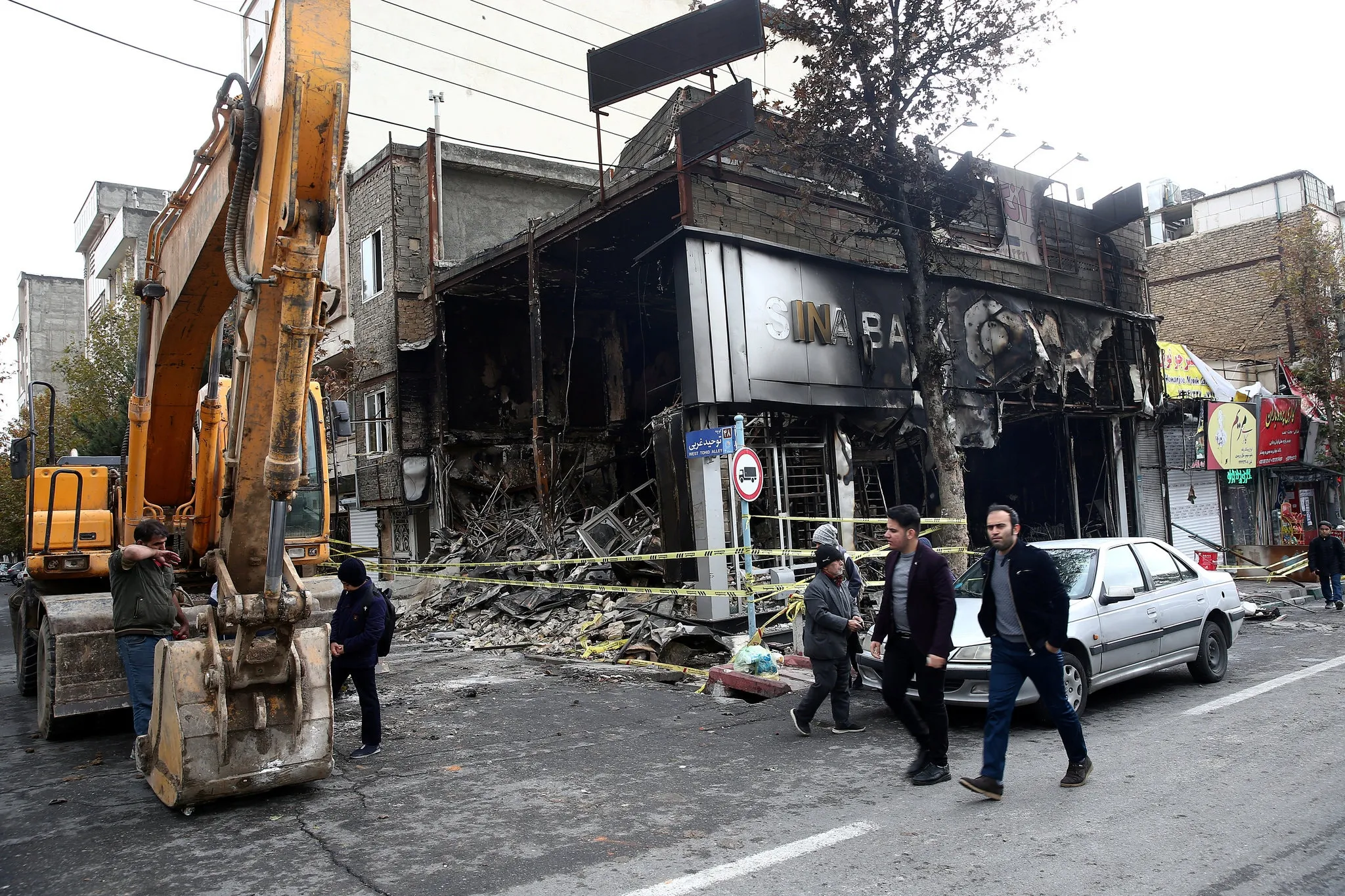
A burned bank in Tehran after protests against increased fuel prices in Tehran in November 2019. Source: Nazanin Tabatabaee/West Asia News Agency/Reuters/The New York Times
The protests were unquestionably anti-government in nature, with protesters calling for “an end to the Islamic Republic’s government and the downfall of its leaders .” Iranian citizens, many of whom are financially struggling and/or living in poverty, are fed up with the stark divide between the rich and the poor and frustrated with the regime. They are not phased by the regime’s efforts to cover up and deny government “systemic corruption;” on the contrary, Iranians are widely aware that their own government’s widespread internal financial corruption, cronyism and nepotism is largely the cause of the country’s own financial and economic crisis. With the absence of independent institutions and the “systemic corruption” of government apparatuses and Iran’s judiciary , protesting is the only and last resort for many Iranians. The streets become the only place for them to express their anger and show their disapproval of their government and their leaders, whose failure to govern properly has been shaped in large part by the neoliberal structures of the contemporary global economy.
These protests have been picked up by international media outlets, particularly that of the U.S., as clear calls for a regime change. And yet, when protests of a similar nature have taken place elsewhere—take, for example, the Yellow Vest movement in France—narratives around regime-change or revolutionary discourse are not used; rather, the focus is on making simple amendments to the existing model. This stark characterization and media coverage by the U.S. is a double-standard that the U.S. places on Iran in order to mask its own neoliberal policies against Iran, a double-standard that the Iranian government has been, of course, quick to point out, using it also to mask its own corruption.
It’s clear, then, that corruption in Iran is a symptom of larger economic issues around neoliberalism; however, these neoliberal policies stem from within Iran’s own regime and the U.S. government.
Abrahamian, Ervand. A History of Modern Iran . 2008.
Abrahamian, Ervand. Khomeinism: Essays on the Islamic Republic . 1993.
Axworthy, Michael. Revolutionary Iran: A History of the Islamic Republic . 2016.
Azadi, Pooya. “ The Structure of Corruption in Iran .” Stanford Iran 2040 Project. 2020.
Davari, Arash, et al. “ Roundtables: Iran’s Domestic Politics and Political Economy (Part 1) .” Jadaliyya. 2019.
Davari, Arash, et al. “ Roundtables: Iran’s Domestic Politics and Political Economy (Part 2) .” Jadaliyya. 2019.
Kajsiu, Blendi. A Discourse Analysis of Corruption: Instituting Neoliberalism Against Corruption in Albania, 1998-2005 . 2015.
Katzarova, Elitza. The Social Construction of Global Corruption: From Utopia to Neoliberalism . 2018.
Mitchell, Timothy. “ The Limits of the State: Beyond Statist Approaches and their Critics .” American Political Science Review. 1991.
Salihu, Habeeb A, and Amin Jafari. “ Corruption and Anti-Corruption Strategies in Iran: An Overview of the Preventive, Detective and Punitive Measures .” Journal of Money Laundering Control . 2020.
Solimano, Andrés. Global Capitalism in Disarray: Inequality, Debt, and Austerity . 2016.
Villalón, Roberta. “ Neoliberalism, Corruption, and Legacies of Contention: Argentina’s Social Movements, 1993-2006 .” Latin American Perspectives . 2007.
The emergence of the Occupy Wall Street movement nearly a decade ago provided a particularly new rhetoric of protest that has persisted across uprisings, political debates, and numerous crises that have come in its wake. “We are the 99%” identified economic inequality as a central problem that unified many concurrent and overlapping concerns regarding taxation, employment, wealth, kleptocracy, financialization, corruption, neoliberalism, race, etc. Over the course of the last decade, however, wealth inequality has only worsened, and the knotty issues of international finance have loomed over more and more desperate economic situations across the Middle East and the world. At the same time, the direct criticism of the 99% against the 1% has seldom met squarely with critiques of the financial system by those more intimately familiar with the way it works. The exception to this seems to have been in the recent, and dire, situation in Lebanon, where the issue of corruption within the banking system, mismanagement of foreign debt, and resultant collapse of the local currency has triggered a systemic shock of proportions so grand that even former bastions of the neoliberal establishment have called on Lebanon’s bankers to “take a haircut”. Surely, the issues and stakes involved in Lebanon have also manifested themselves in serious, if only slightly less severe ways in Turkey, Iran, Egypt, and elsewhere across the Middle East. Moreover, the current pandemic has seemingly preyed more harshly on states and societies with extreme wealth inequality across the globe.
Pınar Bedirhanoğlu is an Associate Professor at the Department of International Relations at Middle East Technical University.
Nils Gilman is the Vice President of Programs at the Berggruen Institute , in which capacity he leads the Institute’s research program, directs its resident fellowship program, and is also Deputy Editor of Noema Magazine . He has previously worked as Associate Chancellor at the University of California Berkeley, as Research Director and scenario planning consultant at the Monitor Group and Global Business Network, and at various enterprise software companies including Salesforce.com and BEA Systems.
Adam Hanieh is a senior lecturer at the School of Oriental and African Studies (SOAS), University of London and the author of Lineages of Revolt: Issues of Contemporary Capitalism in the Middle East
Aaron Jakes is an Assistant Professor of History and Co-Director of Capitalism Studies at The New School.
Part of the Fall 2020 course Problems and Methods in Middle Eastern Studies
The Arab uprisings of 2010-2011 undoubtedly created a wave of political change in the Middle East that is not only manifest in the fall of long-standing dictatorships, but also, as we shall see, in the initiation of a series of economic wars that deepened the financial inequalities in the region.
In 2013, almost three years after the onset of the Arab uprisings, Saudi Arabia, the UAE and Kuwait provided material support to the military coup led by then Egyptian Defense Minister Abdul-Fattah al-Sisi, which overthrew the Muslim Brotherhood president and elected government. On the other hand, Qatar backed up the Muslim Brotherhood in Egypt and other Arab countries, such as Tunisia and Syria. This kind of political tension had its impact on the economic dimension as well.
National flag of Qatar and Saudi Arabia. Source: Shutterstock
According to Adam Hanieh, to better understand Gulf capital and Middle Eastern politics, it is essential to look at the economic processes over the last couple of decades, which witnessed a “widespread adoption of market-led neoliberal economic policies across the entire region,” which “has been driven by structural adjustment packages linked to loans from international financial institutions (IFIs)” (Hanieh 2020). These adjustments were evident in policies, such as privatization, labor market, financial deregulation, and opening-up to foreign investments. These “reforms,” as Hanieh states, had always been lauded by the IFI’s as “successes” up until the breakout of the Arab uprisings in 2010.
However, these economic transitions were “closely associated with hardening forms of authoritarianism throughout the region” (ibid). It’s worth remembering that in the 1980s when Zine El Abidine Ben Ali in Tunisia and Hosni Mubarak in Egypt came to power, they were welcomed by the World Bank and the IMF, as they were seen as capable of performing these transitions through such structural adjustment packages that were widely opposed by the public. This explains why, as Hanieh puts it:
[T]here has historically been such a close association between authoritarianism and neoliberal reform in the Middle East. It’s a reality that runs against the myth, peddled by US policymakers through the 1990s and 2000s, of free markets and free elections.
This connection between political change and socioeconomic transformation is evident in the 1990s and 2000s with “the internationalization of Gulf capital throughout the region.” That is “cross-border investments by Gulf conglomerates into neighboring Arab countries” (Ibid.). The neoliberal turn in the Middle East ended up mostly benefiting Gulf investment in the region, including real estate, banking and finance, and the media. According to Hanieh:
These regional capital flows have occurred through a variety of mechanisms, including mergers and acquisitions, minority portfolio investments in other Arab stock markets, the establishment of cross-border subsidiaries, and control over licensing and agency rights. Through these and other means, the internationalization of Gulf capital increasingly acts to shape production, consumption, and financial activities across various Arab states. The political economy of various Arab countries has become closely attuned to the dynamics of capital accumulation in the Gulf itself.
The tension between Qatar on the one hand, and Egypt and other Gulf states on the other since 2017, has definitely had its impact on the political economy in the region, which is evident in Qatar’s investments in Turkey, and other Gulf states’ “dollar reserves” (Ibid.) in neighboring Arab countries like Egypt, Tunisia and Jordan.
National flags of Turkey and Qatar. Source: I Love Qatar /Shutterstock
Given the trade volume of the two countries, trade capacity between Turkey-Qatar, which has risen from $26 million in 2002 to $1.4 billion in 2019, does not indicate a significant economic transaction. The most striking point in the economic relations between the two countries in recent years, especially after 2018, is that Qatar has become the second largest investor in Turkey within a short period of time. How can we explain this rapid rise in economic relations between the two countries? At first glance, this convergence might appear to be related to the Islamic orientations of both governments. However, the confrontation of these states with countries that have similar orientations, such as the UAE, Saudi Arabia or Egypt does not support this argument. However, a more profound analysis of the political scence in the Middle East shows that the two governments in Qatar and Turkey support the Muslim Brotherhood and its regional project, while Saudi Arabia and the UAE strongly oppose it. For Turkey, an additional and more decisive factor is the presence of economic sanctions imposed by the US for human rights violations by the Turkish government.
On the other hand, there are structural factors that make these two countries economically viable partners. For Qatar, the decrease in oil reserves in the world and the declining value of oil due to booming alternative energy sources prompted Qatari politicians to make foreign investments. As a result, the Qatar Investment Authority was established and the fund reached a value of approximately $400 billion in financial and property investments in foreign countries. For Turkey, on the other hand, since 2002, holding a majority in Parliament, the AK Party has created a government-business cooperation based on the model of state capitalism. Particularly after the 2008 global financial crisis, foreign currency in terms of dollars that became abundant in the world economy created important opportunities for developing countries. Focusing on short-term returns rather than long-term investments in this economic environment, the Turkish government encouraged consumption in the domestic market, with abundant loans made possible by the flow of currency from abroad (Berk 2018). The construction and banking sectors benefited the most from this model, and the business class enriched by the AK Party government invested the most in these sectors. However, Turkey began to act independently of US foreign policy interests in the Middle East and thus needed an autonomous defense industry, which was previously highly dependent on the US in terms of both financial and technological assistance.
Turkish Military Bases in the Middle East. Source: Jewish News Synicate
A closer look at the investment from Qatar to Turkey would provide us with a more meaningful framework in order to comprehend the relationship between the two countries. The Qatar Investment Authority mostly invested in finance, banking, real estate, and defense sectors in Turkey: QNB Finansbank and a 10% stake in Borsa Istanbul (banking and finance), shopping center land purchases from valuable areas of Istanbul (real estate), and a 40% stake in BMC (defense industry) and a Tank Factory. On the other hand, Turkey supports Qatar in the security field through its military, one of Turkey’s most important assets in international relations. Approximately 3000 Turkish soldiers are serving at the Turkish military base in Qatar and training the Qatari army (Girit 2020). Considering the frequency of military coups in the Middle East, this military support can be better understood. Another striking fact with the Qatari investments in Turkey is that around 75% of the total investment of Qatar worth $ 22 billion has come in the last two years. The reason for this is the decrease both in the existing foreign investments in Turkey as a result of direct or indirect US or western economic sanctions. In this environment, Turkey started to look for alternative countries and sources of investment, and this is where Qatar turned out to be a good partner (Dakka 2015).
What does all this information tell us in terms of financialization? Financialization emerged in the post-1980 period when the neoliberal paradigm dominated the world economy; and implies that the value of real commercial goods is determined in currency. Moreover, in this paradigm, investment capacity is more important than commercial capacity for a country’s economic power. Turkey-Qatar relations represent a good example of financialization. First, the total commercial capacity between the two countries is $1.4 billion, while the financial relationship amounts to $22 billion. Second, attracting foreign financial investment means a highly viable economic resource for a government (Göksedef 2020). Because public services, which are normally fulfilled with taxes collected from citizens, can be realized more easily through foreign investments with much lower political cost. More specifically, financial and infrastructure investments from Qatar to Turkey address the most significant prominent sectors that establish the relationship between state and business. Thanks to the rents generated by the increasing public expenditures, both businesspeople close to the government and some segment of voters, especially those preferred for job opportunities, benefit most. Therefore, in this way, the AK Party consolidates voter support.
Qatari Investments in Turkey. Source: The Peninsula Qatar
In an interview in November 2020, the Prime Minister of Pakistan, Imran Khan, briefly discussed the normalisation of relations with Israel that had been initiated by the UAE, Bahrain, and Sudan. When asked if Pakistan would follow in suit, he affirmed that he had no such plans until a just settlement was reached for the Palestinians. While both the PM and the interviewer declined to name the countries that may be pushing for normalisation with Israel, it is widely understood that the countries in question here are the Kingdom of Saudi Arabia and the UAE. In this same interview, he also upheld the close relationship between Pakistan and Saudi Arabia (Khan 2020). Indeed, from as early as the 1960s the Kingdom has had a significant interest in Pakistan, and this has only increased over time in response to regional and international politics.
Much of the Kingdom’s influence over Pakistan comes from the financial support they have provided to Pakistan, as well as trade relations and military collaborations between the two nations. As Ahmed and Akbarzadeh point out, ‘Saudi Arabia is among Pakistan’s top 15 trading partners, with an annual trade volume of US$4 billion and there are around 2.2 million Pakistanis working in Saudi Arabia – a significant source of remittances’ (Ahmed and Akbarzadeh 2020, 339). As a nation born in 1947 sharing a border with its rival country, India, Pakistan has always been anxious to assert itself as the stronger country in South Asian subcontinent; simultaneously, as an Islamic nation it has sought strategic relations with other Muslim countries, thus bringing them directly into the arms of the Kingdom. Research by Ahmed Akbarzadeh points out that, while Pakistan has tried to remain neutral in the ongoing tensions between Iran and Saudi Arabia, certain foreign policy choices made by Pakistan in the twenty-first century suggests that they are largely toeing the line of the Kingdom (Ibid., 347). For the Kingdom, Pakistan could be an essential ally if a crisis with Iran is to ever arise. For years Saudi has tapped into Pakistan’s military to train its own with an initial agreement taking place in 1967 (Ahmed 1982, 52). In addition to this, in 2017 the well-known General Raheel Sharif was recruited to lead the Islamic Military Counter Terrorism Coalition which is headed up by the Kingdom and based in Riyadh (Ahmed and Akbarzadeh 2020, 338).
Weibaum and Khurram summarise the financial relations between the Kingdom and Pakistan as one where both can benefit but ultimately one where the latter is increasingly reliant on the former:
Pakistan’s appetite for economic assistance and Saudi Arabia’s willingness to use its oil wealth to further foreign policy objectives binds the two nations. The government has bailed Pakistan out of cash flow and balance of payments crises. A major means of providing this assistance has been through deferred payments for Saudi-supplied oil. The Saudi government has also provided cash transfers, and when Pakistan’s foreign currency reserves were dangerously low, the Kingdom has parked money with the State Bank of Pakistan as a confidence-building measure. (Weinbaum and Khurram 2014, 219)
Leading on from this, Khan’s current government has also accepted a $6 billion rescue package after the pledge was made in 2018 by the Kingdom’s government (Haider and Dilawar 2018). However, it seems that the recent tensions around human rights violations in Kashmir by the Indian government has affected Pakistan-Saudi relations. Reports suggest that the Kingdom’s refusal to support the plight of the Kashmiri people is apparently related to the recent return of $1 billion to the Kingdom by the Pakistani government (Pakistan 2020).
The willingness of the Kingdom to work with most of Pakistan’s leaders over time has made it difficult for any subsequent leaders to break away from this close-knit relationship: as shown by the recent statements made by Imran Khan above, although he may not want to initiate warmer relationships with Israel, it seems that he may ultimately have to bend to the will of Pakistan’s ‘friendly’ neighbours. However, the Kingdom’s unwillingness to support Pakistan in the tensions over Kashmir may encourage Pakistan to further its warm relationship with China; indeed, Pakistan is believed to have turned to the Chinese government after initiating the return of the funds to Saudi Arabia (Ibid.). In coming years it will be interesting to see how flexible the Kingdom of Saudi Arabia is towards Pakistan’s demands; Khan seems to be convinced that they will not be abandoned and it might be that this confidence is located in knowledge of the Kingdom’s desire to maintain its prominent status within the Middle Eastern region as well as in Pakistan, which, in an ideal world, would be a loyal proxy against Iran.
Besides the issue of recognising Israel, the Kingdom also shares with Pakistan, a complicated relationship of harbouring a massive number of migrant workers under the Kafala system (Robinson 2020). A method of sponsorship that was built to monitor and have almost full authority over the employment and immigration of the cheap labour that the Gulf States needed and still need in order to keep up with their growing industrial requirements. The system has been used to exploit labour in the UAE, Bahrain, Kuwait, Lebanon, Qatar but the biggest number of migrant workers are found in Saudi Arabia, which has up to 12 million, only 8 million less than its entire population (Chulov and Safi 2020).
Pakistan also happens to be the biggest sender of migrant labour to the rest of the world, according to the International Labour Organisation. The migration of Pakistani workers is mostly concentrated in Gulf Cooperation Council countries (96 per cent), with Saudi Arabia and the United Arab Emirates hosting the majority. The Remittances by Migrant Workers to Pakistan reached US$21.84 billion during the 2019 financial year, 60-65 percent of the remittances were from the Arab States (International Labour Organisation). Pakistan has relied on the Saudi Kingdom whenever looking for stability in its poor economic conditions, but it has mostly been in vain as the country continues to exploit labour.
The highest number of Pakistanis jailed abroad are in Saudi Arabia, which are reported to be around 3500, of which an estimate of 100 have been executed. Human Rights organizations like Justice Project Pakistan have been trying to push the government to take strict action since the case of Fatima Ejaz, the first Pakistani woman ever to be executed by the Kingdom (Dawn 2019). There has been outrage through human rights organizations all over the world but there is little light being shed on how the Gulf states will most likely collapse in the absence of the 35 million international migrant workers that find their sustenance outside of their home countries (Ibid.). The relationship between the Gulf Cooperation Council and foreign workers is one of mutual, if uneven, interdependence. Over 90 percent of private sector workers in the UAE and Qatar are foreigners and 80 percent or higher in Saudi Arabia and Kuwait. Despite labor policies encouraging employment of nationals and technology, foreign workers, low wage or otherwise, will remain critical to these economies for many years. Unless changes are made, labor conditions will remain shameful (Karasapan 2020).
Large-scale carbon energy resources were discovered in the Levant region in 2010. “The US Geological Survey estimated that 122 trillion cubic feet of gas and 1.7 billion barrels of oil lie” in the offshore between Cyprus, Israel, and Egypt. For instance, the Aphrodite gas field is one of the major gas and oil resources in the Cypriot Exclusive Economic Zone (EEZ). This reserve approximately contributes direct economic benefits of over $9 billion to Cyprus.
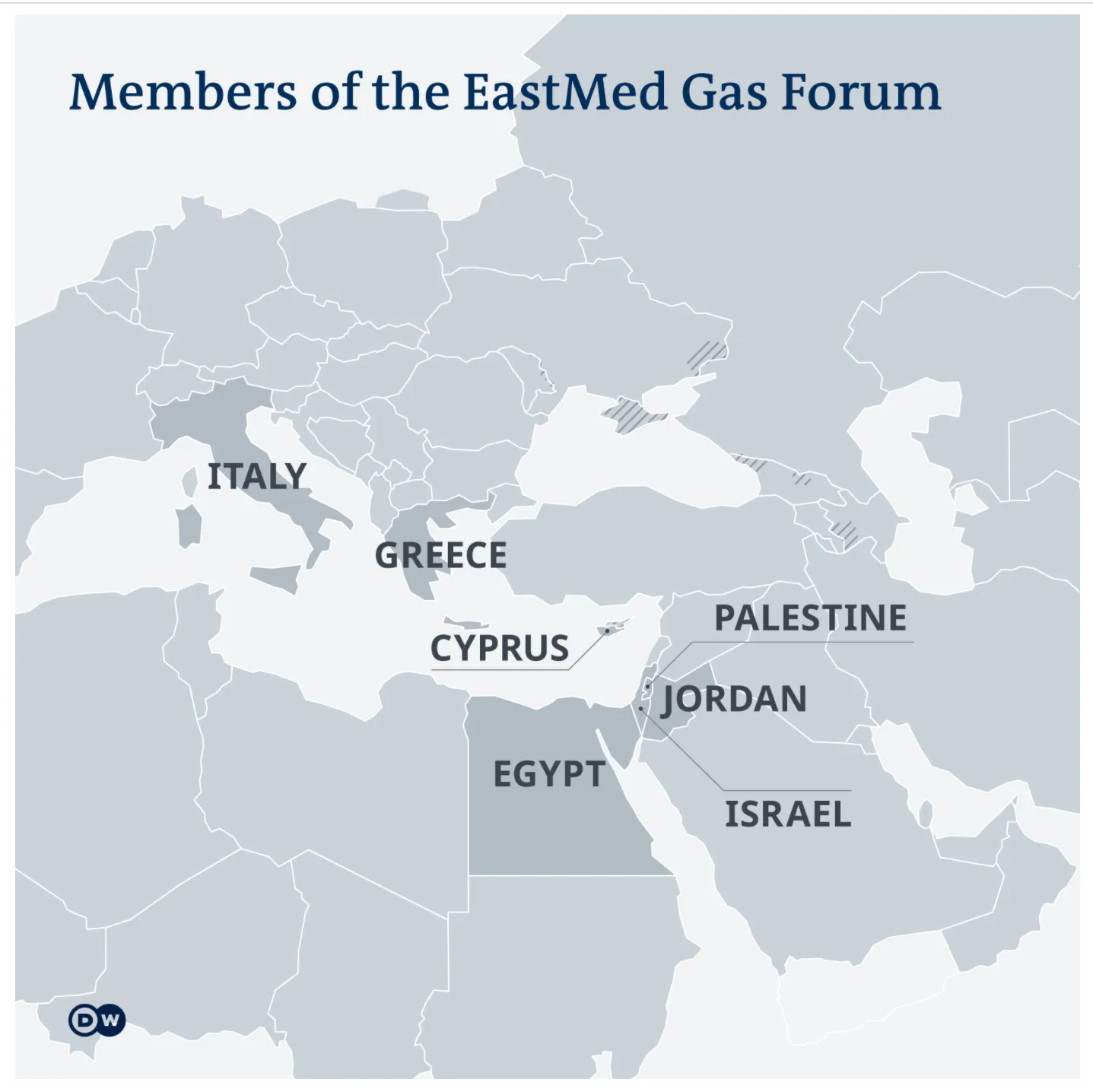
The member states of the East Mediterranean Gas Forum. Source: DW
However, this discovery has opened a new chapter in geopolitical tensions in the Eastern Mediterranean. Egypt, Israel, Cyprus, and Greece have directly participated in this new condition. Since 2010, these countries have set an informal agenda to establish a new energy corridor that feeds the region as well as Europe. This agenda turned into a regional organization, the East Mediterranean Gas Forum powered by European Union in 2014 (Logicon).
The East Mediterranean Gas Forum (EMGF) is the consortium of a group of countries including Cyprus, Egypt, Greece, Israel, Italy, Jordan, and the Palestinian Territories (Figure 5). EMGF aims to supply the chains of secure and economic oil and gas to the Levant region as well as European encounters. The forum earned international legal status in 2017 at the time of “the trilateral agreement of Israel, Greece, and Cyprus to build an energy corridor, known as East Med gas pipeline which connects to the Middle East with Europe (Figure 6). The forum’s project costs around $6.7, and it will “bring gas from offshore fields in Israel and Cyprus to Greece, Italy, and Bulgaria” (Psaropoulos 2020). The East Med pipeline will be able to transport as much as around 20 billion cubic meters of gas to those countries annually. This pipeline project will be conducted by ExxonMobil and Qatar Petroleum, and to be completed in 2025” (Stamouli 2018).
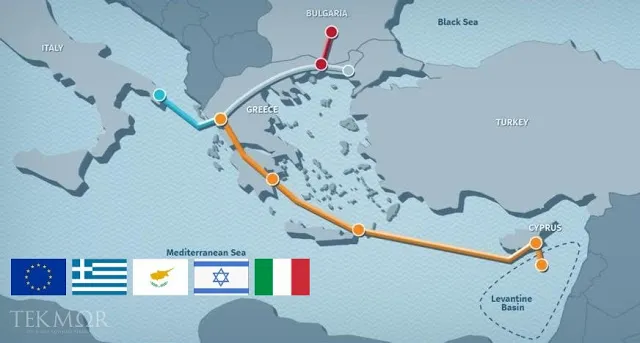
The East Mediterranean Gas Pipeline. Source: Tekmor Monitor
Even though the East Mediterranean Gas Forum seems to be a strategic partnership for sharing the revenue of the region, it produces a conflict between the forum and Turkey, which also might be an alternative route to transport gas reserves to Europe by low-cost. But Turkey’s political struggle in Europe as well as the Middle East since the Arab Spring set a barrier for Turkey’s participation in the East Mediterranean Gas Forum.
Furthermore, Turkey seems intent on not sharing revenues of potential gas in the Eastern Mediterranean (Ibid.). Turkey itself has initiated its own project to drill in the exclusive economic zone since 2011 (Guler, Mullen and Tzimitras 2013). Turkey’s initiative also produces the struggle of EMGF and the country into more complex conditions. One of the reasons is that Turkey claims that EMGS, especially, Cyprus is in illegal activity in the region including in controversial exclusive economic zones.
From this departure point, in 2013, Turkey announced a new national agenda with the title of “Blue Homeland” in international relations. Turkey’s claim has turned into sharp political debate in Greece and has evolved into a new diplomatic war between Turkey and Greece (Ibid.).
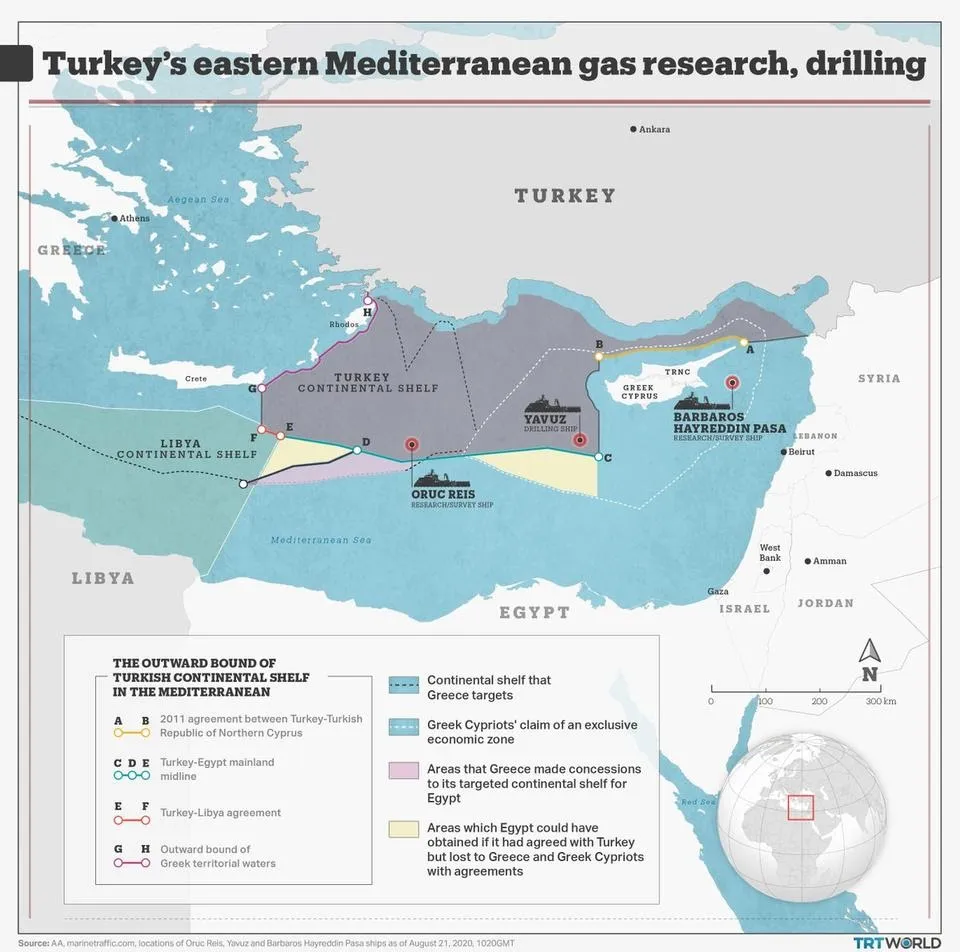
Turkey’s gas research zone. Source: TRT World
Turkey argues that Cyprus in particular and the East Mediterranean Forum in general violate International Law which designates a legal continental shelf between the state’s sea borders (33). This national agenda seems that Turkey attempts to disqualify the East Mediterranean Gas Forum and its pipelining project while it benefits the region reserves in the name of national interest. This strategic argument seems to be successful because the UN and other international organizations take a side by Turkey. Nevertheless, EMGF’s pipeline project is still in progress as it planned. However , Turkey takes action with appropriate political channels such as the declarations of NAVTEX from 2017 to 2020. One of the results of Turkish NAVTEX notice causes the block of Eni, an Italian gas company drilling in the Turkish Exclusive Economic Zone (Kambas 2018).
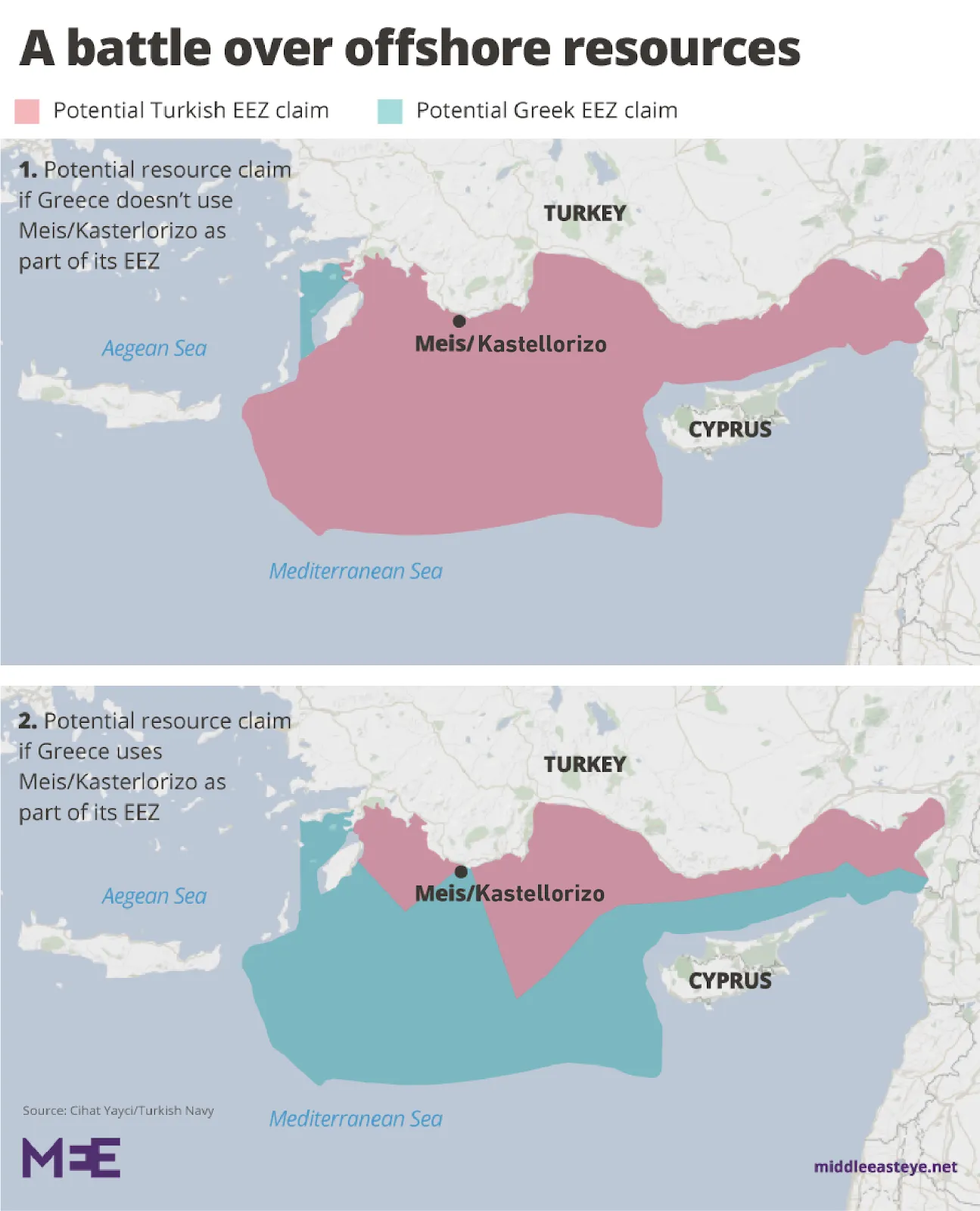
The conflict zone of the exclusive economic zone between Turkey and Greece. Source: Middle East Eye
In a nutshell, the Arab uprising has changed the political and economic dynamics of the Middle East. It can be seen that not only did this wave uproot long-standing political systems, but it also reforumated the socioeconomic structure of the very societies that called for change.
Buğra, Ayşe and O. Savaşkan. New Capitalism in Turkey: The Relationship Between Politics, Religion and Business . 2014.
Çeviker Gürakar, Esra. Politics of Favoritism in Public Procurement in Turkey: Reconfigurations of Dependency Networks in the AKP Era . 2016.
Ahmed, Naveed. “ Pakistan-Saudi Relations .” Pakistan Horizon . 1982.
Ahmed, Zahid Shahab and Shahram Akbarzadeh. “ Pakistan caught between Iran and Saudi Arabia .” Contemporary South Asia. 2020.
Babar, Zahra. “ Purveyors of Dreams: Labour Recruiters in the Pakistan to Saudi Arabia Migration Corridor .” Migration and Development . 2020.
Berk, Esen. “ Building a Competitive Authoritarian Regime: State–Business Relations in the AKP’s Turkey .” Journal of Balkan and Near Eastern Studies. 2018.
Guler, Ayla, Fiona Mullen and Harry Tzimitras. “ The Cyprus Hydrocarbons Issue: Context, Positions and FutureScenarios .” PRIO Report . 2013.
Hamza, Sara. “ Migrant Labor in the Arabian Gulf: A Case Study of Dubai, UAE .” Pursuit . 2015.
Ocaklı, Feryaz. “ Reconfiguring State‒Business Relations in Turkey: Housing and Hydroelectric Energy Sectors in Comparative Perspective .” Journal of Balkan and Near Eastern Studies . 2018.
Öniş, Ziya. “ Turkey Under the Challenge of State Capitalism: The Political Economy of the Late AKP Era .” Southeast European and Black Sea Studies. 2019.
Weinbaum, Marvin G., and Abdullah B. Khurram. “ Pakistan and Saudi Arabia: Deference, Dependence, and Deterrence.” Middle East Journal . 2014.
Chulov, Martin and Michael Safi. “’ We’re Poor People’: Middle East’s Migrant Workers Look for Way Home Amid Pandemic .” The Guardian . June 9, 2020.
Dakka, Iyad. “ Turkey Doubles Down on De-Facto Alliance with Qatar .” World Politics Review . December 17, 2015.
FH, Sumaira. “ Turkey, Qatar Seal 10 New Deals on Economic Cooperation-Reports .” Urdupoint . November 27, 2020.
Girit, Selin. “ Why is Turkey Standing Up For Qatar? ” BBC News. June 14, 2017.
Göksedef, Ece. “Türkiye-Katar İlişkileri: Bölgesel Ortaklıktan Stratejik İşbirliğine (Turkey-Qatar Relations: From Regional Partnership to Strategic Cooperation).” BBC Turkish . December 14, 2020.
Hanieh, A. “ A Marxist Guide to Understanding the Gulf States’ Political Economy .” Interview by Hamza Culin. Jacobin. July 13, 2020.
Haider, Kamran and Ismail Dilawar. “ Pakistan Secures $6 Billion Aid Package from Saudi Arabia .” Bloomberg . 2018.
Hashim, Asad. “ Pakistan-Saudi Rift: What Happened? “ Al-Jazeera. August 28, 2020.
Hincks, Joseph. “ Saudi Arabia Is Investing $20 Billion in Pakistan. Here’s What It’s Getting in Return .” TIME. February 19, 2019.
International Labour Organisation
“ IPA Qatar, Invest in Türkiye Launch Joint Report on Qatar-Turkey Investment Relations .” Gulf Times. December 14, 2020 .
Jacobs, Harrison. “ Commentary: Migrant Labour Abuse Makes Dubai A Questionable Tourist Destination .” Business & Human Rights Resource Centre . 2019.
Karasapan, Omer. “ Pandemic Highlights the Vulnerability of Migrant Workers in the Middle East .” Brookings . September 17, 2020.
Khan, Imran. “ PM Imran Khan Exclusive Interview .” GNN. November 12, 2020.
Latif, Aamir. “ Is Saudi Arabia pressing Pakistan to recognize Israel? “ Anadolu Agency . November 24, 2020.
McQue, Katie. “ ‘I Am Starving’: The Migrant Workers Abandoned by Dubai Employers .” The Guardian . September 3, 2020.
“ Pakistan Returns $1 Billion of Saudi Arabia’s Soft Loan, Officials Say .” Dawn . December 16, 2020.
Psaropoulos, John. “ Greece, Israel, Cyprus Move to Build East Med Gas Pipeline .” Al Jazeera . January 2, 2020.
“ Qatari Investments in Turkey Reach $22bn .” The Peninsula . December 15, 2020.
Raza, Malaka. “ A Bitter Homecoming .” The News International. October 19, 2020.
Robinson, Kali. “ What Is the Kafala System? “ Council on Foreign Relations. November 20, 2020.
“ Recent Deals Between Qatar, Turkey to Boost Cooperation via Free Trade Zones .” Daily Sabah . November 29, 2020.
“ Saudi Arabia Executes Pakistani Couple on Drug-Related Charges .” Dawn . April 11, 2019.
Shahid, Kunwar Khuldune. “ How Saudi Arabia Is Pressuring Pakistan to Recognize Israel .” Haaretz . November 22, 2020.
Stamouli, Nektaria. “ Israel, Greece and Cyprus Back EastMed Gas Pipeline .” Wall Street Journal . December 18, 2018.
Yigal, Carmon and Maital C. “ Turkey-Qatar Relations: From Bilateral Ties to Strategic Partnership .” Jewish News Syndicate . November 13, 2019.
Uprising everywhere seems to take the excessive power of police as a clarion call. From the Middle East to the US, "police" appears as a name for the broad systemic injustice of modes of rule. And though the militarization of police is a given, some questions remain unclear. How has policing blurred the line between itself and war? In turn, how has the policing-war complex become a modality inseparable from wider politics? Or, from the predatory and dispossessive mechanisms of global capitalism? What is the place of counter-insurgency and national liberation movements in this history? How has the Middle East played a role in this wider global assemblage? How do we conceptualize this space of indistinction? And counter it? How have insurrectionist moments both pegged back and come unstuck against police power?
Nadia Abu El-Haj is Ann Olin Whitney Professor in the Departments of Anthropology at Barnard College and Columbia University, Chair of the Board of Directors of the Society of Fellows/Heyman Center for the Humanities, and Codirector of the Center for Palestine Studies at Columbia.
The recipient of numerous awards, including from the Social Science Research Council, the Wenner Gren Foundation, the MacArthur Foundation, the Harvard Academy for Area and International Studies, the Institute for Advanced Study at Princeton, and the Harry Frank Guggenheim Foundation, she is the author of numerous journal articles published on a range of topics including settler-nationhood in Israel/Palestine; race, genomics and the politics of (Jewish) identity; and militarism, combat trauma and the obligations of citizenship in the contemporary U.S.
Paul Amar is the director of the Orfalea Center for Global and International Studies and Professor at the Department of Global Studies at the University of California, Santa Barbara . He is a political scientist and anthropologist who speaks seven languages and has published in nine languages.
He holds affiliate appointments in Feminist Studies, Sociology, Comparative Literature, Middle East Studies, and Latin American & Iberian Studies, and has been awarded two Fulbright Fellowships in the past. Before he began his academic career, he worked as a journalist in Cairo, a police reformer and sexuality-rights activist in Rio de Janeiro, and as a conflict-resolution and economic-development specialist at the United Nations. His books include: Cairo Cosmopolitan (2006); New Racial Missions of Policing (2010); Global South to the Rescue (2011); Dispatches from the Arab Spring (2013); and The Middle East and Brazil (2014). His book "The Security Archipelago" was awarded the Charles Taylor Award for "Best Book of the Year" in 2014 by the American Political Science Association.
Stuart Schrader is the associate director of the Program in Racism, Immigration, and Citizenship and a lecturer at Johns Hopkins University . He is the author of Badges Without Borders: How Global Counterinsurgency Transformed American Policing (University of California Press, 2019). He received his PhD in American Studies from NYU in 2015.
In this virtual event, Stuart Schrader (Johns Hopkins University) used the example of the 1925 French bombing of Damascus to discuss entanglements between policing and the military, arguing that, as an indeterminate and elastic form of coercive power that evades legal boundaries, policing has long been at the heart of the military project.
Nadia Abu El-Haj (Columbia University) addressed the location of the terms “police” and “military” in the liberal moral and political imaginary in the US. She showed how the military has sidestepped critique, even on the left, by reframing violence as patriotic sacrifice, while police have played a much more divisive political role.
Paul Amar (UC Santa Barbara) de-centered the US perspective by discussing his work in Egypt and Brazil, arguing that activists have focused on disaggregating the monopoly on coercive power away from monolithic conceptions of the state to allow for multifarious openings for citizen engagement.
Nikhil Pal Singh (NYU) posed the question of what the panelists see as the trajectory of these discussions given the recent change in the US administration, as well as how the roles of military and the police can be repurposed and redirected.
Panelists also addressed abolitionist organizing and the need for redistribution and decriminalization, as well as how an overemphasis on policing can reify repressive state power, and the overlaps between how various policing institutions in the US view themselves. This event was co-sponsored by the Human Rights Initiative at NYU Gallatin .
We tend to think of uprising as the purview of the Left—what ‘we’ do as opposed to what ‘they’ do. And yet the last decade has seen an insurrectionist Right appropriate much of the Left’s style. Uprising today can often start with an ideological indeterminacy, around a populist refusal of sitting forms of authority, that might easily lurch rightwards. This is especially the case where sitting Leftist governments struggle to balance redistribution and political liberties. Do we think of uprising, then, simply as a political form? Or does it necessarily contain a content, the way we think of revolution as the stuff of social transformation, always a turn to the Left? What are the conceptual and analytical tools we need to confront uprising from the Right? In much of the non-Western world, this poses the question of the geopolitical—how do uprisings, their class and ideological character but also their fate, so often pivot around the interventions of imperial states (often spiralling into the conceptually distinct phenomenon that is armed civil war)? How do we think through the interplay between imperialism and popular insurrections?
Anthony Alessandrini is a Professor of English at Kingsborough Community College and of Middle Eastern Studies at the CUNY Graduate Center, where he is also a member of the Committee on Globalization and Social Change.
He is the author of Frantz Fanon and the Future of Cultural Politics; the editor of Frantz Fanon: Critical Perspectives; and the co-editor of "Resistance Everywhere": The Gezi Protests and Dissident Visions of Turkey. He has also published a poetry chapbook, Children Imitating Cormorants. He is on the faculty of the Brooklyn Institute for Social Research, is a co-organizer of the International Solidarity Action Research Network (ISARN), and is a Co-Editor of Jadaliyya E-Zine. His book Decolonize Multiculturalism is forthcoming in 2021.
Ayça Çubukçu is an Associate Professor in Human Rights at the London School of Economics and Political Science. She is the author of For the Love of Humanity: the World Tribunal on Iraq (2018) and a co-editor of Humanity Journal, Jadaliyya-Turkey, and the LSE International Studies Series at Cambridge University Press.
Alejandro Velasco is an Associate Professor of Latin American history at New York University, Executive Editor of NACLA Report on the Americas (nacla.org), and co-convener of The Latin East Initiative (latineast.org). An expert on urban culture, social movements, and democratization, he is the author of the award-winning book Barrio Rising: Urban Popular Politics and the Making of Modern Venezuela, and is a regular contributor to national and international media outlets including the New York Times, NPR, BBC, Al Jazeera, CBS, and Nueva Sociedad, among others.
Vijay Prashad is the Director of Tricontinental: Institute for Social Research, Chief Editor of LeftWord Books, and Chief Correspondent of Globetrotter. His most recent book is Washington Bullets: A History of the CIA, Coups, and Assassinations, with a foreword by Evo Morales Ayma.
Reflecting on the US context in the wake of the capitol riots, Anthony Alessandrini (Kingsborough Community College & CUNY Graduate Center) argued that there is indeed a necessary content for uprising, one that should be determined through the lens of decolonization and abolition.
Counter to this, and with the current attack on the left by the Turkish government in mind, Ayça Çubukçu (London School of Economics and Political Science) contended that we need to rethink both the form and content of what we call uprising, which can no longer be presumed to be only leftist.
Discussing the rightward shift in Latin American governments, Alejandro Velasco (NYU) argued that the right has gained traction by controlling the discourse on the left, highlighting the failures of previous leftist governments and hiding their accomplishments.
Vijay Prashad (Tricontinental) offered an insightful provocation to the panelists throughout, asking them to think through contextual, historical, and geographic differences in the uprisings being analyzed. The outcome was a fruitful discussion on solidarity, conjuncture, and the opportunities of the present. This virtual event was co-sponsored by the NYU Center for Latin American and Caribbean Studies (CLACS).
Uprisings we are told move not by contamination but by resonance. It’s the affective force of the uprising itself that is the current of both movement and change. Bodies acting together in risk is transformative. A change that starts not with consciousness but with the body, from what was once thought of as the “discharge” of crowds, the loss of the fear of touch in the indistinction the crowd produces. The past decade has witnessed intense moments of bodily interaction in uprising in both violent forms — pepper spray, the billy club, the ‘dumdum’ bullet — and more intimate nonviolent forms — the crowd itself, kissing, hugging, praying. How do we make sense of the corporeality of uprising today? How do we account for the unspoken, the tactile, and the affective in uprising? Is the crowd still a great equalizing event? How do allyship and tactics today themselves counter-mobilize difference and the uneven distribution of risk and bodily vulnerability (“white allies to the front”)? In the face of regimes of racializing, gendering, and sexualizing hierarchy, how does the crowd at once confirm and upend difference?
Nadje Al-Ali is Director of the Center for Middle East Studies at Brown University, where she is also Robert Family Professor of International Studies and Professor of Anthropology and Middle East Studies. Her main research interests revolve around feminist activism and gendered mobilization, mainly with reference to Iraq, Egypt, Lebanon, Turkey and the Kurdish political movement. Professor Al-Ali is on the advisory board of kohl: a journal of body and gender research and has been involved in several feminist organizations and campaigns transnationally.
Her publications include What kind of Liberation? Women and the Occupation of Iraq (2009, University of California Press, co-authored with Nicola Pratt); Women and War in the Middle East: Transnational Perspectives (Zed Books, 2009, co-edited with Nicola Pratt); Iraqi Women: Untold Stories from 1948 to the Present (2007, Zed Books), and Secularism, Gender and the State in the Middle East (Cambridge University Press 2000. Her co-edited book with Deborah al-Najjar entitled We are Iraqis: Aesthetics & Politics in a Time of War (Syracuse University Press) won the 2014 Arab-American book prize for non-fiction. Her most recent publication is a co-edited book (jointly with Deniz Kandiyoti and Kathryn Spellman Poots) entitled Gender, Governance & Islam (University of Edinburgh Press, 2019).
Frances Hasso is an Associate Professor in the Program in Gender, Sexuality and Feminist Studies at Duke with secondary appointments in the Department of History and Department of Sociology. She taught in and directed the International Comparative Studies Program at Duke from 2010-2015 and was a member of the Oberlin College faculty from 2000-2010. She is Editor Emerita (2015-2018) of the Journal of Middle East Women's Studies.
She has been a National Humanities Center fellow, an ACOR fellow, a Rockefeller fellow, and an SSRC/ACLS fellow. Her research has additionally been supported by the National Science Foundation, American Sociological Association, Woodrow Wilson National National Fellowship Foundation, Andrew W. Mellon Foundation, Palestinian American Research Center, the Institute for the Study of Islam in the Modern World (Leiden), The Josiah Charles Trent Memorial Foundation Endowment, and Duke Arts & Sciences Faculty Committee Research Grants. She is finalizing a book manuscript (Cambridge University Press), Buried in the Red Dirt: Race, Reproduction and Death in Modern Palestine.
Jasbir K. Puar is a Professor and Graduate Director of Women’s and Gender Studies at Rutgers University, where she has been a faculty member since 2000. Her most recent book is The Right to Maim: Debility, Capacity, Disability (2017) published with Duke University Press in the series ANIMA: Critical Race Studies Otherwise that she co-edits with Mel Chen.
Puar is the author of award-winning Terrorist Assemblages: Homonationalism in Queer Times (2007), which has been translated into Spanish and French and re-issued in an expanded version for its 10th anniversary (December 2017). Puar has held visiting positions in the Department of Performance Studies at NYU, the Institute for Cultural Inquiry in Berlin, and Linköping University in Sweden. Currently Professor Puar is completing her third book, a collection of essays on duration, pace, mobility, and acceleration in Palestine titled Slow Life: Settler Colonialism in Five Parts.
Gayatri Gopinath is a Professor and Director of the Center for the Study of Gender & Sexuality at New York University. Her research interests include Transnational queer and feminist studies; postcolonial studies; Asian diaspora studies; visual art; performance.
Opening with her own divergent experiences as part of a crowd, Nadje Al-Ali (Brown University) complicated the romanticization of the crowd as a unifying and equalizing experience. She emphasized the gendered aspect of participation, the importance of temporality, and the prevalence of other affective registers such as fear in the ambivalent potential of the crowd.
Building on this, Frances Hasso (Duke University) stressed the uncertainty of the outcomes of an uprising. She argued that crowds alone cannot overcome the embodied historical, classed, gendered, and ideological differences of participants, as evidenced by the violent aftermaths of the so-called Arab Spring.
Drawing on Saidiya Hartman’s work, Gayatri Gopinath (NYU) asked participants to reflect on the malleability of the crowd and the distinctions between the crowd and the mob.
These questions provoked a discussion of the breakdown of ideological unity in the crowd, the effacement of everyday resistance in favor of dramatic moments of mass mobilization, and the afterlives of feelings such as fear and confidence.
This virtual event was co-sponsored by the Center for the Study of Gender and Sexuality at NYU & the Duke-UNC Consortium for Middle East Studies.
Our age of uprising has also been the age of the urban insurrection. And yet for all their sublime spectacularity, the insurrections seem to reach their own limit, unable to disrupt economic infrastructures or defeat repressive apparatuses. To add to the weakness of organized labor, insurrectionary forms of blockade and occupation—our so-called “movement of the squares,” signaled most emphatically by the name, Tahrir—themselves seem mired in a kind of fatal cycle of reenactment. In this context, the figure of the commune has returned to political thought almost as a line of flight; an exit from the square to more prosaic but durable forms of association. How do we think about this tension between insurrection and autonomy? What histories of ‘the commune,’ beyond its Eurocentric iterations, do we need to engage? What otherwise absented political traditions—anti-colonial, indigenous, feminist, antiracis—should we account for in communal imaginaires?
Joshua Clover is a Professor of English at the University of California, Davis. He specializes in critical theory, Marxism, political theory, political economy, poetry and poetics. Interests include social movements, social reproduction theory, crisis theory, and the end of capitalism.
He is also a faculty member in the Department of Comparative Literature, and affiliated faculty in the French and Italian Department, Film Studies Program, and the Designated Emphasis in Critical Theory. He is affiliated with the Mellon Research Initiative in Racial Capitalism. His most recent book Riot.Strike.Riot: the New Era of Uprisings (Verso in 2016) theorizes riot as historically concrete form of class struggle, and uses the dialectic of riot and strike to develop a revised history of capital accumulation. He has contributed articles to journals from Representations to Critical Inquiry. Forthcoming work focuses on poetry and the transformation of the world-system, and particularly on the dynamic between overdeveloped nations and neocolonialism, oriented by Marx, Fanon, and Mariarosa Dalla Costa. He has also published three books of poetry, most recently Red Epic, which have been translated into a dozen languages and appears in many anthologies including the Norton Introduction to Literature.
Dean Itsuji Saranillio received his Ph.D. from the Program in American Culture at the University of Michigan. His teaching and research interests are in Indigenous studies, Asian American and Pacific Islander histories, and cultural studies.
Currently, he is working on a manuscript on the admission of Hawai‘i as a U.S. state, examining the complex interplay between different Asian American groups, Native Hawaiians, and whites within historical flashpoints of interaction shaped by opposing versions of history. By assembling indigeneity with other analytics, he theorizes the productive tensions created by placing Asian American and Indigenous histories in conversation. Saranillio’s essays have been featured in American Quarterly, Journal of Asian American Studies, and several anthologies.
Nazan Üstündağ received her Ph.D. in 2005 from the sociology department at Indiana University Bloomington. Between 2005 and 2018, she worked as an Assistant Professor at Boğaziçi University, Department of Sociology. Between 2018 and 2020 she was affiliated with the Transregionale Studien in Berlin as an Academy in Exile and IIE-Scholar Rescue Fund fellow.
Currently, she is receiving a fellowship from Gerda Henkel Stiftung Patrimonies program. Üstündağ writes on social policy, gendered subjectivities and state violence in Kurdistan. Her most recent articles appeared in the journals South Atlantic Quarterly, History of the Present and Differences. She has also worked as a columnist in the journal Nokta and the newspaper Özgür Gündem and her opinion pieces appeared in venues such as Bianet, T24, Roar Magazine and Jadaliyya. Üstündağ is a member of Women for Peace and Academics for Peace. Most recently, she is finishing a book manuscript with the working title Mother, Politician and Guerilla: The Emergence of A New Political Cosmology in Kurdistan Through Women’s Bodies and Speech.
Lenora Hanson is an Assistant Professor of English in the Department of English at New York University. Her research interests include British and Italian Romantic poetry and prose; eighteenth and nineteenth-century life science and political economy; rhetoric and translation; materialism.
Joshua Clover (UC Davis) argued against the idea that there is an inherent tension between the riot and the commune, instead positing them as overlapping and interrelated phenomena that occupy structural positions as expressions of circulation struggles and reproduction struggles, respectively.
Drawing on the work of Noelani Goodyear-Ka’opua, Dean Saranillio (NYU) introduced the concept of “slow resistance” and how moving towards subsistence can help us redefine what is imagined as possible for post-capitalist forms of life.
Nazan Üstündağ (Independent Scholar), like Clover and Saranillo, complicated the binary understanding of insurrection/ commune, instead attributing the failures of protest movements in the Middle East to state repression. Additionally, Üstündağ emphasized the importance of self defense as a way to extend the longevity of the commune and the insurrection.
Lenora Hanson (NYU) posed multiple questions and provocations for discussion, including the problem of the hierarchies that carry over into the internal space of the commune and how to struggle against them, as well as the desirability for spectacular moments of uprising over forms of subsistence and reproduction.
This virtual event was co-sponsored by the Cities Collaborative at NYU & the Urban Democracy Lab at NYU Gallatin.
What happens to life after uprising? For many, this question is already present in the moments that precede uprising, and the responses to this question — often in the form of coercive violence -- end up shaping the ways uprising is remembered, narrated, and built upon long into the future. In these two panels, we will discuss how what happened next — in individual and collective terms -- has shaped and could shape our understanding of this protracted present of uprising. In the first panel, we will address how collective action continues in essence through individual struggles against the state as its tools of incarceration, torture, exile, and disappearance are employed in (often vain) attempts to dominate the narrative of movements against the state. We will ask: how does uprising get re-framed through the lives of the incarcerated, exiled, tortured, and disappeared? How can the narrative life of uprising avert or counter mediation through violence? Whose afterlives are we not telling at all, or often enough? In what ways should the experience of those lives most altered by uprising force us to reconsider the event of uprising in retrospect?
Madiha R. Tahir is an independent journalist reporting on conflict, culture and politics in Pakistan. Her work has appeared in Foreign Affairs, Al Jazeera, Vice, The National, Guernica, The New Inquiry, The Columbia Journalism Review, The Wall Street Journal, The Herald (Pakistan), The Friday Times, Caravan, as well as on Democracy Now!, PRI and BBC’s The World, Global Post and other outlets.
She is the director of the short documentary Wounds of Waziristan, focusing on Pakistani survivors of drone attacks. She holds a masters degree in Near Eastern Studies from NYU and an M.S. from Columbia University’s Graduate School of Journalism. Tahir has traveled extensively throughout Pakistan from Balochistan to Swat as well as to rural areas to report on the floods, Sufi music, the Baloch separatist movement, the salience of nationalism and religion, Islamist organizations and national electoral politics. She is co-editor of a volume, Dispatches from Pakistan with historian Vijay Prashad and editor Qalandar Bux Memon and a founding editor of Tanqeed, a magazine of politics and culture.
Randa M. Wahbe is a PhD candidate in anthropology with a secondary field in critical media practice at Harvard University. Her dissertation examines how Israel uses and exploits Palestinian dead bodies to surveil, control and continuously dispossess and incarcerate the Palestinian population.
Her research is supported by fellowships from the Social Science Research Council, the Wenner Gren Foundation and the Palestinian American Research Center. Randa is a policy member for Al-Shabaka: The Palestinian Policy Network and an elected board member for the US Campaign for Palestinian Rights. From 2018-2020, she served on the executive board of Insaniyyat: The Society of Palestinian Anthropologists. Prior to graduate school, Randa led the international advocacy team at Addameer Prisoner Support and Human Rights Association in Ramallah for three years. She also holds an M.P.H. in Epidemiology from the Mailman School of Public Health at Columbia University and a B.A. in International Development from the University of California, Los Angeles.
Amina Zarrugh is an Assistant Professor of Sociology at Texas Christian University. Her research focuses on politics and forced disappearance in North Africa and race/ethnicity in the U.S. She completed her BA in sociology and government and her MA and PhD in sociology at the University of Texas at Austin.
Sinan Antoon is an Associate Professor at NYU. His teaching and research interests lie in pre-modern and modern Arabic literature and contemporary Arab culture and politics.His essays and creative writings in Arabic have appeared in major journals and publications in the Arab world and on Aljazeera.net and in The New York Times, The Nation, Middle East Report, Journal of Palestine Studies, Journal of Arabic Literature, The Massachusetts Review, World Literature Today, Ploughshares, and Washington Square Journal.
Kadhim Hayder, Fatigued Ten Horses Converse with Nothing (The Martyr’s Epic), 1965.
Madiha Tahir (Independent Journalist) began by asking: What does it mean to survive colonial violence? Focusing on the Pashtun anti-war movement in Pakistan, Tahir detailed the formation of a “spectral sovereign”, an arbiter of Pashtun life—born out of the myriad global imperial relationships fueling the boom of carceral topographies in Pakistan.
Randa Wahbe (Harvard University) continued by posing the question of what happens to life after insurrection. She detailed how the Israeli state withholds Palestinian bodies and also makes them illegible to their families. She describee these practices as cosmological warfare that served to suspend death and deny grief, altering the very temporality of death.
Amina Zarrugh (Texas Christian University) shifted the conversation to disappearance in the Libyan context, focusing on how this tool of state violence can open the door to unprecedented forms of resistance. She emphasized how analyses of economic grievances often obscure the routine instances of state violence, harassment, and degradation that create said grievances. Despite disappearance being one of the more powerful tools of state repression, Zarrugh stressed how conversely, the uncertainties and ambiguities of disappearance can compel people into resistance and even sustain movements.
Sinan Antoon (NYU) began his comments by asking: Where do we place beginnings and where do we place endings in regards to uprising and oppression? Concluding, he conveyed how each speaker highlighted the shifts and continuities of resistance, disrupting the ideological and methodological bounds of uprising itself.
If uprising is not a discrete event but a protracted temporality then how do we account for its various afterlives? For the ways it continues to exact an imprint or effect well after insurrectionary moments have passed? In particular, how do we factor things like the movement or displacement of people into our readings of uprising? Or, in turn, track the work of uprising in the political geographies of bordering, encampment, or sanctuary? Is there a way of reading migratory movement and its challenge to a waning border regime not just as the fallout but as the continuation of uprising? In other words not just as perceived but actual threats to established order. How, for example, can we read the Caravan of Hope or, its parallel moment in the Great March of Return, as not just the afterlife but the extension or re-formation of long-standing uprisings in Central America and Palestine respectively? What relation is there between what gets called “social movements” and the movement of people across borders? And in turn, how much of today’s counter-mobilization of the right is itself animated by real cracks in racializing mobility regimes?
Aslı Iğsız is an Associate Professor at New York University. Iğsız earned her B.A. from Boğaziçi University, Turkey (1993). She earned an M.A. in French Literature at Hacettepe University, Turkey (1996); an M.A. in Near Eastern Studies at the University of Michigan, Ann Arbor (2000); and a Ph.D. in Comparative Literature at the University of Michigan (2007).
Iğsız's research interests are multidisciplinary and mainly focus on the nineteenth and twentieth-century Ottoman and Turkish contexts and address a wide variety of issues. Her book Human Ruins: Dynamics of Multiculturalism and Greco-Turkish Memory Zones in Contemporary Turkey, undertakes a multidisciplinary approach and explores cultural memory and representation and politics of “multiculturalism” in post-1980 military coup era Turkey, with a special focus on Greco-Turkish shared heritage and the culture of “minority.”
Léopold Lambert is a trained architect living in Paris. He is the editor-in-chief of the print and online magazine The Funambulist, which attempts to articulate anti-colonial and anti-racist perspectives on the politics of space and bodies. He is also an independent researcher and the author of the books Weaponized Architecture: The Impossibility of Innocence (dpr-barcelona, 2012), Topie Impitoyable: The Corporeal Politics of the Cloth, the Wall, and the Street (punctum books, 2015), and Politics of Bulldozer: The Palestinian Ruin as an Israeli Project (B2, 2016, French). His next book is entitled States of Emergency: A Spatial History of the French Colonial Continuum (forthcoming 2021, Premiers Matins de Novembre, French).
A. Naomi Paik is the author of Bans, Walls, Raids, Sanctuary: Understanding U.S. Immigration for the 21st Century (2020, University of California Press), which examines the criminalization of immigrants in the U.S. and the need for a radical, abolitionist approach to sanctuary movements.
She also published her first book, Rightlessness: Testimony and Redress in U.S. Prison Camps since World War II in 2016 (UNC Press; winner, Best Book in History, AAAS 2018; runner-up, John Hope Franklin prize for best book in American Studies, ASA, 2017), as well as articles, opinion pieces, and interviews in a range of academic and public-facing venues. As a board member of the Radical History Review, she has co-edited three special issues of the journal—on “Militarism and Capitalism (Winter 2019), “Radical Histories of Sanctuary” (Fall 2019), and “Policing, Justice, and the Radical Imagination” (Spring 2020)—and will coedit “Against the Anthropocene” with Ashley Dawson (Winter 2023). Collaborating with Gerry Cadava and Cat Ramirez, she is also coediting the “Borderlands” section of Public Books. She is an associate professor at the University of Illinois, Urbana-Champaign, the HRI-Mellon faculty fellow in Legal Humanities, and the Center for Advanced Studies Resident Associate for the Initiative on “Abolition.” Her research and teaching interests include comparative ethnic studies; U.S. imperialism; U.S. militarism; social and cultural approaches to legal studies; transnational and women of color feminisms; carceral spaces; and labor, race, and migration.
Paula Chakravarty is an associate professor at the Gallatin School and the Department of Media, Culture and Communication. Her research and teaching interests span comparative political economy, migration, labor and social movements , and decolonial and critical race theory.
Her books include Race, Empire and the Crisis of the Subprime (Johns Hopkins University Press, 2013), Media Policy and Globalization (Edinburgh University Press, 2006), and Global Communications: Towards a Transcultural Political Economy (Rowman & Littlefield Publishers, 2008). She serves on the executive board of the NYU Association for University Professors (AAUP), and is affiliated faculty at the Asian/Pacific/American Institute at NYU, South Asia @ NYU, and the NYU Hagop Kevorkian Center for Near Eastern Studies.
In this virtual event, Aslı Iğsız (NYU) discussed mobility in the Turkish context in the aftermath of the uprisings in the Middle East. She emphasized the contradictions in Turkey’s response to the uprising and the linkages between uprising and mobility. For example, Turkey took in Syrian migrants and decried racism in the United States while simultaneously erecting a wall between Europe and the Middle East and suppressing dissent within Turkey.
Léopold Lambert (The Funambulist) shared work from his upcoming book discussing the connections between the Algerian Revolution, the Kanak Insurrection, and the Banlieue Uprising as a “colonial continuum.” He then highlighted the importance of thinking through these uprisings and the responses of the French state to them in terms of the “space-time” of colonial mobility.
Considering the US context, A. Naomi Paik (University of Illinois, Urbana-Champaign) discussed migration as a form of decolonization, wherein the refusal to abide by the restrictions of borders is an act of resistance to the neoliberal order. In this context, she showed how the sanctuary movement can be thought of not as a humanitarian movement, but as a way of thinking about the undoing of neoliberal capitalism and state subject-making.
Paula Chakravartty (NYU) asked the panelists to think through the internal contradictions of liberalism, the relationship between mobility and debt, the rise of ethno-nationalism, and how we can begin to reimagine the role of the state.